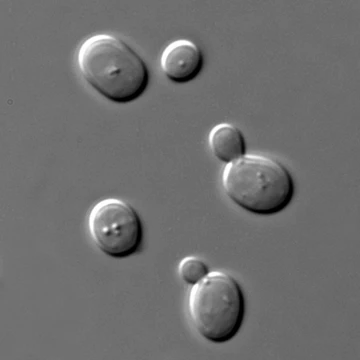
Komagataella mondaviorum
A yeast species identified in 2018 from older strains.

Komagataella mondaviorum is a species of ascomycete fungi existing as a yeast. It was identified as a unique species in 2018 from strains collected throughout the 1950s and 1970s, previously believed to be Komagataella pastoris. It is notable for its proposed utility in industrial protein synthesis, with the potential to synthesize products more efficiently than commonly used Komagataella species such as K. phaffii.
- Year identified
- 2018
- Collection period
- 1950s and 1970s
- Cell shape
- spherical or ovoid
- Cell length range
- 2-7 μm
- Maximum growth temperature
- 35°C
- Fermentation
- glucose only
- Closest relatives
- K. populi and K. pseudopastoris
Lore & Background
Komagataella mondaviorum was identified as a distinct species in 2018 from strains collected throughout the 1950s and 1970s. The strains were previously believed to be Komagataella pastoris. K. mondaviorum was declared a distinct species due to differences in the genome found during DNA sequencing. It was named after Robert and Margrit Mondavi for their contributions to the California wine industry.
When grown on malt extract agar, cells are spherical or ovoid, with lengths ranging between 2-7 μm. Cells are observed to grow singly or in pairs. Colonies are white and smooth. Hat-shaped ascospores have been observed. Glucose is fermented by K. mondaviorum; fermentation of other common sugars has not been observed. No growth occurs at or above 35°C.
Within Komagataella, K. mondaviorum is considered to be most closely related to K. populi and K. pseudopastoris. It has been isolated from various tree species, including cottonwood, black cottonwood, black oak, willow, and hackberry. It has been discovered in the United States (California, Washington, and Alaska) as well as Canada (British Columbia).
Reader's Guide
Komagataella mondaviorum holds significance as a recently identified yeast species that was distinguished from Komagataella pastoris through genomic analysis. Its naming after Robert and Margrit Mondavi ties it to the California wine industry. The species has been proposed as a promising candidate for industrial protein synthesis, with the potential to synthesize products more efficiently than commonly used Komagataella species such as K. phaffii. Its ecological distribution across multiple tree species in the western United States and Canada suggests a broad natural habitat. The species' inability to grow at or above 35°C and its limited fermentation to glucose alone define its physiological boundaries. Its close phylogenetic relationship to K. populi and K. pseudopastoris places it within the Komagataella genus, which is known for industrial applications. The discovery from strains collected decades earlier highlights the value of preserving microbial collections for future genomic analysis.
Did You Know?
- The yeast has been isolated from trees including cottonwood, black oak, willow, and hackberry.
- It has been proposed as a promising candidate for industrial protein synthesis, potentially more efficient than Komagataella phaffii.
More in Yeasts, Part 2 1-24
Spotted an error? Know more?
Reader corrections go straight into our review queue. Suggest an edit · How this site is sourced