Kriegeriales
An order of yeasts and fungi in Pucciniomycotina.

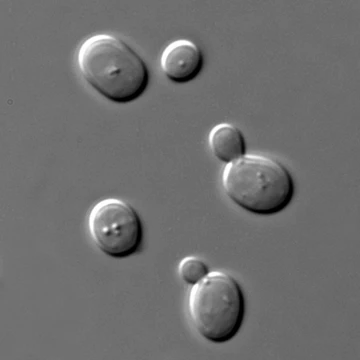
The Kriegeriales are a fungal order within the subdivision Pucciniomycotina. The majority of its members are known only in their yeast form and inhabit a wide range of environments, from cold arctic waters to the surfaces of tropical ferns. When a hyphal state occurs, it produces basidia that are auricularioid, meaning they have lateral septa. Taxonomically, the order was established in 2013 after DNA sequence analysis revealed that a newly described neotropical yeast, *Meredithblackwellia eburnea*, was closely related to species in the genera *Kriegeria*, *Camptobasidium*, and *Glaciozyma*. Subsequent work added the genera *Phenoliferia* and *Yamadamyces* to accommodate several yeast species that had previously been classified under *Rhodotorula*. In terms of morphology, most Kriegeriales are asexual yeasts with no known sexual stage. They are white or cream-colored, with elongated cells that reproduce by budding from both ends. For the few species studied in detail, nuclear division occurs inside the bud, a trait shared with most other basidiomycete yeasts. However, in *Meredithblackwellia eburnea*, *Kriegeria eriophori*, and *Yamadamyces rosulatus*, budding cells remain attached at the base, forming distinctive cell clusters not seen in other basidiomycete yeasts. The genus *Glaciozyma* is unusual in that its members are yeasts with a known sexual state. Only two members of Kriegeriales, *Kriegeria eriophori* and *Camptobasidium hydrophilum*, are known to form hyphae. Of these, *K. eriophori* also has an asexual yeast state, leaving *C. hydrophilum* as the only species in the order that is hyphal throughout its life cycle. Ultrastructural studies of these two hyphal species show they have simple septal pores, a feature common to all other Pucciniomycotina. Regarding habitat and distribution, species of Kriegeriales occupy diverse ecological niches. Known members include plant parasites (such as *Kriegeria eriophori*), aquatic fungi (like *Camptobasidium hydrophilum*), saprobes, and organisms with unknown ecological roles. Some have been collected from psychrophilic environments, including glaciers and Antarctic seas; for instance, *Glaciozyma antarctica* was among the first basidiomycete yeasts ever isolated from Antarctic seawater.
- Order described
- 2013
- Subdivision
- Pucciniomycotina
- Known hyphal species
- 2
- Known sexual state yeasts
- Glaciozyma species
- Only fully hyphal species
- Camptobasidium hydrophilum
Lore & Background
The order was described in 2013 based on evidence from DNA sequence data that showed that a newly discovered neotropical yeast, Meredithblackwellia eburnea, was closely related to several species in the genera Kriegeria, Camptobasidium and Glaciozyma. Further research added the new genera Phenoliferia and Yamadamyces to accommodate several yeast species formerly placed in Rhodotorula. Most species of Kriegeriales are asexually reproducing yeasts that do not currently have a known sexual state. All are white or cream, with elongated cells that reproduce by budding at either end. A handful of species have been studied in greater detail and for these it has been shown that the nuclear division of the yeast state occurs in the bud, a common character shared with most other basidiomycete yeasts. However, in Meredithblackwellia eburnea, Kriegeria eriophori, and Yamadamyces rosulatus budding cells remain attached to each other at the base, forming characteristic clusters of cells that are otherwise unknown in basidiomycete yeasts. The species in Glaciozyma differ in that these are yeasts with a known sexual state. Only two members of Kriegeriales, Kriegeria eriophori and Camptobasidium hydrophilum, are known to form hyphae. Of these, K. eriophori also has an asexual yeast state, leaving C. hydrophilum as the only species in the order that is hyphal throughout its life cycle. Ultrastructural studies of these two hyphal species have determined that they have simple septal pores, as is true for all other known Pucciniomycotina.
Reader's Guide
The Kriegeriales are notable for encompassing a wide ecological range, from plant parasites to aquatic fungi and psychrophilic species associated with glaciers or the Antarctic sea. Their discovery and classification in 2013 relied on DNA sequence data, highlighting the role of molecular phylogenetics in modern fungal taxonomy. The order includes species that challenge typical basidiomycete yeast morphology, such as the unique cell clusters formed by Meredithblackwellia eburnea, Kriegeria eriophori, and Yamadamyces rosulatus. The presence of simple septal pores in the hyphal species aligns them with other Pucciniomycotina. The order's significance also lies in its inclusion of Glaciozyma antarctica, one of the first basidiomycete yeasts isolated from the Antarctic sea, underscoring the adaptability of these fungi to extreme environments. Many species remain poorly understood, with unknown roles in their habitats, indicating that further research is needed to fully appreciate their ecological and evolutionary contributions.
Did You Know?
- The order Kriegeriales was described in 2013 based on DNA sequence data.
- Only two species in the order, Kriegeria eriophori and Camptobasidium hydrophilum, are known to form hyphae.
- Meredithblackwellia eburnea, Kriegeria eriophori, and Yamadamyces rosulatus form characteristic cell clusters unknown in other basidiomycete yeasts.
More in Yeasts, Part 2 1-24
Spotted an error? Know more?
Reader corrections go straight into our review queue. Suggest an edit · How this site is sourced