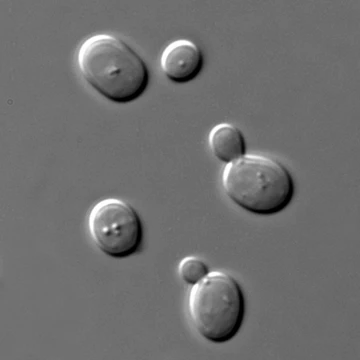
Malassezia furfur
A skin commensal yeast that can become an opportunistic pathogen.

Malassezia furfur, once called Pityrosporum ovale, is a yeast that naturally lives on the skin of humans and certain other mammals. While usually a harmless part of the skin’s microbial community, it can turn into an opportunistic pathogen, causing several skin conditions like seborrhoeic dermatitis and tinea versicolor. In people with weakened immune systems—such as those receiving hematopoietic transplants or parenteral nutrition—it can also lead to more serious infections, including catheter-related fungemia and pneumonia.
This fungus resides in the outer layers of the epidermis. It typically exists as a commensal organism, but when it shifts from its yeast form to a hyphal (filamentous) form during its life cycle—through changes that are not yet understood—it can overgrow and disrupt the skin’s natural balance. Factors that may boost its infectious nature include forming biofilms, sticking more readily to surfaces, and becoming hydrophobic. Infections often appear on the trunk or limbs as pigmented spots that may merge into scaly patches, and many of these lesions clear up on their own. Children are affected more frequently than other age groups. Besides seborrhoeic dermatitis and tinea versicolor, the yeast is also linked to dandruff, malassezia folliculitis, pityriasis versicolor (alba), malassezia intertrigo, and tinea circinata.
Malassezia furfur cells are unicellular, ranging from 1.5 to 4.5 by 2.0 to 6.5 micrometers in size. They have a bottle-like shape, with a small protrusion at one end. Growing them in a lab is tricky because they need very specific conditions.
Treatment usually involves topical antifungal medications such as ketoconazole, cyclopirox olamine, piroctone olamine, zinc pyrithione, or sulfur compounds.
- Cell size
- 1.5–4.5 × 2.0–6.5 micrometers
- Cell shape
- bottle-like with a small protrusion
- Former name
- Pityrosporum ovale
- Associated conditions
- seborrhoeic dermatitis, tinea versicolor, dandruff, malassezia folliculitis, pityriasis versicolor (alba), malassezia intertrigo, catheter-related fungemia, pneumonia
Lore & Background
Malassezia furfur is a fungus that lives on the superficial layers of the epidermis, generally existing as a commensal organism forming a natural part of the human skin microbiota. It can gain pathogenic capabilities when morphing from a yeast to a hyphal form during its life cycle, through unknown molecular changes, leading to uncontrolled proliferation and imbalance of the residential skin flora. Virulence factors that may increase its infectious nature include the formation of biofilms, increased adherence to surfaces, hydrophobicity, and the ability to form hyphae.
Infections with pathogenic M. furfur occur on the trunk or limbs and present clinically as pigmented macules that can merge into scaling plaques. Many lesions resolve spontaneously in most patients, and the pathogen most frequently affects children compared to other age groups. The yeast is difficult to grow in a lab since it requires specific conditions.
Treatment typically involves topical application of antifungal medications such as ketoconazole, cyclopirox olamine, piroctone olamine, zinc pyrithione, or sulfur compounds.
Reader's Guide
Malassezia furfur is significant primarily as a common skin commensal that can cause a range of dermatological conditions, from dandruff and seborrhoeic dermatitis to tinea versicolor and malassezia folliculitis. Its legacy in medical mycology stems from its dual role as a normal inhabitant of human skin and an opportunistic pathogen, particularly in immunocompromised patients receiving hematopoietic transplants or parenteral nutrition, where it can cause catheter-related fungemia and pneumonia. The yeast's ability to switch from a yeast to a hyphal form, though the molecular triggers remain unknown, is central to its pathogenicity. Its morphological features—bottle-like cells with a small protrusion—and its fastidious growth requirements in the laboratory have shaped research into its biology. The conditions it causes are generally treated with topical antifungals, and many infections resolve spontaneously, especially in children, who are most frequently affected. The organism's association with both superficial skin infections and systemic disease in vulnerable populations underscores its importance as a subject of ongoing study.
Did You Know?
- Malassezia furfur was formerly known as Pityrosporum ovale.
- It is naturally found on the skin surfaces of humans and some other mammals.
- It is associated with catheter-related fungemia and pneumonia in patients receiving hematopoietic transplants or parenteral nutrition.
More in Yeasts, Part 2 1-24
Spotted an error? Know more?
Reader corrections go straight into our review queue. Suggest an edit · How this site is sourced