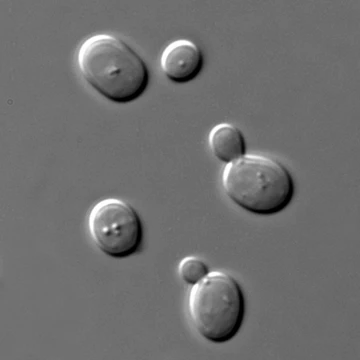
Lachancea thermotolerans
A yeast notable for lactic acid production in fermentation.

Lachancea thermotolerans is a species of yeast. It serves as the type species for the genus *Lachancea*. First described in 1932 under the name *Zygosaccharomyces thermotolerans*, it has also been classified as *Kluyveromyces thermotolerans*.
This yeast is widespread and can be found in many natural and human-made environments around the world. It is often associated with fruit and with insects like fruit flies that feed on fruit. It has also been identified among the species present in some naturally fermented foods.
What sets *Lachancea thermotolerans* apart from many other yeasts is its ability to produce lactic acid during fermentation. This trait has led to research into its use for making wine and beer, which are traditionally fermented with *Saccharomyces* yeasts. In winemaking, it has been studied for how its byproducts affect flavor, and it has been used in co-fermentation with wine yeast or as a substitute for lactic acid bacteria, offering an alternative to malolactic fermentation. It is sold commercially both alone and in yeast blends. In beer brewing, it has been explored as a way to produce sour beer. This yeast can ferment at low temperatures (17 °C) and high temperatures (27 °C), with sulfur dioxide levels of 25 mg/L and 75 mg/L, and yields ethanol between 7–11% by volume. Studies of sequential inoculations and co-inoculations with other non-*Saccharomyces* yeasts have shown significant interactions, both synergistic and inhibitory, in lactic acid production. In craft beer, primary fermentation with *L. thermotolerans* lowers pH to 3.41 by producing l-lactic acid, and conditioning with *Hanseniaspora vineae* boosts aromatic esters like 2-phenylethyl acetate, a marker of high olfactory quality.
Non-thermal technologies like pulsed electric fields (PEF) and ultra-high pressure homogenization (UHPH) are used to partially or fully eliminate microorganisms, improving must quality and wine sensory profiles without harming organoleptic qualities. PEF helps implanted yeasts like *L. thermotolerans* establish, increasing lactic acid and 2-phenylethyl acetate production, as well as anthocyanin extraction. UHPH sterilizes must (300 MPa/77 °C for under 0.2 seconds), removes microbial load and oxidative enzymes, boosts antioxidant activity, protects acylated anthocyanins, reduces higher alcohols, and increases 2-phenylethyl acetate. When *L.
- Type species of genus
- Lachancea
- First described as
- Zygosaccharomyces thermotolerans
- Year first described
- 1932
- Fermentation temperature range
- 17 °C to 27 °C
- So2 doses studied
- 25 mg/L and 75 mg/L
- Ethanol yield range
- 7-11% vol
- Ph after primary fermentation
- 3.41
Lore & Background
Lachancea thermotolerans is the type species of the genus Lachancea. It has previously been known as Kluyveromyces thermotolerans and Zygosaccharomyces thermotolerans, the name by which it was first described in 1932. The species is widely distributed and occurs in diverse environments, both natural and man-made, and has been isolated from locations around the world. It is commonly associated with fruit and with insects such as fruit flies that feed on fruit, and has been identified in naturally fermented foods.
In winemaking, L. thermotolerans has been studied for the effects of its metabolites on flavor profiles. Systems including L. thermotolerans in co-fermentation with wine yeast or in place of lactic acid bacteria have been described as an alternative to traditional malolactic fermentation. It has been sold commercially on its own and in a yeast blend. In beer brewing, it has been considered as a method for producing sour beer. The yeast ferments at low temperatures (17 °C) as well as at high temperatures (27 °C) and with SO2 doses of 25 mg/L and 75 mg/L, with an ethanol yield between 7-11% vol.
Sequential inoculations and sequential co-inoculations with different non-Saccharomyces yeasts, including L. thermotolerans, have been studied, resulting in very significant synergies and inhibitions in lactic acid production. Primary fermentation with L. thermotolerans significantly lowers the pH (3.41) due to its production of l-lactic acid. Non-thermal technologies such as PEF and UHPH have been used to improve must quality; PEF facilitates implantation of inoculated L. thermotolerans, increasing lactic acid and aromatic esters, while UHPH sterilization of must has been observed to enhance synergy in co-inoculation with Metschnikowia pulcherrima, generating over 5 g/L lactic acid and an almost twofold increase in ethyl lactate.
Reader's Guide
Lachancea thermotolerans is significant for its unusual ability among yeasts to produce lactic acid through fermentation, a property that has driven its study in winemaking and beer brewing. In winemaking, it has been explored as an alternative to traditional malolactic fermentation, either in co-fermentation with wine yeast or in place of lactic acid bacteria, and has been sold commercially. In beer brewing, it has been considered for producing sour beer. The species has been studied in sequential inoculations and co-inoculations with other non-Saccharomyces yeasts, revealing synergies and inhibitions in lactic acid production. Its fermentation at both low and high temperatures, and with varying SO2 doses, adds to its versatility. Non-thermal technologies like PEF and UHPH have been applied to musts to enhance the performance of L. thermotolerans, increasing lactic acid and aromatic esters, and improving wine quality. The species' role in craft beer has also been noted, where primary fermentation with L. thermotolerans lowers pH and conditioning with Hanseniaspora vineae enhances aromatic esters. Its legacy lies in its contribution to alternative fermentation methods and its potential to modify sensory profiles in alcoholic beverages.
Did You Know?
- It can produce lactic acid through fermentation, a property unusual among yeasts.
- Primary fermentation with L. thermotolerans significantly lowers pH to 3.41 due to l-lactic acid production.
More in Yeasts, Part 2 1-24
Spotted an error? Know more?
Reader corrections go straight into our review queue. Suggest an edit · How this site is sourced