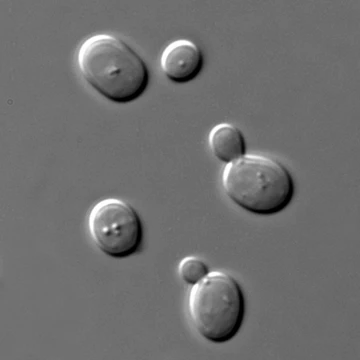
Malassezia
A yeast genus causing dandruff, dermatitis, and other skin disorders.

Malassezia is a genus of yeast fungi within the division Basidiomycota. These organisms are commonly found on the skin of humans and other animals. Because they depend on fats for growth, they thrive in areas rich in sebaceous glands—particularly the scalp, face, and upper torso.
In human health, Malassezia infections can trigger or worsen several skin conditions, including dandruff, seborrheic dermatitis, and acne. When the yeast multiplies too quickly, it disrupts the normal shedding of skin cells, leading to dandruff and itching (other fungi or bacteria can cause a similar issue). DNA-based methods have helped identify which species are involved; these studies show that *M. globosa* is the main culprit in most human skin diseases and the leading cause of dandruff and seborrheic dermatitis, though *M. restricta* also plays a role. A single human head can host up to ten million *M. globosa* organisms. In 2007, the genome of *M. globosa* was sequenced, revealing 4,285 genes. The yeast uses eight different lipases and three phospholipases to break down scalp oils; any of these 11 proteins could serve as targets for dandruff treatments. Both prescription and over-the-counter shampoos containing ketoconazole are commonly used to manage dandruff from Malassezia. Although *M. globosa* is predicted to be capable of sexual reproduction, this has never been observed.
In some opportunistic infections on the trunk and other body areas, certain Malassezia species can cause either hypopigmentation or hyperpigmentation. Allergy tests for these fungi exist. The rash known as tinea versicolor (pityriasis versicolor) is also caused by a Malassezia infection.
When Malassezia species move from the intestines into pancreatic neoplasms, they have been linked to pancreatic ductal adenocarcinoma, and the fungi may help tumors progress by activating the host’s complement system.
*M. restricta*, normally found on the skin, has been associated with Crohn’s disease and inflammatory bowel disease when present in the gut. This link is especially strong in individuals carrying the N12 *CARD9* allele, which triggers a more intense inflammatory response.
Malassezia folliculitis (also called pityrosporum folliculitis) results from infection with Malassezia.
- Genome size genes
- 4285
- Species count
- 22
- Cell size range
- 1.5–4.5 μm by 3–7 μm
- Growth temperature range
- 30–35 °C
- Lipase types
- 8
- Phospholipases
- 3
- Organism count on human head
- up to ten million
Lore & Background
Malassezia was originally identified by French scientist Louis-Charles Malassez in the late nineteenth century, who associated it with seborrhoeic dermatitis. Raymond Sabouraud identified a dandruff-causing organism in 1904 and called it Pityrosporum Malassezii, honoring Malassez at the species level. When the organisms were determined to be the same, the term Malassezia was judged to possess priority. In the mid-twentieth century, it was reclassified into two species: Pityrosporum (Malassezia) ovale, which is lipid-dependent and found only on humans, and Pityrosporum (Malassezia) pachydermatis, which is lipophilic but not lipid-dependent and found on the skin of most animals. Current sources consider P. ovale and P. orbiculare to refer to a single species, with M. furfur the preferred name.
Malassezia is the sole genus in the family Malasseziaceae, which was validated by Cvetomir Denchev and Royall T. Moore in 2009. The order Malasseziales had been proposed by Moore in 1980 and emended by Begerow and colleagues in 2000, at which time it was classified as a member of unknown class placement in the subdivision Ustilaginomycotina. In 2014, Cvetomir and Teodor Denchev circumscribed the class Malasseziomycetes to contain the group. The yeast-like cells of Malassezia, measuring between 1.5–4.5 μm by 3–7 μm, are characterised as phialides featuring tiny collarettes, which are challenging to identify using standard light microscopes. A defining characteristic is that one end is round while the other has a distinctly blunt termination, where singular, broad-based bud-like structures emerge.
Reader's Guide
Malassezia is significant primarily for its role in human diseases, including dandruff, seborrheic dermatitis, acne, tinea versicolor, and Malassezia folliculitis. When Malassezia grows too rapidly, the natural renewal of cells is disturbed, and dandruff can appear with itching. Molecular or DNA-based techniques have identified M. globosa as the species causing most skin disease in humans, and it is the most common cause of dandruff and seborrhoeic dermatitis, though M. restricta is also involved. There can be as many as ten million M. globosa organisms on a human head. A 2007 project sequenced the genome of dandruff-causing M. globosa and found it to have 4,285 genes, using eight different types of lipase and three phospholipases to break down scalp oils; any of these 11 proteins would be a suitable target for dandruff medications. Prescription and over-the-counter shampoos containing ketoconazole are commonly used to treat dandruff caused by Malassezia. In occasional opportunistic infections, some species can cause hypopigmentation or hyperpigmentation. Translocation of Malassezia species from the intestines into pancreatic neoplasms has been associated with pancreatic ductal adenocarcinoma, and M. restricta is linked to Crohn's disease and inflammatory bowel disease when found in the gut, especially in organisms with the N12 CARD9 allele. The genus requires specific growth media and sometimes grows very slowly in laboratory culture; an essential factor for growth is the presence of long-chain fatty acids, with M. pachydermatis being an exception.
Did You Know?
- M. globosa has been predicted to have the ability to reproduce sexually, but this has not been observed.
- Malassezia is the sole genus in the family Malasseziaceae, which is the only family in order Malasseziales.
- M. pachydermatis was first isolated from the skin of an Indian rhinoceros.
More in Yeasts, Part 2 1-24
Spotted an error? Know more?
Reader corrections go straight into our review queue. Suggest an edit · How this site is sourced