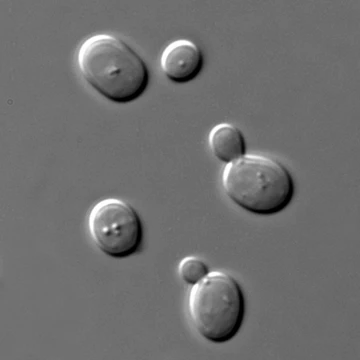
Malassezia globosa
A yeast causing dandruff, dermatitis, and tinea versicolor.

Malassezia globosa is a species of yeast that is a common cause of skin conditions in humans. It is notable for being the primary agent responsible for dandruff and seborrhoeic dermatitis, as well as the skin rash of tinea versicolor (pityriasis versicolor).
- Genome size genes
- 4285
- Lipase types
- 8
- Phospholipase types
- 3
- Total oil breaking proteins
- 11
- Maximum specimens on human head
- 10000000
Lore & Background
Malassezia globosa was previously thought to be Malassezia furfur. In 2007, it was discovered that this scalp-specific fungus metabolizes triglycerides present in sebum by expressing lipase, resulting in the lipid byproduct oleic acid. This process is responsible for dandruff and dermatitis. The fungus requires fat to grow, so it is most common on areas with many sebaceous glands: the scalp, face, and upper body. When it grows too rapidly, the natural renewal of cells is disturbed, and dandruff appears with itching. Identification of Malassezia on skin has been aided by molecular or DNA-based techniques, showing that M. globosa causes most skin disease in humans, though M. restricta is also involved. A project in 2007 sequenced its genome, finding 4,285 genes. M. globosa uses eight different types of lipase and three phospholipases to break down oils on the scalp; any of these 11 proteins would be a suitable target for dandruff medications. The number of specimens on a human head can be up to ten million. It has been predicted to have the ability to reproduce sexually, but this has not been observed.
Reader's Guide
Malassezia globosa is significant as the primary fungal agent causing dandruff and seborrhoeic dermatitis in humans, as well as tinea versicolor. Its discovery in 2007 as the specific species responsible for metabolizing sebum into oleic acid clarified the mechanism behind these common skin conditions. The sequencing of its genome in the same year, revealing 4,285 genes and 11 oil-breaking proteins (eight lipases and three phospholipases), provided specific molecular targets for developing dandruff medications. The application of DNA-based techniques has confirmed M. globosa as the most common Malassezia species involved in human skin disease, though M. restricta also plays a role. Its requirement for fat explains its prevalence on sebaceous gland-rich areas like the scalp, face, and upper body. The potential for sexual reproduction, though unobserved, suggests further complexity in its life cycle. The high population density—up to ten million specimens on a human head—underscores its impact on human health.
Did You Know?
- Its genome was sequenced in 2007 and found to have 4,285 genes.
- It uses eight types of lipase and three phospholipases to break down scalp oils.
- Up to ten million specimens of M. globosa can be present on a human head.
More in Yeasts, Part 2 1-24
Spotted an error? Know more?
Reader corrections go straight into our review queue. Suggest an edit · How this site is sourced