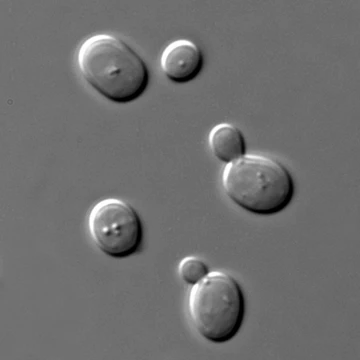
Scheffersomyces stipitis
Yeast with highest natural xylose-to-ethanol fermentation ability.

Scheffersomyces stipitis (formerly Pichia stipitis) is a species of yeast belonging to the 'CUG Clade' of ascomycetous yeasts, a group that substitutes serine for leucine when the CUG codon is encountered. It is distantly related to brewer's yeast, Saccharomyces cerevisiae, which uses the conventional codon system. Found in the guts of passalid beetles, S. stipitis is notable for having the highest known natural ability of any yeast to directly ferment xylose, converting it to ethanol.
Quick Facts
- Taxon
- Scheffersomyces stipitis
Facts from the source article.
Lore & Background
Scheffersomyces stipitis is a predominantly haploid yeast that can be induced to mate with itself or other strains by cultivating cells on minimal medium containing limiting amounts of carbon sources and nitrogen. It is capable of both aerobic and oxygen-limited fermentation. Xylose, the sugar it ferments, is a hemicellulosic sugar found in all angiosperm plants and constitutes the second most abundant carbohydrate moiety in nature. Xylose can be produced from wood or agricultural residues through auto- or acid hydrolysis.
Reader's Guide
The significance of Scheffersomyces stipitis lies in its natural ability to ferment xylose to ethanol, a trait that is economically valuable because xylose is abundant in lignocellulosic biomass. Ethanol production from such residues does not compete with food production through grain consumption. This natural ability has inspired efforts to engineer the trait into Saccharomyces cerevisiae, which does not natively metabolize xylose. Specifically, the S. stipitis genes XYL1 and XYL2, coding for xylose reductase and xylitol dehydrogenase, have been added to S. cerevisiae to convert xylose to xylulose, which S. cerevisiae can ferment. However, additional modifications are necessary for rapid fermentation. An extensive genetic toolbox has been developed for S. stipitis, including synthetic drug resistance markers and a synthetic form of Cre for marker excision. Engineered strains produce 57 g/L ethanol from pure xylose in under 48 hours, and adapted strains produce significant ethanol from acid hydrolysates of lignocellulose.
Did You Know?
- Scheffersomyces stipitis belongs to the 'CUG Clade' of ascomycetous yeasts, which substitute serine for leucine when the CUG codon is encountered.
- Native strains produce approximately 50 g/L ethanol in 48 hours from pure xylose using urea as a nitrogen source.
- The complete sequencing of its genome was announced in 2007.
More in Yeasts, Part 2 1-24
Spotted an error? Know more?
Reader corrections go straight into our review queue. Suggest an edit · How this site is sourced