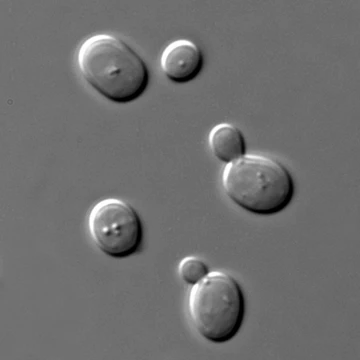
Saccharomycotina
Subphylum of Ascomycota comprising most ascomycete yeasts.

Saccharomycotina is a subphylum within the fungal phylum Ascomycota. It includes the majority of ascomycete yeasts, which reproduce by budding and never produce fruiting bodies (ascocarps). Well-known members include *Saccharomyces cerevisiae*, the yeast used in baking, and the genus *Candida*, which contains several species that cause disease in humans.
The name derives from the Greek words for "sugar" and "fungus." Evidence of brewing and baking, processes reliant on these yeasts, dates back to ancient Egypt and China, roughly 8,000 to 10,000 years ago, and appears to have emerged alongside early agriculture. In the 1850s, Louis Pasteur proved that yeasts are responsible for fermenting grape juice into wine. Economically, these fungi are among the most significant: they are used in brewing, baking, food fermentation, citric acid production, recombinant protein manufacturing, biofuel generation, and biological pest control. Conversely, some species cause substantial economic harm as plant pathogens or contaminants of food and drink, while others are pathogens of animals and humans.
Morphologically, saccharomycete yeasts typically exist as single cells with a simple structure, though their growth forms are highly adapted. Their asci are naked, and ascospores come in various shapes; no species produce ascocarps. Their genomes tend to be smaller than those of filamentous fungi. Some species, like those in the genus *Metschnikowia*, often form chains of budding cells called pseudohyphae. Others, such as *Candida albicans*, can produce true septate hyphae and are termed dimorphic, meaning they can grow either as budding yeasts or as filamentous hyphae.
Asexual reproduction occurs mainly through mitosis and holoblastic budding, where all layers of the parent cell wall participate, leaving a scar that prevents further budding at that site. The shape of asexual cells can help identify the mode of reproduction or taxonomic group. Some species, including certain *Candida* species, form endospores—asexual spores produced inside a mother cell. Strains of *Candida* and *Metschnikowia* can also form chlamydospores, a type of asexual resting spore.
Sexual reproduction is not observed in all species but can occur under favorable conditions, such as nitrogen or carbohydrate deficiency.
Quick Facts
- Taxon
- Saccharomycotina
Facts from the source article.
Lore & Background
The name Saccharomycotina derives from the Greek σάκχαρον (sugar) and μύκης (fungus). Historical records from ancient Egypt and China describe brewing and baking from 10,000 to 8,000 years ago. In the 1850s, Louis Pasteur demonstrated that yeasts are responsible for fermentation of grape juice to wine. Members of Saccharomycotina are among the economically most important fungi, used in brewing, baking, fermentation of food products, production of citric acid, recombinant proteins, biofuel, and biological pest control, while others cause economic losses as plant pathogens or contaminants.
Saccharomycete yeasts usually grow as single cells with simple cellular morphology. They reproduce asexually by mitosis and holoblastic budding, leaving a scar. Some species form endospores or chlamydospores. Sexual reproduction is not known for all species but occurs in some under nitrogen or carbohydrate deficiency; in Saccharomyces cerevisiae, the life cycle alternates between haploid and diploid phases, with two mating types that use pheromones to organize cell fusion. No species produce ascocarps.
Saccharomycotina are found worldwide, including hot deserts, polar areas, freshwater, salt water, and the atmosphere. Their growth is mainly saprotrophic, but some are important pathogens. They are often associated with insects, plants, or specialized habitats like flower nectar. Accurate identification now relies on DNA-based methods, as traditional morphology-based classification led to misclassifications.
Reader's Guide
Saccharomycotina holds profound significance as the subphylum containing most ascomycete yeasts, including Saccharomyces cerevisiae, a cornerstone of biotechnology and food production. The article notes that historical records of brewing and baking date back 10,000 to 8,000 years, and Louis Pasteur's 1850s work established yeasts as the agents of fermentation. Economically, Saccharomycotina members are used in brewing, baking, fermentation, citric acid production, recombinant protein production, biofuel, and biological pest control, while also causing losses as plant pathogens and contaminants. Their legacy includes shaping modern microbiology and industry. The article emphasizes that DNA-based methods have revolutionized taxonomy, revealing yeasts as polyphyletic and leading to major reclassification under the International Code of Nomenclature, which now requires a single name per fungus. This has prompted large-scale revisions, notably in the genus Candida. Future classification will rely on phylogenetic analysis of DNA sequences rather than morphology. The subphylum's ecological diversity—from saprotrophs to human pathogens—underscores its importance in both natural and human-altered environments.
Did You Know?
- Saccharomycotina members reproduce by holoblastic budding, leaving a scar through which no further budding occurs.
- Some species, such as Candida albicans, are dimorphic and can propagate both as budding yeasts and as filamentous hyphae.
- Sexual reproduction in Saccharomyces cerevisiae involves two mating types that use peptide pheromones to organize cell fusion.
- Saccharomycete yeasts are found in nearly all regions, including hot deserts, polar areas, and the atmosphere.
More in Yeasts, Part 2 1-24
Spotted an error? Know more?
Reader corrections go straight into our review queue. Suggest an edit · How this site is sourced