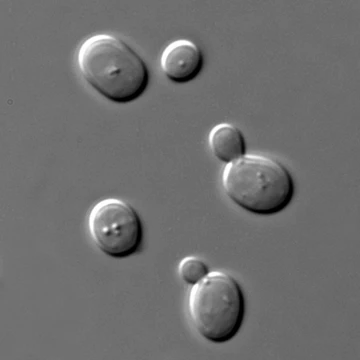
Saccharomyces uvarum
A bottom-fermenting yeast found in cold-fermented beverages.

Saccharomyces uvarum is a yeast species often found in drinks fermented at low temperatures, such as cider, wine, and beer, as well as on oak tree bark in the wild. First described in 1898 by Martinus Willem Beijerinck, it was long mistaken for the same species as S. bayanus. Genetic studies in 2000 and 2005, however, proved it is a separate species. This yeast is a bottom-fermenter, meaning it settles at the bottom of the fermentation vessel rather than forming a foam layer on top. Several genomes of S. uvarum have been sequenced, including a recent long-read sequence of strain CBS 7001, a more fertile relative of the type strain CBS 395. Each haploid genome contains 16 chromosomes. While natural strains are pure, human-associated strains show genetic introgression from S. eubayanus and S. kudriavzevii. Multiple independent hybridizations with S. eubayanus, followed by backcrossing, have occurred in collected strains. Yeasts with high proportions of S. eubayanus and S. uvarum are considered undesirable in beer brewing because they can produce off-flavors, partly due to the compound 4-vinyl guaiacol.
Quick Facts
- Genus
- Saccharomyces
- Species
- uvarum
- Type Strain
- CBS 395
Facts from the source article.
Lore & Background
Saccharomyces uvarum was originally described by Martinus Willem Beijerinck in 1898, but for many years it was considered identical to Saccharomyces bayanus. It was not until genetic investigations in 2000 and 2005 that S. uvarum was recognized as a genetically distinct species. This yeast is a bottom-fermenting type, meaning it does not form foam on top of the wort, unlike top-fermenting yeasts. It is commonly found in cider, wine, and beer-brewing locations, as well as on oak tree barks in nature. Several genomes are available for S. uvarum, including a recent long read sequence of strain CBS 7001, a more fertile relative of the type strain CBS 395. Each haploid genome includes 16 chromosomes. Unlike natural strains, human-associated strains show introgression from Saccharomyces eubayanus and Saccharomyces kudriavzevii. There have been multiple independent hybridization events with S. eubayanus and subsequent backcrossing in collected strains.
Reader's Guide
Saccharomyces uvarum holds significance in both natural and industrial contexts. Its discovery in 1898 by Martinus Willem Beijerinck and its later genetic distinction from S. bayanus in the early 2000s clarified a long-standing taxonomic confusion. As a bottom-fermenting yeast, it plays a role in the production of fermented beverages, especially those fermented at colder temperatures, such as certain ciders, wines, and beers. However, its presence in brewing is not always desired: yeasts with high proportions of S. eubayanus and S. uvarum are considered undesired producers of off-flavors in beer-brewing, partly due to the production of 4-vinyl guaiacol. The availability of genomic sequences, such as that of strain CBS 7001, aids in understanding its biology and hybridization history. The introgression from S. eubayanus and S. kudriavzevii in human-associated strains, along with multiple hybridization events, highlights its evolutionary complexity and relevance to fermentation science.
Did You Know?
- It is a bottom-fermenting yeast that does not form foam on top of the wort.
- Yeasts with high S. eubayanus and S. uvarum content are considered undesired in beer-brewing due to 4-vinyl guaiacol production.
More in Yeasts, Part 2 1-24
Spotted an error? Know more?
Reader corrections go straight into our review queue. Suggest an edit · How this site is sourced