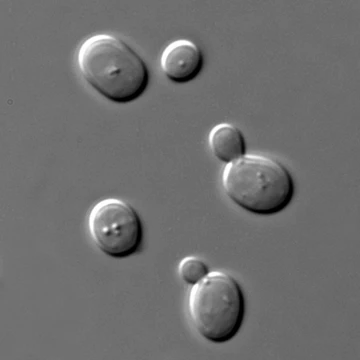
Saccharomyces paradoxus
Wild yeast closest to Saccharomyces cerevisiae, used in population genomics.

Saccharomyces paradoxus is a wild yeast and the closest relative of the baker's yeast Saccharomyces cerevisiae. Researchers use it in population genomics and phylogenetic studies to contrast its natural traits with those of lab-adapted yeasts.
In the wild, this yeast is most often found on deciduous trees like oak, maple, and birch, and occasionally on insects and fruit. It frequently shares its habitat with other Saccharomyces species. Like S. cerevisiae, it is found worldwide and prefers moderate temperatures, which restricts its range to lower latitudes. However, S. paradoxus grows better at cooler temperatures than S. cerevisiae, shifting its distribution slightly toward colder regions such as the British Isles and eastern Canada.
Unlike most other Saccharomyces species, there is no evidence that S. paradoxus has ever been domesticated by humans. Its biogeography is therefore shaped by natural factors like limited migration, glacial refugia, and climate adaptation. At least four genetically and phenotypically distinct populations have been identified, corresponding to Europe (including western Siberia), Far East Asia (Japan and eastern Siberia), North America (east and west coasts plus the Great Lakes region), and northeastern America (the Gaspé Peninsula, Saint Lawrence Valley, and Appalachians). Strains from these populations show partial post-zygotic isolation. A fifth population consists of a single isolate from Hawaii. Some European strains have been found in North America and New Zealand, likely from recent colonization. Two South American isolates, once described as Saccharomyces cariocanus, are genetically identical to American strains but show post-zygotic isolation due to chromosomal translocations.
S. paradoxus is naturally homothallic and is mostly found as a diploid in the environment. Reproduction is mainly clonal, and 99% of sexual reproduction occurs between spores from the same ascus. This process, called "genome renewal," purges recessive deleterious mutations that build up during clonal growth. Post-zygotic isolation between strains is common and can result from either genetic divergence between populations or chromosomal changes within them. As with other Saccharomyces species, heterothallism can be restored using standard genetic tools to create stable haploid strains for experiments.
Quick Facts
- Genus
- Saccharomyces
- Species
- paradoxus
Facts from the source article.
Lore & Background
Saccharomyces paradoxus is mostly isolated from deciduous trees such as oak, maple, and birch, and in rare occasions from insects and fruits. It is often found in sympatry with other Saccharomyces species. Like Saccharomyces cerevisiae, it has a worldwide distribution and is mesophilic, which limits its natural distribution to low latitudes. However, Saccharomyces paradoxus typically grows at lower temperatures than Saccharomyces cerevisiae, resulting in a slight shift in its distribution toward cooler regions, like the British islands and Eastern Canada.
Unlike most other Saccharomyces species, there is no evidence that Saccharomyces paradoxus has been domesticated by humans. Its biogeography is mostly marked by natural processes like limited migration, glacial refugia, and adaptation to climate. At least four genetically and phenotypically distinct populations have been identified, corresponding to Europe (including West Siberia), Far East Asia (Japan, Eastern Siberia), North America (North American East and West coasts, Great Lakes region), and North-East America (Gaspé Peninsula, Saint Lawrence Valley, and Appalaches). A fifth population is represented by a singleton isolate from Hawaii. Some strains from the European population are found in North America and New Zealand, likely resulting from recent colonization events. Two isolates from South America, described as Saccharomyces cariocanus, are genetically indistinguishable but exhibit post-zygotic isolation when crossed to strains from the American population, due to chromosomal translocations.
Saccharomyces paradoxus is naturally homothallic and is mostly found as diploid in the environment. Reproduction is mostly clonal, and 99% of sexual reproduction occurs between spores from the same ascus. This purges recessive deleterious mutations that accumulated during clonal expansion, in a process known as 'genome renewal.' Post-zygotic isolation between strains is commonly observed and could be due to genetic divergence between populations or to chromosomal changes within populations. Like in other Saccharomyces species, heterothallism can be restored using standard genetic tools to obtain stable haploid strains for experimental purposes.
Reader's Guide
Saccharomyces paradoxus holds significance primarily as a wild counterpart to the domesticated Saccharomyces cerevisiae, serving as a model for population genomics and phylogenetic studies. Its lack of domestication allows researchers to examine natural evolutionary processes, including limited migration, glacial refugia, and climate adaptation, without human influence. The identification of at least four distinct populations—European, Far East Asian, North American, and North-East American—along with a singleton from Hawaii, provides a framework for studying genetic divergence and post-zygotic isolation. The observation that some European strains have colonized North America and New Zealand highlights recent natural dispersal events. Additionally, the existence of South American isolates (Saccharomyces cariocanus) that are genetically identical but reproductively isolated due to chromosomal translocations underscores the role of chromosomal changes in speciation. Its reproductive strategy, with 99% of sexual reproduction occurring between spores from the same ascus, facilitates genome renewal by purging recessive deleterious mutations. The ability to restore heterothallism using standard genetic tools makes it experimentally tractable. Overall, Saccharomyces paradoxus provides a natural baseline for understanding yeast evolution, population structure, and reproductive isolation, distinct from laboratory and domesticated strains.
Did You Know?
- Saccharomyces paradoxus is the closest known species to the baker's yeast Saccharomyces cerevisiae.
- It is mostly found as diploid in the environment and reproduces clonally, with 99% of sexual reproduction between spores from the same ascus.
- At least four genetically distinct populations have been identified, corresponding to Europe, Far East Asia, North America, and North-East America.
More in Yeasts, Part 2 1-24
Spotted an error? Know more?
Reader corrections go straight into our review queue. Suggest an edit · How this site is sourced