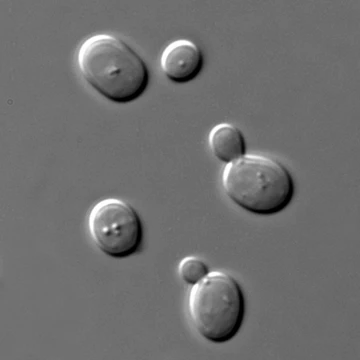
Saccharomyces boulardii
A probiotic yeast lineage of Saccharomyces cerevisiae used for gastrointestinal health.

Saccharomyces boulardii is a yeast first isolated in 1923 from lychee and mangosteen fruit peels by the French scientist Henri Boulard. Originally described as a distinct species, subsequent genomic analyses have shown it is a lineage of Saccharomyces cerevisiae, sharing greater than 99% genomic sequence identity with other S. cerevisiae strains, and is often referred to as S. cerevisiae var. boulardii. It is notable for its use as a probiotic yeast, intended to transiently colonize the gastrointestinal tract and reduce the risk of certain gastrointestinal disorders, and for its applications in brewing, baking, and synthetic biology.
Quick Facts
- Genus
- Saccharomyces
- Species
- boulardii
- Type Strain
- Hansen CBS 5926
Facts from the source article.
Lore & Background
Henri Boulard first isolated S. boulardii in 1923 from lychee and mangosteen fruit peels. He reportedly became interested in the yeast after observing residents of Southeast Asia consuming these fruit skins during cholera outbreaks, a practice believed to alleviate diarrheal symptoms. Early reports described S. boulardii as a distinct species based on phenotypic traits such as inability to ferment galactose, lack of sporulation under standard laboratory conditions, and increased tolerance to human body temperature, gastric acidity, and digestive enzymes. However, subsequent molecular and genomic analyses revealed that S. boulardii falls within the genetic diversity of S. cerevisiae, forming a distinct clade most closely related to wine-associated strains. Like other S. cerevisiae strains, it possesses 16 nuclear chromosomes and a 2-micron plasmid, and is diploid, carrying genetic determinants for both mating types (MATa and MATα). The MATa locus contains mutations predicted to impair mating and sporulation, which may account for its reduced or absent sporulation phenotype under laboratory conditions.
Reader's Guide
S. boulardii is significant primarily as a probiotic yeast, with the best-characterized type strain CBS 5926 (also ATCC 74012 and CNCM I-745) dominating commercial use and evaluated in more than 90 randomized clinical trials. Evidence supports its use for prevention of antibiotic-associated diarrhea in adults and children, as an adjunct in acute gastroenteritis in children, for reducing recurrence rates in recurrent Clostridioides difficile infection, and for modestly increasing eradication rates in Helicobacter pylori infection when added to standard therapy. A randomized controlled trial in patients with advanced HIV/AIDS showed higher recovery rate from chronic diarrhea and weight gain with S. boulardii supplementation. It produces secreted proteins that interfere with bacterial pathogens and their toxins, including a 63-kDa phosphatase (Pho8) that reduces Escherichia coli endotoxin activity and a 54-kDa serine protease (Ysp3) capable of degrading Clostridioides difficile toxins A and B. It also produces high amounts of acetate, increasing acidity and having strong antibacterial properties, and has been found to reverse antibiotic-induced gut dysbiosis in rodents. Beyond medical use, S. boulardii is usable in beer brewing and baking, where it inhibits rope spoilage. It has attracted interest as a chassis organism for synthetic biology, with engineered strains reported to express heterologous proteins such as interleukin-10.
Did You Know?
- S. boulardii was first isolated in 1923 from lychee and mangosteen fruit peels by French scientist Henri Boulard.
- The type strain CBS 5926 has been evaluated in more than 90 randomized clinical trials.
More in Yeasts, Part 2 1-24
Spotted an error? Know more?
Reader corrections go straight into our review queue. Suggest an edit · How this site is sourced