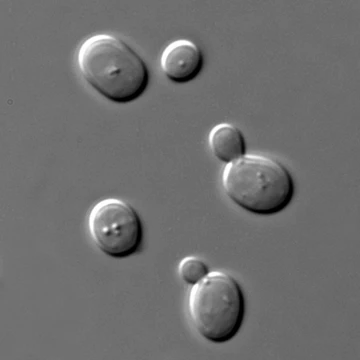
Ogataea
A methanol-utilizing yeast genus separated from Hansenula in 1994.

Ogataea is a genus of ascomycetous yeasts belonging to the family Saccharomycetaceae. In 1994, Yamada, Maeda, and Mikata separated it from the former genus *Hansenula* after analyzing partial base sequences of 18S and 26S rRNA. The genus name honors Koichi Ogata, a Japanese microbiologist at Kyoto University who studied how methanol-utilizing yeasts oxidize and assimilate methanol. The genus was formally circumscribed in *Bioscience, Biotechnology, and Biochemistry* (volume 58, issue 7, page 1253) that same year.
Species in *Ogataea* are single-celled or form pseudohyphae of just a few elongated cells; they do not produce true hyphae. Asexually, they reproduce by multilateral budding on a narrow base, forming spherical to ellipsoidal buds. Sexually, they produce deliquescent asci that may be unconjugated or show conjugation between a cell and its bud or between independent cells. Each ascus yields one to four (sometimes more) ascospores that are hat-shaped, allantoid, or spherical with a ledge. Most species are homothallic, though some are heterothallic. They can ferment glucose or other sugars, and some assimilate nitrate. All known species use methanol as a carbon source. Their predominant ubiquinone is coenzyme Q-7, and they test negative with diazonium blue B. Several species—such as *Ogataea polymorpha*, *Ogataea minuta*, and *Ogataea methanolica*—are cultivated for microbiological and genetic research. The type species is *Ogataea minuta*.
*Ogataea* is placed within the Saccharomycetales as a sister genus to *Ambrosiozyma*. According to Kurtzman et al. (2011), the genus includes 31 species, though additional taxa within the polyphyletic genus *Candida* also belong here. The recognized species are: *Ogataea allantospora*, *O. chonburiensis*, *O. corticis*, *O. dorogensis*, *O. falcaomoraisii*, *O. ganodermae*, *O. glucozyma*, *O. henricii*, *O. kodamae*, *O. methanolica*, *O. methylivora*, *O. minuta*, *O. naganishii*, *O. nakhonphanomensis*, *O. neopini*, *O. nitratoaversa*, *O. nonfermentans*, *O. paradorogensis*, *O. philodendri*, *O. pilisensis*, *O. pini*, *O. polymorpha*, *O. populialbae*, *O. ramenticola*, *O. salicorniae*, *O. siamensis*, *O. thermomethanolica*, *O. trehaloabstinens*, *O. trehalophila*, *O. wickerhamii*, and *O. zsoltii*.
- Family
- Saccharomycetaceae
- Type species
- Ogataea minuta (Wickerham) Y. Yamada, K. Maeda & Mikata
- Number of species
- 31 (per Kurtzman et al. 2011)
- Predominant ubiquinone
- coenzyme Q-7
- Diazonium blue b test
- negative
- Year of circumscription
- 1994
- Journal of circumscription
- Biosc., Biotechn. Biochem. vol.58 (Issue 7) on page 1253
Lore & Background
The genus name Ogataea honors Koichi Ogata, a Japanese microbiologist from the Department of Agricultural Chemistry, Faculty of Agriculture, at Kyoto University, for his studies on the oxidation and assimilation of methanol in methanol-utilizing yeasts. The genus was circumscribed by Yuzo Yamada, Kojiro Maeda and Kozaburo Mikata in 1994. Species within Ogataea are single-celled or build pseudohyphae of only a few elongated cells; true hyphae are not formed. They reproduce sexually or asexually, with asexual reproduction by multilateral budding on a narrow base. Sexual reproduction involves deliquescent asci that may be unconjugated or show conjugation, producing one to four or more ascospores that are hat-shaped, allantoid or spherical with a ledge. The species are homothallic or infrequently heterothallic. Ogataea cells can ferment glucose or other sugars, some assimilate nitrate, and all known species utilize methanol as a carbon source. The genus is placed within the Saccharomycetales as a sister genus to Ambrosiozyma. Following Kurtzman et al. 2011, the genus consists of 31 species but also shows that there are several more within the taxon that are part of the polyphyletic genus Candida.
Reader's Guide
Ogataea is significant primarily for its metabolic specialization: all known species utilize methanol as a carbon source, a trait that links the genus to the research legacy of Koichi Ogata, after whom it is named. The genus was established through molecular analysis of 18S and 26S rRNA partial base sequencings, separating it from Hansenula. Its circumscription in 1994 by Yamada, Maeda and Mikata provided a taxonomic framework for methanol-utilizing yeasts. Some species, such as Ogataea polymorpha, Ogataea minuta and Ogataea methanolica, are used and cultured for microbiological and genetic research. The genus is placed as a sister group to Ambrosiozyma within the Saccharomycetales. The type species is Ogataea minuta. The article notes that while Kurtzman et al. 2011 lists 31 species, additional taxa within the genus are part of the polyphyletic genus Candida, indicating ongoing taxonomic complexity. The predominant ubiquinone is coenzyme Q-7, and the diazonium blue B test is negative, which are diagnostic features. The genus includes species isolated from diverse substrates, as reflected in species names such as Ogataea corticis (from bark) and Ogataea populialbae (from poplar).
Did You Know?
- The genus Ogataea was separated from Hansenula based on 18S and 26S rRNA partial base sequencings.
- All known species of Ogataea can utilize methanol as a carbon source.
- The type species is Ogataea minuta (Wickerham) Y. Yamada, K. Maeda & Mikata.
- The genus is named after Koichi Ogata, a Japanese microbiologist at Kyoto University.
More in Yeasts, Part 2 1-24
Spotted an error? Know more?
Reader corrections go straight into our review queue. Suggest an edit · How this site is sourced