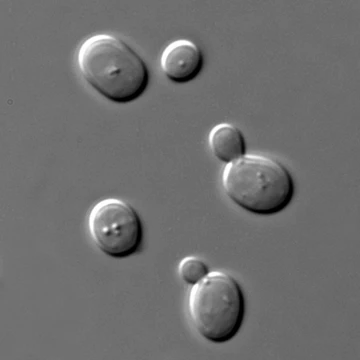
Ogataea polymorpha
Methylotrophic yeast used for pharmaceutical protein production.

Ogataea polymorpha is a methylotrophic yeast species of the family Saccharomycetaceae, notable for its ability to grow on methanol and its use as a protein factory for pharmaceuticals. It is one of a limited number of methylotrophic yeasts, alongside Candida boidinii, Pichia methanolica, and Pichia pastoris.
- Strains
- CBS4732, DL-1, NCYC495
- Genome sequenced
- CBS4732
- Temperature tolerance
- above 50 °C (122 °F)
- Key enzymes
- MOX, FMDH, DHAS
- Glycan structure
- Man8-12GlcNAc2 with terminal alpha-1,2-linked mannose
- Network founded
- 2000
- Network name
- Hansenula polymorpha worldwide network (HPWN)
Lore & Background
Three O. polymorpha strains, identified in the 1950s, have unclear relationships and independent origins. They were found in soil samples, insect guts, or spoiled concentrated orange juice. Strain CBS4732 and NCYC495 can be mated, while DL-1 cannot. CBS4732 and DL-1 are used for recombinant protein production; NCYC495 is mainly used for nitrate assimilation studies. The entire genome of CBS4732 has been sequenced.
O. polymorpha is thermo-tolerant, with some strains growing above 50 °C. It assimilates nitrate and grows on various carbon sources. Under elevated temperature, cells accumulate trehalose as a thermo-protective compound; trehalose synthesis is not required for growth but for thermotolerance. The TPS1 gene, key for trehalose synthesis, has been isolated and characterized. All methylotrophic yeasts share an identical methanol utilization pathway, and O. polymorpha is a model for studying peroxisomal functions. During methanol growth, key enzymes MOX, FMDH, and DHAS are highly abundant, regulated at the transcriptional level. Unlike related species, O. polymorpha shows strong expression of these genes with glycerol or glucose starvation. It produces glycoproteins with N-linked chains lacking allergenic terminal alpha-1,3-linked mannose residues.
Reader's Guide
Ogataea polymorpha is significant as a platform for gene technological production of pharmaceuticals, including insulin, hepatitis B vaccines, and IFNalpha-2a. Derivatives of strains CBS4732 and DL-1 are employed for such production. It can be cultured to high cell densities in large fermenters, is safe (no pyrogens, pathogens, or viral inclusions), and can secrete compounds into the culture medium, unlike bacteria such as Escherichia coli. Its genetic components include strong, regulatable promoters derived from highly expressed genes like MOX, FMD, and TPS1. The general design of a vector for transformation includes a selection marker, elements for propagation and chromosomal targeting (ARS and/or rDNA sequence), and an expression cassette with a promoter, variable coding sequence, and terminator. The attractiveness of the platform is commercially exploited by companies such as PharmedArtis (Aachen, Germany) and the Leibniz-Institut für Pflanzengenetik und Kulturpflanzenforschung (IPK). An informal society, the Hansenula polymorpha worldwide network (HPWN), was founded in 2000 by Marten Veenhuis and Gerd Gellissen, holding meetings every two years.
Did You Know?
- O. polymorpha can grow on methanol and is one of only a few methylotrophic yeast species.
- Its N-linked glycans lack allergenic terminal alpha-1,3-linked mannose residues found in baker's yeast.
- Strain CBS4732 has a fully sequenced genome.
- Trehalose accumulation in O. polymorpha is linked to thermotolerance, not growth.
More in Yeasts, Part 2 1-24
Spotted an error? Know more?
Reader corrections go straight into our review queue. Suggest an edit · How this site is sourced