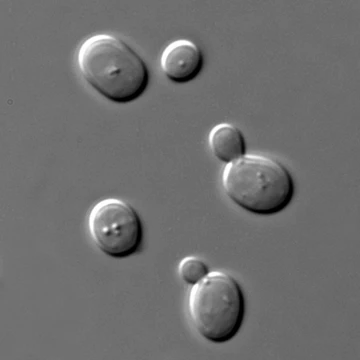
Nakaseomyces glabratus
A haploid yeast with innate azole resistance and biofilm-forming ability.

Nakaseomyces glabratus, once called Candida glabrata, is a haploid yeast in the Nakaseomyces genus. It normally lives harmlessly on human mucosal tissues, but in people with weakened immune systems—due to factors like HIV, diabetes, or treatments that suppress immunity—it frequently becomes an opportunistic pathogen. It ranks as the second or third most common cause of candidiasis, and infections can involve the urogenital tract or enter the bloodstream to cause candidemia, especially in immunocompromised patients.
Phylogenetically, N. glabratus is closer to Saccharomyces cerevisiae than to Candida species. It belongs to the Nakaseomyces group within the whole genome duplication clade of Saccharomycetaceae. That duplication event happened roughly 90 million years ago, while the common ancestor of N. glabratus and Candida albicans lived between 200 and 300 million years ago. A major 2018 study of budding yeasts showed that the genus Candida is scattered across several families, meaning the ability to cause candidiasis is a paraphyletic trait shared by diverse yeasts with different metabolisms.
Clinically, N. glabratus is especially important in hospital-acquired infections because it has innate high resistance to azole antifungals like fluconazole and ketoconazole, which fail in 15–20% of cases. Resistance to echinocandins is also rising, leaving only expensive and toxic options like intravenous amphotericin B, which can cause chronic kidney failure. Amphotericin B vaginal suppositories, combined with boric acid capsules, are used effectively since they aren’t absorbed into the bloodstream. For vaginal infections, a first-line treatment is a 7-day course of terconazole cream, though the cure rate is about 40% and recurrences are common, sometimes spreading to skin and scalp. Boric acid suppositories from compounding pharmacies serve as an experimental second-line treatment for chronic infections, sometimes with vitamin E oil to reduce irritation. Borax and boric acid can also be used for persistent scalp and skin infections.
Beyond drug resistance, other virulence factors contribute to its pathogenicity. N. glabratus expresses adhesin genes, mostly located in subtelomeric chromosome regions, whose activity is triggered by environmental cues.
- Mating types
- both mating types commonly found
- Antifungal resistance
- low-level intrinsic resistance to azoles; azoles not effective in 15–20% of cases
- Sugar utilization
- ferments and assimilates only glucose and trehalose
- Phylogenetic relationship
- more closely related to Saccharomyces cerevisiae than to Candida species; common ancestor with C. albicans dated between 200 and 300 million years ago
- Whole genome duplication
- occurred about 90 million years ago
Lore & Background
Nakaseomyces glabratus is a haploid yeast of the genus Nakaseomyces, previously classified as Candida glabrata. No sexual life cycle has been documented for this species, yet strains of both mating types are commonly found. It is generally a commensal of human mucosal tissues, but in the era of wider human immunodeficiency—from therapeutic immunomodulation, longer survival with comorbidities such as diabetes, and HIV infection—it often becomes the second or third most common cause of candidiasis as an opportunistic pathogen. Infections can affect the urogenital tract or become systemic via bloodstream entry (candidemia), especially in immunocompromised patients.
The species is of special clinical relevance in nosocomial infections due to its innately high resistance to azole antifungals. Other virulence factors include expression of adhesin genes, mostly encoded in subtelomeric chromosome regions, whose expression is activated by environmental cues to enable adherence to biotic and abiotic surfaces. This adhesin expression is suspected to be the first mechanism for forming fungal biofilms, which are more resistant to antifungals than planktonic cells. The genome frequently undergoes rearrangements hypothesized to improve fitness under stress and linked to virulence potential.
Reader's Guide
Nakaseomyces glabratus holds significant clinical importance as an opportunistic pathogen, particularly in immunocompromised populations, where it is often the second or third most common cause of candidiasis. Its innate resistance to azole medications—the most prescribed antifungals—renders standard treatments ineffective in 15–20% of cases, and resistance to echinocandins is also increasing. This leaves clinicians with limited options, often resorting to polyene medications like amphotericin B, which can cause severe side effects such as chronic kidney failure. The species' ability to form biofilms via adhesin expression further complicates treatment, as biofilms are more resistant to antifungals than planktonic cells. Diagnosis relies on cultures, which are effective for vaginal infections but less so for skin disease, where special assessment is required. The yeast's restricted sugar utilization—only glucose and trehalose—aids identification via commercial kits. Phylogenetically, N. glabratus is more closely related to Saccharomyces cerevisiae than to Candida species, belonging to the Nakaseomyces group within the whole genome duplication clade of Saccharomycetaceae. This underscores that pathogenic power among budding yeasts is a paraphyletic trait, not confined to the genus Candida.
Did You Know?
- The species ferments and assimilates only glucose and trehalose, a trait used in commercial identification kits.
- Azole medications are not effective in 15–20% of cases against N. glabratus.
More in Yeasts, Part 2 1-24
Spotted an error? Know more?
Reader corrections go straight into our review queue. Suggest an edit · How this site is sourced