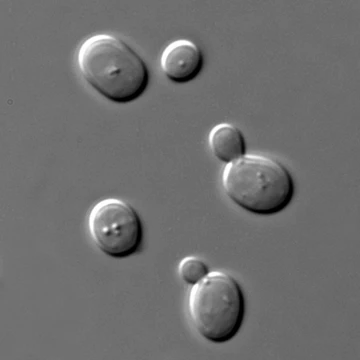
Mrakia frigida
Obligate psychrophilic yeast from Antarctic snow, grows at subzero temperatures.

Mrakia frigida, a fungus in the order Cystofilobasidiales, exists as both a yeast and a hyphal form, with the latter producing teliospores that give rise to basidia. First isolated from Antarctic snow in its yeast state, it is an obligate psychrophile: it thrives at subzero temperatures but cannot survive above 18–20 °C. Growth occurs between −2 °C and 20 °C, with rapid growth at 17 °C; a slight temperature increase then slows it. The maximum growth temperature depends on the carbon source—19–20 °C on glucose, but only 17–18 °C on ethanol—and growth rates are higher on glucose. Cell yield peaks at subzero temperatures.
The fungus adjusts its membrane fluidity by altering the degree of fatty-acid unsaturation in its cell lipids, which correlates positively with growth temperature. This ability to modify membrane composition sets the species’ temperature limits: the lower bound occurs when membrane lipids solidify, the upper when they melt. Cytochrome concentrations (aa3, b, and c) show a negative relationship with membrane-lipid unsaturation. At maximum growth temperatures, when unsaturation is high, final cell yield drops, suggesting glucose repression of cytochrome synthesis. However, cytochrome c levels rise at these high temperatures, possibly as a compensatory shift to alternative electron transport pathways when cytochrome a+a3 declines. Together, these relationships highlight how membrane structure and composition are key to Mrakia frigida’s temperature adaptation.
- Order
- Cystofilobasidiales
- Original habitat
- Antarctic snow
- Growth temperature range
- −2–20 °C (28–68 °F)
- Maximum growth temperature on glucose
- 19–20 °C (66–68 °F)
- Maximum growth temperature on ethanol
- 17–18 °C (63–64 °F)
- Rapid growth temperature
- 17 °C (63 °F)
Lore & Background
Mrakia frigida was originally isolated in its yeast state from Antarctic snow. It exists in both yeast and hyphal forms, with the hyphal state producing teliospores from which basidia emerge. The species is classified as an obligate psychrophile because it grows well at subzero temperatures and cannot grow above 18–20 °C. Its growth range is −2–20 °C, with rapid growth at 17 °C; a slight temperature increase above that results in growth decrease. The maximum growth temperature depends on the carbon source: 19–20 °C on glucose and 17–18 °C on ethanol. Growth rate on glucose is higher than on ethanol at a given temperature, and cell yield is maximum at subzero temperatures.
Reader's Guide
The significance of Mrakia frigida lies in its adaptation to cold environments, as described by its membrane lipid composition and cytochrome concentration. There is a positive correlation between growth temperature and the degree of fatty-acid unsaturation of cell lipids, indicating that the yeast alters its membrane fluidity to adapt to temperature changes. The lower growth limit is the point at which membrane lipids solidify, and the upper limit is where they melt. Cytochrome concentrations (aa3, b, and c) are negatively related to membrane-lipid unsaturation rate. At maximum growth temperatures, when lipid unsaturation is high, final cell yield is lower, suggesting glucose repression of cytochrome synthesis. However, a high concentration of cytochrome c at maximum growth temperatures may compensate for decreased cytochrome a+a3 via alternative electron transport pathways. These relationships underscore the importance of membrane structure and composition in temperature adaptation.
Did You Know?
- Mrakia frigida was originally isolated from Antarctic snow in its yeast state.
- It produces teliospores in its hyphal state, from which basidia emerge.
- Cell yield of Mrakia frigida is maximum at subzero temperatures.
More in Yeasts, Part 2 1-24
Spotted an error? Know more?
Reader corrections go straight into our review queue. Suggest an edit · How this site is sourced