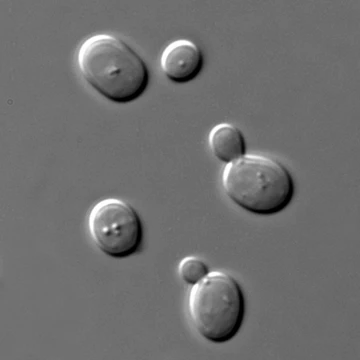
Mrakia aquatica
A psychrophilic yeast from English lake water producing mycocins.

Mrakia aquatica is a species of fungus in the family Mrakiaceae, known only from its yeast state. It was originally isolated from lake water in England and is notable for its production of mycocins, proteinaceous toxins that kill or inhibit fungi in the order Cystofilobasidiales.
- Optimal growth temperature
- 9 °C
- Minimum growth temperature
- 2 °C
- Time to stationary phase in liquid media
- approximately 76 hours
- Cell shapes
- oval, cylindrical, or dumb-bell shaped
- Reproduction
- bipolar mypodial budding
- Fermentation capabilities
- weakly ferments D-glucose, D-galactose, maltose, and melezitose
- Dbb result
- positive
Lore & Background
Mrakia aquatica was originally isolated from lake water in England and is only known from its yeast state. It grows optimally at 9 °C and can grow at temperatures as low as 2 °C. On agar, it produces smooth, butyrous cream-colored colonies. In liquid media, it takes about 76 hours to reach stationary phase and is very sensitive to decreases in pH. Its cells are typically oval or cylindrical, but can also be dumb-bell shaped. The species reproduces through bipolar mypodial budding and can weakly ferment D-glucose, D-galactose, maltose, and melezitose. It is DBB-positive.
The species has been studied for its ability to produce pectinase, specifically polygalacturonase, but not isoenzymes of polygalacturonase. Its pectinase activity increases in the presence of glucose. A notable trait is its production of mycocins, which are proteinaceous toxins that kill or inhibit fungi in the same or related taxonomic rank. The mycocin produced by M. aquatica is only able to kill species in the Cystofilobasidiales.
Reader's Guide
Mrakia aquatica is significant primarily for its production of mycocins, which are proteinaceous toxins that selectively kill or inhibit fungi in the order Cystofilobasidiales. This specificity makes it a potential tool for studying fungal interactions and possibly for biocontrol within that taxonomic group. Additionally, its ability to produce pectinase, specifically polygalacturonase, with increased activity in the presence of glucose, has drawn research interest. The species is also notable for its psychrophilic nature, with an optimal growth temperature of 9 °C and the ability to grow at 2 °C, reflecting its adaptation to cold lake water environments. Its isolation from lake water in England and its limited known distribution (only the yeast state) add to its ecological and taxonomic interest. The species' sensitivity to pH changes and its weak fermentation of several sugars further characterize its physiology. Overall, Mrakia aquatica contributes to understanding cold-adapted yeasts, pectin degradation, and fungal antagonism through mycocins.
Did You Know?
- It produces mycocins that specifically kill species in the Cystofilobasidiales.
- Its optimal growth temperature is 9 °C, and it can grow at temperatures as low as 2 °C.
- It produces polygalacturonase, but not isoenzymes of polygalacturonase.
More in Yeasts, Part 2 1-24
Spotted an error? Know more?
Reader corrections go straight into our review queue. Suggest an edit · How this site is sourced