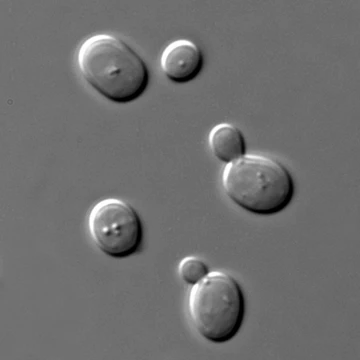
Metschnikowiaceae
Yeast family with altered CUG codon and diverse habitats.

The Metschnikowiaceae are a family of yeasts that reproduce by budding and belong to the order Serinales (class Pichiomycetes). A defining feature of this family is its members' altered genetic code: the codon CUG is translated as serine instead of leucine. The family includes sixteen genera, with the type genus *Metschnikowia* being widespread in floral nectar and spread by pollinators across all continents except Antarctica. The family name was originally proposed in 1900 but was not validly published until 2013, and a major taxonomic revision based on genome-scale studies in 2024 established thirteen new genera to better reflect evolutionary relationships. Members are characterized by multilateral budding, often elongated asci, and narrow, thread-like ascospores. They inhabit a range of environments, including marine settings, decaying plant material, and especially flower nectar, where they can alter nectar chemistry and influence pollinator behavior.
- Type genus
- Metschnikowia
- Number of genera
- 16
- Year family proposed
- 1900
- Year validly published
- 2013
- Year thirteen new genera established
- 2024
- Order
- Serinales
- Class
- Pichiomycetes
Lore & Background
The family name Metschnikowiaceae was originally used by Franciszek Kamienski in 1900, but that publication lacked an acceptable description and was therefore invalid under the International Code of Nomenclature for algae, fungi, and plants. The family was later validly established by Alexander Doweld in 2013. In genome-informed classifications, Metschnikowiaceae is placed in the order Serinales, which was introduced in a genome-scale revision of higher ranks in the budding-yeast subphylum Saccharomycotina. The family has traditionally centered on genera that form a sexual state with asci and ascospores, especially Metschnikowia, Clavispora, and Hyphopichia, while many related species were long treated as Candida, a catch-all genus later shown to be polyphyletic.
In a 2024 phylogenomic study by Liu and colleagues, relationships within Metschnikowiaceae were reconstructed using a genome-scale tree from hundreds of single-copy genes. The analyses recovered numerous well-supported lineages and indicated that some long-used genera were too broad. To reduce mismatched generic names inherited from the old Candida concept, the study proposed thirteen new genera and introduced many new combinations. For example, Candida auris and its close relatives were transferred to the new genus Candidozyma, while the Candida tolerans lineage was separated as Osmozyma. The authors noted that parts of the large Metschnikowia lineage remain genetically diverse and may be revised further.
Reader's Guide
The significance of Metschnikowiaceae lies in its role as a model for understanding yeast evolution and ecology, particularly in floral nectar. Members of the type genus Metschnikowia are commonly found in floral nectar on all continents except Antarctica, where they are dispersed by pollinators. Their growth in nectar can ferment sugars and produce volatile organic compounds, altering nectar chemistry and scent in ways that influence insect foraging behavior. The family's taxonomic history illustrates the shift from morphology-based classification to genome-scale phylogenetics, with the 2024 revision establishing thirteen new genera to better reflect evolutionary relationships. This revision also addressed the polyphyletic nature of the old Candida genus by transferring many species into newly defined genera. The family's altered genetic code—where CUG encodes serine instead of leucine—is a distinctive trait that sets it apart within the budding-yeast subphylum. Ongoing genetic diversity within the Metschnikowia lineage suggests that further taxonomic refinements are likely as additional genomes become available.
Did You Know?
- The family Metschnikowiaceae was originally proposed in 1900 but not validly published until 2013.
- Members of Metschnikowiaceae have an altered genetic code where the codon CUG is translated as serine rather than leucine.
- Thirteen new genera were established in Metschnikowiaceae in 2024 based on genome-scale studies.
More in Yeasts, Part 2 1-24
Spotted an error? Know more?
Reader corrections go straight into our review queue. Suggest an edit · How this site is sourced