Kutná Hora
Historic silver-mining town with UNESCO-listed centre.
Last updated
Where it is
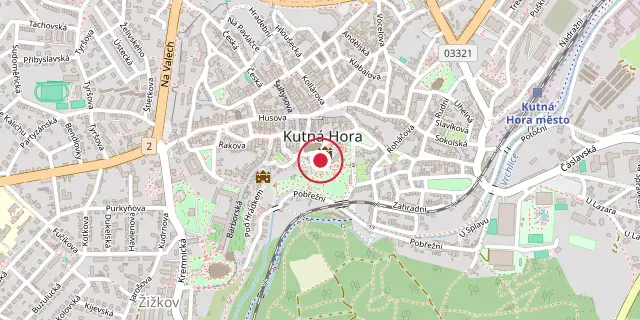
Coordinates: 49°56′53″N 15°16′05″E (49.9480, 15.2680) · Open in OpenStreetMap
Coordinates and connected clubs: the infobox of Wikipedia: Kutná Hora (CC BY-SA 4.0). Map: drawn by Codexery from OpenStreetMap tiles.
Kutná Hora, a town in the Czech Republic’s Central Bohemian Region, is home to roughly 22,000 people. Its fortunes were built on silver mining, which fueled rapid growth and wealth. In 1995, the historical center of Kutná Hora, along with the Church of St. Barbara and the Cathedral of Our Lady at Sedlec, was named a UNESCO World Heritage Site, recognized for its remarkable architecture and its lasting impact on city design across Central Europe.
Lore & Background
The earliest traces of silver in the area date to the 10th century, with silver dinars from 985–995 found in Malín. The Sedlec Abbey, the first Cistercian monastery in Bohemia, was founded in 1142 by monks from Waldsassen Abbey. Silver mining began in 1260, attracting settlers from German-speaking regions.
The first mention of Kutná Hora is from 1289 under its Latin name Mons Cuthna. In 1300, King Wenceslaus II issued the mining code Ius regale montanorum, and shortly after, the town became the seat of the central mint for the Czech lands, minting Prague groschen. The town grew into the second most important town of the Kingdom of Bohemia after Prague.
Silver: The Ore That Built a Kingdom's Second City
The story of Kutná Hora is inseparable from the silver beneath its soil. Traces of the metal date back to the tenth century, with silver dinars struck between 985 and 995 later unearthed in the settlement of Malín. The Cistercian monks who founded Sedlec Abbey in 1142 found their economic troubles eased when silver was discovered nearby, drawing settlers from German-speaking regions. Organized mining began in 1260, and by 1289 the settlement had earned its first recorded name, Mons Cuthna.
King Wenceslaus II codified the industry in 1300 with the Ius regale montanorum, and shortly after, Kutná Hora became the home of the central mint producing Prague groschen. This elevated the town to the status of Bohemia's second city and principal financial hub. Yet the veins eventually weakened: the richest mining zone shut in 1543, groschen production ended in 1547, and the mint itself closed in 1727, marking the definitive end of Kutná Hora's era as a mining town.
Sieges, Decrees, and the Hussite Fury
Kutná Hora's medieval streets witnessed some of Bohemia's most consequential political and military moments. In December 1402, King Sigismund besieged the town after imprisoning Wenceslaus IV. The residents put up fierce resistance through several bloody skirmishes before Sigismund's forces prevailed, compelling the defenders to march to Kolín and kneel in submission. Tragedy struck the victor's camp when his hetman Markvart of Úlice was killed by an arrow during the siege of Suchdol castle on 27 December.
Seven years later, on 18 January 1409, Wenceslaus IV signed the Decree of Kutná Hora, granting the Czech university nation three votes in Prague University faculty elections against one for the three other nations combined. The Hussite Wars brought further devastation: in 1420 Sigismund used the town as a base for his failed assault on the Taborites, and in 1421 the Hussites burned Sedlec Abbey and seized the town. Between 1422 and 1424, part of the German population was expelled and two major fires ravaged the settlement. Silver mining was not restored until 1469.
Stone, Faith, and World Heritage
Today, Kutná Hora draws visitors from across the globe to its dense cluster of sacral and civic monuments, many of which rank among the most visited in the entire Czech Republic. In 1995, UNESCO inscribed the town centre—including the Sedlec Abbey and the striking Sedlec Ossuary—on its World Heritage list, citing the site's outstanding architecture and its demonstrable influence on the development of city centres throughout Central Europe. The historic core is also safeguarded as an urban monument reservation, the fourth largest in the country.
The town's religious buildings, in particular, carry extraordinary weight in the national landscape of heritage. Beyond tourism, the modern economy of this 22,000-inhabitant town rests on industry: the production of tobacco products and electrical engineering provide the commercial backbone that replaced the silver trade centuries ago. The result is a place where medieval stonework and contemporary factory floors coexist within a single compact municipal boundary of twelve parts.
A Name in the Hills: Etymology and Ancient Roots
The very name of Kutná Hora carries layers of linguistic history. The Czech word hora simply means 'mountain,' and the town takes its name from the eponymous hill. A popular legend attributes the name to the cowls worn by monks—Kutten in German, kutny in Czech—but scholars consider it more probable that the root lies in the Middle High German word kutte, meaning 'pit.' Czech derivations from kutit ('to work') or kutat ('to mine') have also been proposed, though a Slavic origin is deemed less likely.
Geographically, the town sits roughly 52 kilometres east of Prague, straddling two distinct landscapes: the flat agricultural expanse of the Central Elbe Table to the east and the rolling Upper Sázava Hills to the west, where the highest point, Malý Kuklík, rises to 359 metres. The Vrchlice Stream threads through the settlement. Archaeological evidence pushes human presence here back to the Bronze and Iron Ages, with Celtic Hallstatt and La Tène period ceramics and a smelting furnace containing ten kilograms of slag—bearing traces of pyrrhotine, chalcopyrite, sphalerite, and copper—revealing that underground mining in the Kaňk hill predates the famous silver era by over a millennium.
Reader's Guide
Kutná Hora's significance stems from its role as a medieval silver-mining and minting center, which made it the financial heart of the Kingdom of Bohemia. Its wealth funded the construction of outstanding Gothic monuments, such as the Church of Saint Barbara and the Italian Court. The town's architectural heritage influenced other Central European city centres, leading to its UNESCO World Heritage designation in 1995. Today, Kutná Hora is a major tourist destination, with its sacral monuments among the most visited in the Czech Republic.
The Sedlec Ossuary and the Church of the Assumption of Our Lady and Saint John the Baptist are notable attractions. The town's economy also includes industry, notably tobacco products (Philip Morris ČR) and electronics manufacturing (Foxconn Technology CZ). The historic centre, protected as an urban monument reservation since 1961, contains over 300 cultural monuments.
More in World Heritage Sites in the Czech Republic
Sources
Compiled from Wikipedia and the sources listed below. Text from Wikipedia is available under CC BY-SA 4.0; this entry is adapted from it.
- Wikipedia: Kutná Hora (CC BY-SA 4.0).
Spotted an error? Know more?
Reader corrections go straight into our review queue. Suggest an edit · How this site is sourced