Holašovice
Preserved Baroque village, UNESCO site since 1998.
Last updated
Where it is
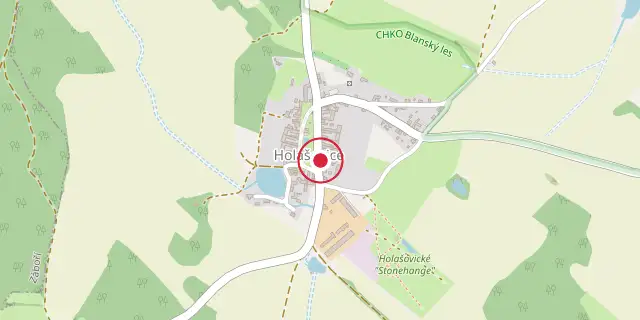
Coordinates: 48°58′08″N 14°16′23″E (48.9690, 14.2730) · Open in OpenStreetMap
Coordinates and connected clubs: the infobox of Wikipedia: Holašovice (CC BY-SA 4.0). Map: drawn by Codexery from OpenStreetMap tiles.
Holašovice, also known as Holschowitz, is a small historic settlement in southern Czechia, located 16 kilometers west of České Budějovice and part of the Jankov municipality. To its south lies the Blanský Forest protected landscape area. After World War II, the village was abandoned, which left its medieval layout and vernacular buildings—built in the South Bohemian Folk or Rural Baroque style—completely untouched. Restoration and repopulation began in 1990, and in 1998 UNESCO recognized it as a World Heritage Site for its outstandingly well-preserved example of a traditional Baroque-era village.
History
The earliest written record of Holašovice dates to 1263. In 1292, King Wenceslaus II granted the village, along with several others, to the Cistercian monastery at Vyšší Brod, which retained ownership until 1848. Between 1520 and 1525, the bubonic plague nearly wiped out the population, leaving only two survivors. A column at the northern edge of the village marks the plague grave.
The monastery then gradually resettled the area with people from Bavaria and Austria. By 1530, monastery records show a population of 17, and the village had become a mostly German-speaking enclave within a Czech-speaking region. In 1900, there were 163 German inhabitants and just one Czech.
Following the expulsion of German residents at the end of World War II, many farms were left empty and deteriorated. Under the post-war Communist regime, Holašovice became a desolate, abandoned place. Since 1990, the village has been extensively restored and reoccupied, and today it has about 140 residents.
Buildings and architecture
Architecturally, Holašovice is a typical Bohemian village of the Hlubocká Blata area near České Budějovice. It comprises 23 brick farmsteads—totaling 120 buildings—along with a fish pond, a forge, and a chapel.
The farms are built in the South Bohemian Folk Baroque style, arranged in U-shapes with a central farmyard and stucco gable ends facing a broad village green. Most of the structures date from the second half of the 19th century, though they span the 18th to 20th centuries. The chapel of St. John of Nepomuk, located on the green, was constructed in 1755.
Lore & Background
Holašovice is first mentioned in 1292, when King Wenceslaus II gave the village and several others to the Cistercian monastery of Zlatá Koruna, which held it until 1848. Around 1520–1521, the bubonic plague is traditionally said to have nearly wiped out the village, leaving only two survivors. The monastery repopulated it with settlers from Bavaria and Austria, and by 1530 the population had reportedly risen, though exact numbers are uncertain and vary among historical sources. By 1900, the population was predominantly of German origin, but precise ethnic breakdowns from census data are disputed or not clearly documented.
Reader's Guide
After the displacement of German residents at the end of the Second World War, many farms were deserted and fell into disrepair. Holašovice became a desolate, abandoned place under the Communist regime. From 1990, the village was lavishly restored and repopulated, now housing around 140 people. Its medieval plan and vernacular buildings in the South Bohemian Folk Baroque style remained intact because the village was deserted after the war.
The site consists of 23 brick farmsteads containing 120 buildings, with a fish pond, a forge, and a chapel of St. John of Nepomuk built in 1755. The farms are arranged in U shapes around a central village green, with stucco gable ends facing the green. Holašovice's significance lies in its intact representation of a traditional Baroque-era village, recognized by UNESCO in 1998 for its exceptional preservation.
Frequently Asked Questions
What is Holašovice?
Holašovice is a small, remarkably well-preserved village in South Bohemia that showcases traditional Baroque-era rural architecture. It sits within the municipality of Jankov and is home to roughly 140 residents today.
Where exactly is Holašovice located?
The village lies in the southern part of the Czech Republic, about 16 kilometres to the west of the city of České Budějovice. Administratively it falls under the municipality of Jankov.
Why did UNESCO designate Holašovice as a World Heritage Site?
In 1998, UNESCO recognized Holašovice as an outstanding example of a South Bohemian Folk Baroque village kept in exceptional condition. Its 23 farmsteads together form a rare, intact snapshot of traditional rural life from the Baroque period.
More in World Heritage Sites in the Czech Republic
Sources
Compiled from Wikipedia and the sources listed below. Text from Wikipedia is available under CC BY-SA 4.0; this entry is adapted from it.
- Wikipedia: Holašovice (CC BY-SA 4.0).
Spotted an error? Know more?
Reader corrections go straight into our review queue. Suggest an edit · How this site is sourced