Český Krumlov
Historic Czech town with a UNESCO-listed castle complex.
Last updated
Where it is
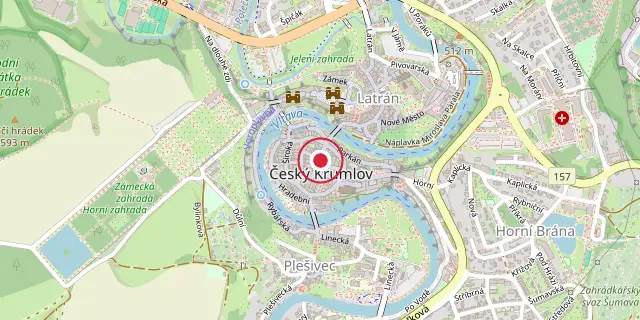
Coordinates: 48°48′40″N 14°18′54″E (48.8110, 14.3150) · Open in OpenStreetMap
Coordinates and connected clubs: the infobox of Wikipedia: Český Krumlov (CC BY-SA 4.0). Map: drawn by Codexery from OpenStreetMap tiles.
Český Krumlov is a town in the South Bohemian Region of the Czech Republic, located on the Vltava River in the Bohemian Forest Foothills. It is known as a tourist centre and one of the most visited places in the country, with its historic centre and castle complex designated a UNESCO World Heritage Site since 1992.
Lore & Background
Český Krumlov Castle was founded shortly before 1250 by a local branch of the noble Vítkovci family. The first written mention of the town was in a 1253 deed as Chrumbenowe. The town developed in two stages: Latrán, built spontaneously below the castle, and the Old Town, founded as a new settlement. Both Czech and German nationalities were represented from the start, and a Jewish community is documented since 1334.
In 1302 the local Vítkovci line that held Krumlov became extinct, and the estate passed to the Rosenberg family, who made it their main residence. Under Peter I of Rosenberg, the upper castle was erected in the early 14th century.
The town achieved its highest prosperity in the 15th century under Oldřich II of Rosenberg. In 1602, Peter Vok of Rosenberg sold Krumlov to Emperor Rudolf II, who gave it to his illegitimate son. After the Battle of White Mountain in 1620, Emperor Ferdinand II gave Krumlov to the Eggenberg family, and from 1719 to 1947 it belonged to the Schwarzenberg family.
In the 19th century, industrialization and transport development led to the demolition of most town fortifications. After World War I, the town became part of Czechoslovakia, though German-Austrian deputies initially declared it part of German-Austria. In 1938 it was annexed by Nazi Germany, and after World War II the German majority population was expelled. During the Communist era the town fell into disrepair, but after the Velvet Revolution of 1989 much was restored.
A Name Carved by the River
The name Český Krumlov carries the memory of a river's curve. Its roots trace back to the Middle High German phrase Krumme Aue, meaning "crooked meadow," a reference to the bend the Vltava makes as it threads through the Bohemian Forest Foothills. The qualifier "Český," meaning "Bohemian," was not added until the fifteenth century, when the need arose to distinguish this town from its namesake Moravský Krumlov in south Moravia.
Human presence here stretches back farther than most. Traces of habitation from the Older Stone Age, seventy to fifty thousand years before the common era, mark the earliest footprint. By the Bronze Age, around fifteen hundred BC, the area supported mass settlement, and Celtic communities followed during the Younger Iron Age. Slavic settlers arrived by the sixth century AD, and trade routes along the Vltava served the region in the Early Middle Ages.
The castle was raised shortly before 1250 by a branch of the Vítkovci nobility, and the town's first written appearance, recorded as Chrumbenowe in a 1253 deed, confirms its medieval birth. The settlement grew in two phases: Latrán, which sprang up organically beneath the castle, and the Old Town, a new planned foundation. A Jewish community is documented as early as 1334.
The Rosenberg Century and the Castle
When the Vítkovci line became extinct in 1302, King Wenceslaus II acquired the estate by escheat and ceded it to the Rosenberg family, who would shape the town's identity for over two centuries. Peter I of Rosenberg, serving as Lord Chamberlain to King John of Bohemia, commissioned the present upper castle in the early fourteenth century, and under his stewardship the Rosenberg estates flourished. The town reached its zenith in the fifteenth century under Oldřich II of Rosenberg, whose considerable enlargement of the estate territory brought unmatched prosperity.
The Rosenbergs actively promoted trade and crafts within the town walls, and when gold was discovered nearby in the late fifteenth century, German miners flocked to settle, shifting the ethnic balance. In 1555, William of Rosenberg finally unified Latrán and Old Town, which had operated as separate entities, and in the late sixteenth century he had the castle rebuilt in the Renaissance style. After 1602, ownership passed through the Habsburgs and the Eggenberg family, and from 1719 until 1947 the Schwarzenberg family held the castle.
Divided Loyalties and a Century of Upheaval
By 1910, the town's population of 8,662 was overwhelmingly German, with 85 percent belonging to that community and only 15 percent Czech. After World War I, Český Krumlov became part of the newly created Czechoslovakia, though German-Austrian deputies contested the border, claiming the region for German-Austria. The 1919 Treaty of Saint-Germain-en-Laye settled the matter in Czechoslovakia's favour. The fragile peace shattered in 1938, when the Munich Agreement handed the town to Nazi Germany, where it was administered as part of the Reichsgau Oberdonau.
The aftermath of World War II brought a dramatic demographic reversal: the longtime German majority was expelled, and the town was returned to Czechoslovakia. Under Communist rule, the historic centre fell into disrepair, a period of neglect that contrasted sharply with its earlier golden ages. The Velvet Revolution of 1989 turned the tide, sparking a wave of restoration that transformed the town into one of the country's most visited destinations. In August 2002, the European floods dealt a further blow, damaging parts of the town.
From Neglect to the World Stage
Today, Český Krumlov stands as one of the Czech Republic's most visited destinations, its historic centre and castle complex protected as an urban monument reservation and inscribed as a UNESCO World Heritage Site since 1992, a recognition of its remarkably preserved Gothic, Renaissance, and Baroque architecture. With roughly thirteen thousand inhabitants, the town balances tourism with a working industrial base: Linde Pohony manufactures propulsion systems for forklifts, Fronius produces welding equipment and photovoltaic plant components, and the Schwan-Stabilo group operates both a cosmetics and a writing-instruments division.
The largest non-industrial employer is the local hospital. The town's brewing heritage, traceable to the Pivovar Eggenberg brewery founded in 1560, continues in a small historical brewery that reopened in the old premises in 2016. Connectivity has improved markedly since the nineteenth-century demolition of most fortifications: the I/39 road links the town to České Budějovice and Volary, direct buses run to Prague, Linz, Salzburg, and Munich, and two railway stations serve the České Budějovice–Černý Kříž line.
Reader's Guide
Český Krumlov's significance lies in its well-preserved Gothic, Renaissance, and Baroque architecture, which earned it UNESCO World Heritage status in 1992. The historic town centre, with its medieval street layout and the castle complex—one of the largest in central Europe at 7 hectares—attracts visitors from around the world. The castle is notable for its moat filled with bears, a reference to the Orsini family, and for its Baroque theatre built in 1680–1682, the oldest preserved theatre of its kind. The town hosts annual events such as the Five-Petalled Rose Festival, which recreates a medieval atmosphere, and the International Music Festival Český Krumlov, held since 1992.
Economically, the town supports several industrial companies, including Linde Pohony, Fronius Česká republika, and divisions of Schwan-Stabilo, as well as a hospital. The Pivovar Eggenberg brewery operated from 1560 until 2014, with a small historical brewery reopening in 2016. The town's legacy is also shaped by its complex history of ethnic shifts, from German and Czech coexistence to the expulsion of Germans after World War II, and its recovery from Communist-era neglect.
Frequently Asked Questions
Where is Český Krumlov located and what does its landscape look like?
The town nestles in the Bohemian Forest Foothills, with the Vltava wrapping around its historic core in a horseshoe curve. Its terrain rises to Vyšný vrch, the local high point at 744 metres above sea level.
Why is Český Krumlov considered a World Heritage Site?
UNESCO recognized in 1992 that the town offers an exceptionally intact example of a Central European medieval urban landscape, where Gothic, Renaissance, and Baroque layers sit side by side. The castle complex, perched above the Vltava bend, is the visual and cultural heart of that ensemble.
More in World Heritage Sites in the Czech Republic
Sources
Compiled from Wikipedia and the sources listed below. Text from Wikipedia is available under CC BY-SA 4.0; this entry is adapted from it.
- Wikipedia: Český Krumlov (CC BY-SA 4.0).
Spotted an error? Know more?
Reader corrections go straight into our review queue. Suggest an edit · How this site is sourced