Litomyšl
Czech town with a UNESCO castle and Smetana festival.
Last updated
Where it is
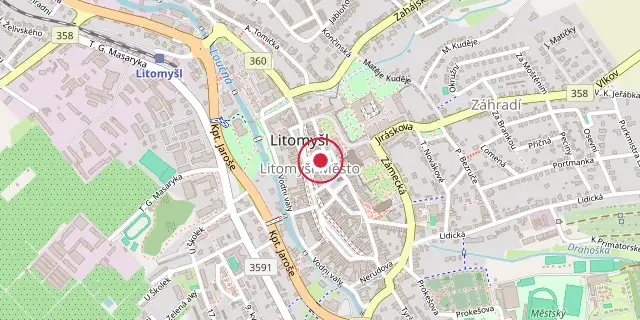
Coordinates: 49°52′19″N 16°18′40″E (49.8720, 16.3110) · Open in OpenStreetMap
Coordinates and connected clubs: the infobox of Wikipedia: Litomyšl (CC BY-SA 4.0). Map: drawn by Codexery from OpenStreetMap tiles.
Litomyšl is a town in the Svitavy District of the Pardubice Region, Czech Republic, with about 10,000 inhabitants. It is known for its UNESCO World Heritage Site, the Litomyšl Castle, and its well-preserved historic town centre, which is protected as an urban monument reservation. The town was a former bishopric and Latin Catholic titular see.
Lore & Background
The first written mention of Litomyšl is from 981, recorded in the early 12th-century Chronica Boemorum, noting the death of Duke Slavník. It began as a fortified settlement of the Slavník dynasty on a trade route from Bohemia to Moravia.
In 1259, King Ottokar II promoted it to a town. Over centuries, it was owned by noble families including Kostka of Postupice, Pernštejn, Trauttmansdorff, Waldstein-Wartemberg, and Thurn und Taxis. The Litomyšl Castle was built between 1568 and 1581 by the Pernštejns.
From 30 April 1344 until 1474, Litomyšl was the seat of the Latin Catholic Diocese of Litomyšl, which was suppressed in 1474; its territory was later incorporated into the Diocese of Hradec Králové, and it was restored as a titular see in 1970. A congregation of the Unitas Fratrum (Unity of the Brethren) was documented as early as 1490, protected by the Kostka family, and the town became a major centre for the Brethren. After the Schmalkaldic War, bishop Jan Augusta was captured in 1548, and the Brethren were expelled, many emigrating to Poland and Moravia.
In the 19th century, Litomyšl remained a cultural and educational centre. Until 1918, it was part of Austria-Hungary. A Jewish community existed from at least the late 16th century; the last families were deported in 1942 during the Holocaust. A German-speaking community was expelled in 1945 under the Beneš decrees.
Reader's Guide
Litomyšl's significance lies in its layered history as a medieval fortified settlement, a Renaissance noble seat, and a centre of Protestant reform. The Litomyšl Castle, a UNESCO World Heritage Site since 1999, is one of the largest Renaissance castles in the Czech Republic, with architectural refinement and a complex including a brewery, park, and the birthplace of composer Bedřich Smetana. The town's elongated square, nearly 500 metres long, is among the largest in Central Europe, lined with Gothic, Renaissance, and Baroque houses.
The annual Smetana festival, held since 1946, draws classical music audiences. The town also preserves the Portmoneum, a museum of artist Josef Váchal, and the Piarist college with gardens featuring sculptures by Olbram Zoubek. Litomyšl's unique local Czech dialect, called Teták, underwent an unusual sound change before front vowels, documented by linguist Henning Andersen.
Did You Know?
- The name Litomyšl is derived from the personal name Litomysl, meaning 'Litomysl's (castle)'.
More in World Heritage Sites in the Czech Republic
Sources
Compiled from Wikipedia and the sources listed below. Text from Wikipedia is available under CC BY-SA 4.0; this entry is adapted from it.
- Wikipedia: Litomyšl (CC BY-SA 4.0).
Spotted an error? Know more?
Reader corrections go straight into our review queue. Suggest an edit · How this site is sourced