Jankov (České Budějovice District)
Czech municipality with a UNESCO-listed Baroque village.
Last updated
Where it is
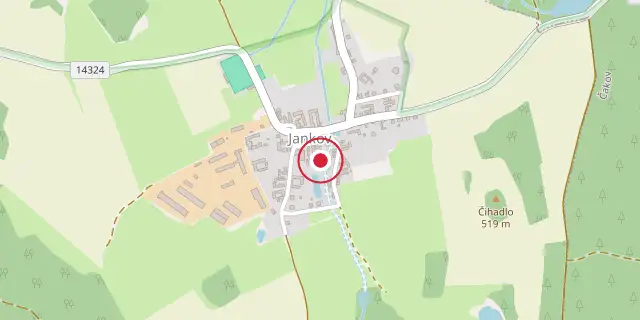
Coordinates: 48°57′58″N 14°17′53″E (48.9660, 14.2980) · Open in OpenStreetMap
Coordinates and connected clubs: the infobox of Wikipedia: Jankov (České Budějovice District) (CC BY-SA 4.0). Map: drawn by Codexery from OpenStreetMap tiles.
Jankov is a municipality and village in the South Bohemian Region of the Czech Republic, located about 12 kilometers west of České Budějovice. Its population is around 400. The municipality includes two parts: Jankov itself and Holašovice, which is protected as a UNESCO World Heritage Site for its well-preserved Baroque village layout.
The name Jankov comes from the personal name Janek, meaning "Janek's court." The area lies in the Bohemian Forest Foothills, with the highest point being Švelhán hill at 722 meters. Several fishponds are found in the northern part of the territory, and most of the municipality falls within the Blanský les Protected Landscape Area.
Jankov was first mentioned in writing in 1379. Until 1850, it belonged to the Český Krumlov estate.
Historically, Jankov was a Czech village, while Holašovice was German-speaking until the end of World War II, after which the German population was expelled. From 1850 to 1956, Jankov was part of Čakov; it became a separate municipality in 1957. Holašovice was part of Záboří until 1964, when it was annexed to Jankov.
No railways or major roads pass through the municipality. The main landmark in Jankov is the Chapel of Saint Vitus, built in 1882 and decorated with folk Baroque elements. Holašovice has been a UNESCO World Heritage Site since 1998.
Lore & Background
Jankov consists of two municipal parts: Jankov (173 inhabitants) and Holašovice (204 inhabitants), according to the 2021 census. The name Jankov is derived from the personal name Janek, meaning 'Janek's (court)'. The village lies about 12 km west of České Budějovice in the Bohemian Forest Foothills, with the highest point being the Švelhán hill at 722 m. Several fishponds are located in the northern part of the municipal territory, and most of the municipality lies within the Blanský les Protected Landscape Area.
Reader's Guide
The first written mention of Jankov is from 1379. Until 1850, it belonged to the Český Krumlov estate and shared its owners. Until the end of World War II, Jankov was an ethnically Czech village and Holašovice was a German village; after the war, the German-speaking population was expelled. From 1850 to 1956, Jankov was a municipal part of Čakov, and since 1957 it has been a separate municipality.
Holašovice was a municipal part of Záboří until 1964, when it was annexed to Jankov. The main landmark of Jankov is the Chapel of Saint Vitus, dating from 1882 and decorated with folk Baroque elements. Holašovice has been a UNESCO World Heritage Site since 1998 due to its exceptional preservation of a traditional Baroque-era village. There are no railways or major roads passing through the municipality.
Frequently Asked Questions
What is Jankov (České Budějovice District)?
Jankov is a small Czech municipality in the South Bohemian Region, sitting roughly 12 km west of České Budějovice with a population of around 400. It comprises two settlements: Jankov village proper and the nearby Holašovice.
Where exactly is Jankov located and what is the terrain like?
The village sits in the Bohemian Forest Foothills within the České Budějovice District. Its highest point is Švelhán hill at 722 meters, and a cluster of fishponds dots the northern part of the territory.
More in World Heritage Sites in the Czech Republic
Sources
Compiled from Wikipedia and the sources listed below. Text from Wikipedia is available under CC BY-SA 4.0; this entry is adapted from it.
- Wikipedia: Jankov (České Budějovice District) (CC BY-SA 4.0).
Spotted an error? Know more?
Reader corrections go straight into our review queue. Suggest an edit · How this site is sourced