Jemeppe Castle
Medieval castle with Roman roots in Wallonia, Belgium.

Jemeppe Castle, also known as Hargimont Castle, is a medieval fortress located in Hargimont, now part of the municipality of Marche-en-Famenne in the province of Luxembourg, Wallonia, Belgium. Its origins trace back to a Roman-era fortified villa, with the present structure developing from a 13th-century donjon built by Jean d'Ochain.
Quick Facts
- Location
- Hargimont (Belgium)
- Open To Public
- Yes
Facts from the source article.
Lore & Background
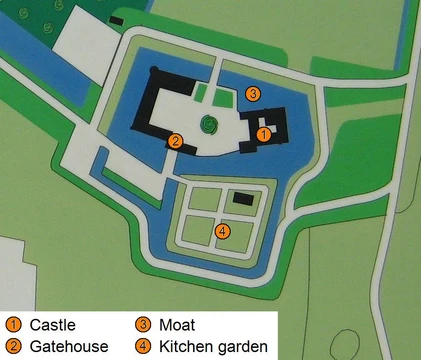
During the Roman era, a fortified villa was established in the region. The present castle is of medieval origin. In the Middle Ages, the manor of Jemeppe consisted of a few buildings surrounded by marshland and the river Hédrée, offering little protection against the ruling families of Namur and Luxembourg, who fought for control of Durbuy and La Roche since the 12th century. A fortified house was built in the early 13th century, later replaced by Jean d'Ochain with a donjon protected by moats.
The donjon originally had four or five storeys (sources vary), with access to all floors via the ground floor's only door. The first two floors were living quarters; the upper two were basic staff quarters, storage, and refuge for manor inhabitants. The donjon remained in the d'Ochain family until around 1615, when heiress Catherine de Jemeppe married Raes d'Ans, sieur de Velroux. Raes d'Ans likely extended the tower into a square castle building, adding wings, a double moat, and a farmstead.
The wings were modernized in 1739 and 1748, with more windows added. Restoration occurred at the beginning of the 19th century, including work on the gallery and gatehouse. In 1838, the castle passed to the de Sauvage-Vercour family. Between 1865 and 1875, Adrien de Sauvage-Vercour oversaw extensive renovations: attics and pitched roofs were added to the wings, a 'crowning apex' was built on the donjon, and the old flat roof was replaced by the present steep roof. Weathervanes in medieval style were added to the tower roofs, one still bearing the de Sauvage-Vercour monogram.
Reader's Guide
Jemeppe Castle illustrates the evolution of a fortified site from Roman times through the medieval period and into the 19th century. Its significance lies in its continuous adaptation: from a Roman villa to a medieval donjon built by Jean d'Ochain, then expanded into a square castle by Raes d'Ans, and later modernized by the de Sauvage-Vercour family. The castle's architecture reflects changing defensive and residential needs, with the donjon's five storeys, moats, and later additions like pitched roofs and weathervanes. The site also highlights regional power struggles between the families of Namur and Luxembourg. As a preserved example of Belgian medieval fortification with later renovations, it offers insight into the history of the province of Luxembourg and Wallonia. Its legacy is tied to the families who owned it—d'Ochain, d'Ans, and de Sauvage-Vercour—each leaving architectural marks. The castle remains a notable landmark in Hargimont, representing centuries of local history.
Did You Know?
- Between 1865 and 1875, Adrien de Sauvage-Vercour added a 'crowning apex' to the donjon and replaced the flat roof with a steep roof.
- One weathervane on the tower roofs still bears the de Sauvage-Vercour monogram.
More in Water castles 1-24
Spotted an error? Know more?
Reader corrections go straight into our review queue. Suggest an edit · How this site is sourced