
Doñana National Park
A unique European wetland sanctuary for migratory birds and endangered wildlife.

Technische Fred at Dutch Wikipedia · CC BY-SA 3.0
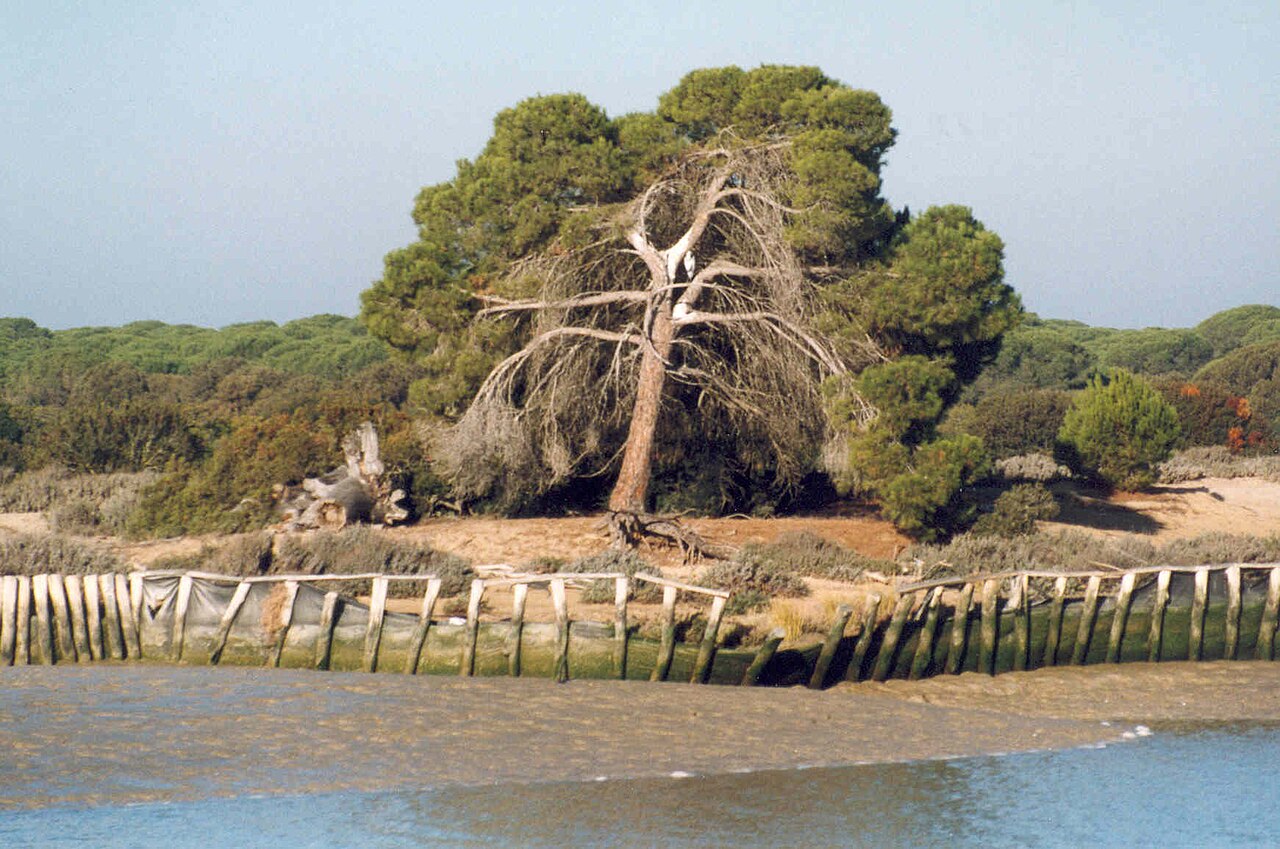
Doñana National Park or Parque Nacional y Natural de Doñana is a natural reserve in Andalusia, southern Spain, in the provinces of Huelva (most of its territory within the municipality of Almonte), Cádiz and Seville. It covers 543, of which 135 are a protected area. It is named after the wife of the 7th Duke of Medina Sidonia. The park is an area of marshes, shallow streams, and sand dunes in Las Marismas, the delta where the Guadalquivir flows into the Atlantic Ocean. It was established as a nature reserve in 1969 when the World Wildlife Fund (WWF) joined with the Spanish government and purchased a section of marshes to protect it. The area was declared a World Heritage Site by UNESCO in 1994.
Quick Facts
- Iucn Category
- II
- Location
- Huelva, Seville and Cádiz provinces - Andalucía, Spain
- Established
- 1969
- Visitation Num
- 392,958
- Visitation Year
- 2007
- Governing Body
- National Parks Autonomous Agency and Regional Government of Andalusia
Facts from the source article.
Lore & Background
The park is named after the wife of the 7th Duke of Medina Sidonia. In 1624, King Philip IV stayed at the estate for several days as a guest of the 9th Duke of Medina Sidonia, and joined in some large hunts. He brought with him a great variety of comestibles, which included such luxuries as snow from the mountains for the frequent banquets he held in honor of the duke.
Reader's Guide
Doñana National Park has a biodiversity that is unique in Europe, although there are some similarities to the Parc Naturel Régional de Camargue of the Camargue river delta in France, with which Doñana Park is twinned. The park features a great variety of ecosystems and shelters wildlife, including thousands of European and African migratory birds, fallow deer, Spanish red deer, wild boars, European badgers, Egyptian mongooses, and endangered species such as the Spanish imperial eagle and the Iberian lynx. Over 300 different species of birds may be sighted there annually. Considered the largest nature reserve in Europe, several different scientific institutions have monitoring stations within its boundaries. In 2006, the park recorded 376,287 visitors.
Did You Know?
- The park covers 543 square kilometers, of which 135 are a protected area.
- Doñana was established as a nature reserve in 1969 when the WWF joined with the Spanish government to purchase a section of marshes.
- The park is twinned with the Parc Naturel Régional de Camargue in France.
A Landscape Forged by Ice and Sea
The physical landscape of Doñana is the product of geological processes stretching back hundreds of thousands of years, shaped by the slow development of a deep aquifer and the shifting interplay of land and water. Following the retreat of the last great glaciers, the region settled into a mosaic of freshwater and brackish marshes, scattered ponds, and wind-built sand dunes, occasionally disrupted by violent marine incursions triggered by tsunamis or severe storms. During the early Flandrian interglacial, the melting of ancient ice sheets drove a rapid global rise in sea level that peaked roughly six to seven thousand years ago. At that peak, the entire Doñana area was submerged, and a vast lagoon took shape—the same body of water the Romans would later name Lacus Ligustinus. Over the subsequent six millennia, sediment gradually filled the lagoon, sandspits elongated, and new inland wetlands emerged. Today the marshes sit on remarkably flat ground, punctuated by shallow depressions known locally as lucios, which hold either temporary or permanent pools. The whole system is shielded from the open Atlantic by the Doñana spit, a broad sandy barrier whose dune fields continue to creep southeastward.
A Crossroads of Living Things
Few places on the European continent match Doñana in the sheer density and variety of life it sustains. Situated at the delta where the Guadalquivir meets the Atlantic, the reserve occupies a strategic corridor between two continents, just a short distance from the Strait of Gibraltar. This position makes its vast salt marshes a critical staging post and breeding ground for thousands of birds travelling between Europe and Africa each year. In winter, the marshes can shelter as many as two hundred thousand migratory waterfowl, and observers routinely record more than three hundred distinct bird species across a single year. Beyond the avian residents, the park's varied habitats support fallow deer, Spanish red deer, wild boar, European badgers, and Egyptian mongooses, while two of Iberia's most threatened mammals—the Iberian lynx and the Spanish imperial eagle—depend on its wetlands and scrub. The ecosystem's uniqueness has earned it comparisons with France's Camargue, with which it is formally twinned, and multiple scientific institutions maintain monitoring stations inside its borders to track both the wildlife and the development of surrounding lands. Recognised as the largest nature reserve in Europe, Doñana remains a living laboratory of continental biodiversity.
From Threat to World Heritage
The story of Doñana's protection is as much a story of near-loss as of triumph. For decades the marshes faced relentless pressure: agricultural expansion drew river water for coastal irrigation, upriver mining poisoned waterways, marshes were drained for farmland, and the tourist industry crept ever closer to the dunes. In 1969, the World Wildlife Fund partnered with the Spanish government to purchase a section of the marshes and establish the national park, buying time against these encroaching threats. A second layer of defence followed in 1989 when the regional government created the Natural Park, later expanded in 1997 to form a broader buffer zone. The two designations were subsequently merged into a single protected landscape spanning 543 square kilometres, of which 135 square kilometres carry the strictest protections. The park takes its name from Doña Ana de Silva y Mendoza, wife of the seventh Duke of Medina Sidonia. International recognition came in 1994 when UNESCO inscribed the area as a World Heritage Site. By 2006 the park was welcoming nearly 377,000 visitors a year, a testament to its growing global profile while conservation efforts continued to balance access with preservation.
Echoes of Ancient Inhabitants
Although the marshes and dunes of Doñana are geologically young, human presence in the area stretches back to the Neolithic, as evidenced by stone tools recovered from the terrain. Scholars suspect that Phoenician traders, Phocaean Greeks, and the enigmatic Tartessians may have lingered here as far back as 2,800 years ago, yet no definitive archaeological traces of those cultures have surfaced. In 1923 the German archaeologist Adolf Schulten, backed by the Duke of Tarifa and Denia who then owned the land, excavated at Cerro del Trigo searching for the legendary Tartessian capital near Almonte but uncovered nothing conclusive; it was not until 1978 that Schulten identified the stele of Villamanrique at a nearby town. More recently, 2007 surveys in the Hinojos salt marsh aimed to locate traces of the mythical Atlantis and instead turned up Roman settlements from the second through fifth centuries AD, whose inhabitants fished the waters and processed catch into garum. In the medieval period, King Alfonso X the Wise designated a royal hunting preserve in the Las Rocinas forest in 1262, drawn by the area's abundant deer, and the noble House of Medina-Sidonia would hold much of this territory for over six centuries.
Gallery
Frequently Asked Questions
What is Doñana National Park?
Doñana National Park is a protected natural reserve in Andalusia, southern Spain, stretching across the provinces of Huelva, Cádiz, and Seville. It is named after Doña Ana de Silva y Mendoza, wife of the 7th Duke of Medina Sidonia. The full 543 km² area carries national park designation.
When did Doñana National Park become a UNESCO World Heritage Site?
The area was first set aside as a nature reserve in 1969 through a joint initiative by the World Wildlife Fund and the Spanish government. It then received its UNESCO World Heritage inscription in 1994, acknowledging its outstanding ecological significance.
Why is Doñana National Park important for wildlife?
The park acts as a critical stopover and breeding ground for millions of migratory birds moving between Africa and northern Europe. It also shelters endangered species such as the Spanish imperial eagle, making it one of Europe's most biodiverse wetland habitats.
How large is Doñana National Park?
The park covers 543 square kilometres (roughly 210 square miles), and every portion of that area is designated as protected national park land. It spans three provinces in the Andalusian region of southern Spain.
What makes Doñana National Park qualify as a UNESCO World Heritage Site?
UNESCO recognized the park in 1994 for its exceptional biodiversity and its role as a vital Mediterranean wetland ecosystem. The interplay of marshes, sand dunes, and forested areas creates habitats of extraordinary concentration, supporting a remarkable range of flora and fauna.
More in Unesco World Heritage Parks 1-19
Spotted an error? Know more?
Reader corrections go straight into our review queue. Suggest an edit · How this site is sourced