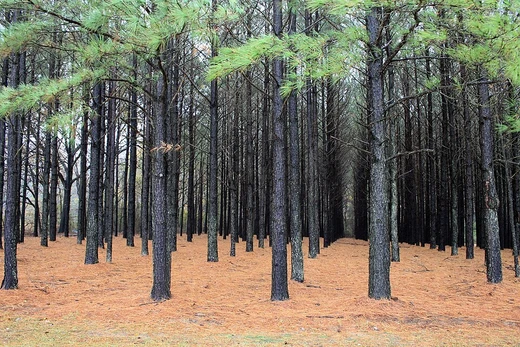
Diospyros
Genus of ebony and persimmon trees, ecologically and commercially important.

Symoum Syfullah Priyo · CC BY-SA 4.0
Diospyros is a large genus made up of more than 700 species of trees and shrubs, both deciduous and evergreen. The plants are usually dioecious, meaning individual trees produce either male or female flowers. Most species grow in tropical regions, where they often play a significant role in their local ecosystems. Those species known for their dense, dark, and heavy wood are called ebony trees, while those grown for their fruit are called persimmon trees.
The genus includes both deciduous and evergreen forms, with male and female flowers on separate plants.
Taxonomically, Diospyros is a sizable group, and the exact number of species varies depending on the source. The Royal Botanic Gardens, Kew lists over 1,000 entries, including synonyms and uncertain identifications, but more than 700 species are considered confidently assigned. The oldest known fossils of the genus come from the Eocene epoch, showing that Diospyros was already widespread across the Northern Hemisphere at that time.
The name Diospyros comes from a Latin term for the Caucasian persimmon (D. lotus), which itself derives from the Greek *dióspyros*—a combination of *diós* (of Zeus) and *pyrós* (wheat). The literal meaning is "Zeus's wheat," but it is generally understood to mean "divine food" or "divine fruit."
Most Diospyros species are native to the tropics, with only a few extending into temperate areas.
In their native habitats, Diospyros trees are important and conspicuous members of many ecosystems, including lowland dry forests in Hawaii, Caspian Hyrcanian mixed forests, various dry deciduous forests in India and Madagascar, rain forests of the Louisiade Archipelago and New Caledonia, New Guinea mangroves, and montane rain forests of the South Western Ghats. The green fruits are avoided by most herbivores, likely because they are rich in tannins, but when ripe, they are eagerly eaten by many animals, such as the rare Aders' duiker in East Africa. The foliage serves as food for the larvae of numerous Lepidoptera species, including several moths and butterflies. An economically significant plant pathogen that infects many Diospyros species is the sac fungus *Pseudocercospora kaki*, which causes a leaf spot disease.
Several Diospyros species are commercially important, either for their edible fruit (persimmons) or for their timber (ebony).
Quick Facts
- Oldest Fossil
- Eocene
- Taxon
- Diospyros
- Type Species
- Diospyros lotus
- Type Species Authority
- L.
- Diversity
- About 750 species
- Diversity Link
- List of Diospyros species
Facts from the source article.
Lore & Background
The genus Diospyros consists of deciduous and evergreen trees and shrubs, with male and female flowers on separate plants. The oldest fossils date to the Eocene, indicating wide distribution over the Northern Hemisphere by that time. The generic name comes from a Latin name for the Caucasian persimmon, derived from Greek meaning 'Zeus's wheat' or 'divine food'.
Reader's Guide
Diospyros species are important and conspicuous trees in many native ecosystems, including lowland dry forests of Hawaii, Caspian Hyrcanian mixed forests, and Madagascar lowland forests. The green fruits are avoided by most herbivores due to high tannin content, but ripe fruits are eaten by many animals, such as the rare Aders' duiker. The foliage serves as food for larvae of numerous Lepidoptera species, including the Luna moth and regal moth. Economically, the genus includes plants valued for edible fruit (persimmons) and timber (ebony). Pure black ebony comes notably from D. ebenum, while striped ebony comes from D. celebica and others. Leaves of some species are used in herbalism, for rolling beedi cigarettes, or for dyeing silk. An economically significant plant pathogen, the sac fungus Pseudocercospora kaki, infects many Diospyros species, causing leaf spot disease.
Did You Know?
- The oldest fossils of Diospyros date to the Eocene.
- The generic name Diospyros literally means 'Zeus's wheat' in Greek.
- The green fruits are rich in tannins and avoided by most herbivores.
- Leaves of Coromandel ebony (D. melanoxylon) are used to roll South Asian beedi cigarettes.
Taxonomy & Deep Time
Diospyros stands as one of the larger genera in the tree world, with more than seven hundred species assigned with high confidence by the Royal Botanic Gardens, Kew. The Kew catalogue actually lists over a thousand entries when synonyms and lower-confidence identifications are included, a testament to how much taxonomic debate still surrounds the group. The members of this genus range from full-sized trees to smaller shrubs, and they may be either deciduous or evergreen. A defining botanical trait is that most species are dioecious, meaning a single plant bears either male or female flowers rather than both. The evolutionary story stretches remarkably far back. The oldest known fossils of Diospyros date to the Eocene epoch, and the geographic spread recorded in those fossils reveals that by that ancient period the genus was already widely distributed across the Northern Hemisphere. Today, the vast majority of species are native to tropical regions, with only a handful extending into temperate climates. This combination of enormous species richness, ancient lineage, and broad tropical dominance makes Diospyros a cornerstone of understanding how tree genera diversify over deep time.
Ecological Web & Interactions
Within their native ranges, Diospyros species are not merely present but conspicuous and ecologically central. They anchor forests across an astonishing array of biomes: the lowland dry forests of former Maui Nui in Hawaii, the Caspian Hyrcanian mixed forests, the Khathiar–Gir dry deciduous forests of India, rain forests of the Louisiade Archipelago, Madagascar's lowland forests, the Narmada Valley dry deciduous forests, New Caledonian sclerophytic vegetation, New Guinea mangroves, and the South Western Ghats montane rain forests. The genus weaves itself deeply into food webs. Unripe green fruits are rich in tannins and are shunned by most herbivores, but once ripe they become eagerly consumed by a wide range of animals, including the rare Aders' duiker of East Africa. The foliage serves as larval food for an impressive roster of Lepidoptera spanning at least seven families, from the Luna moth and promethea silkmoth of Saturniidae to the Quaker butterfly of Lycaenidae. On the other hand, the sac fungus Pseudocercospora kaki poses a significant threat, causing leaf spot disease in multiple species including American persimmon, date-plum, and Coromandel ebony.
Timber, Medicine & Industry
The commercial value of Diospyros spans two very different trades. In the timber world, species prized for their hard, heavy, dark wood are known as ebony trees. Trade divides these into pure black ebony, notably from D. ebenum, and striped ebony or calamander wood, sourced from D. celebica, D. mun, and others. Most of the genus, however, produces little to no true black ebony; the hard timber of species like American persimmon (D. virginiana) finds more limited applications. On the medicinal and industrial side, the genus is equally remarkable. Leaves of D. blancoi contain isoarborinol methyl ether and fatty esters of α- and β-amyrin, all of which demonstrated antimicrobial activity against pathogens including E. coli, P. aeruginosa, Candida albicans, Staphylococcus aureus, and Trichophyton interdigitale, with the amyrin mixture also showing anti-inflammatory and analgesic effects. D. leucomelas yields betulinic acid, a versatile medical compound, while extracts from Diospyros plants have been proposed as novel anti-viral treatments. In Vietnam, D. mollis, known locally as mặc nưa, is used to dye the famous black lãnh Mỹ A silk of Tân Châu district, and in South Asia, leaves of Coromandel ebony are rolled into beedi cigarettes.
Cultural Reverence & the Name 'Divine Fruit'
The very name Diospyros carries a mythic weight. Derived from the Greek dióspyros—a compound of diós (of Zeus) and pyrós (wheat)—the literal translation is 'Zeus's wheat,' though the broader sense is 'divine food' or 'divine fruit.' That reverence for the genus in its native range is not merely linguistic; it is embedded in the political and cultural identity of numerous regions. In Indonesia, D. celebica, the Makassar ebony known locally as eboni, serves as the provincial tree of Central Sulawesi, while D. macrophylla, called ajan kelicung, holds the same distinction in West Nusa Tenggara. In Japan, the Yaeyama kokutan (D. ferrea) is the official emblem of the island of Ishigaki. Across Thailand, three different provinces have chosen Diospyros as their floral symbol: the Gold apple (D. decandra) represents both Chanthaburi and Nakhon Pathom, while the black-and-white ebony (D. malabarica) is the emblem of Ang Thong. In Vietnam, the Gold apple, known as 'Trái thị,' features in the beloved Tấm Cám fable. Even place-names carry the imprint: the Thai district of Amphoe Tha Tako translates literally as 'District of the Diospyros pier,' a nod to a local gathering spot built around the tree.
Gallery
Frequently Asked Questions
What is Diospyros?
Diospyros is a massive genus of tropical trees and shrubs that includes both the famous ebony timber species and the persimmon fruit species. It spans over 700 recognized species in both evergreen and deciduous growth forms, making it one of the largest genera in the plant world.
How many species are in the Diospyros genus?
Botanists have confirmed more than 700 distinct species within Diospyros, and the total number of catalog entries including synonyms pushes past 1,000. Its oldest fossil record dates back to the Eocene epoch.
What's the difference between ebony and persimmon trees?
Both are members of the same Diospyros genus, but they are set apart by their primary value to humans: ebony species are harvested for their extremely dense, dark hardwood, while persimmon species are grown for their sweet, edible fruit.
How do Diospyros trees reproduce?
Most species in this genus are dioecious, meaning an individual tree produces either only male flowers or only female flowers, never both. Successful fruiting therefore typically requires a compatible male tree growing nearby to provide pollen.
Why is Diospyros important to tropical ecosystems?
As a dominant genus across tropical regions, Diospyros provides critical habitat, food, and structural diversity for countless animal species. Its dense, heavy wood also makes it a cornerstone of traditional and modern timber industries worldwide.
More in Trees & Timber 1-19
Spotted an error? Know more?
Reader corrections go straight into our review queue. Suggest an edit · How this site is sourced