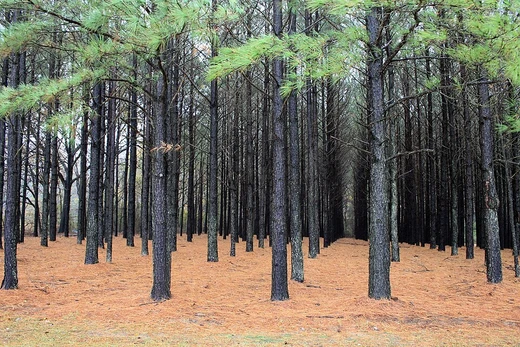
Conifer
Woody, cone-bearing plants dominant in northern forests.

Quincy Morgan · CC0
Conifers are a group of vascular plants and a subset of gymnosperms, comprising woody trees and shrubs that are mostly evergreen with a regular branching pattern. They reproduce with male and female cones, usually on the same tree, are wind-pollinated, and their seeds are typically dispersed by wind. Taxonomically, they form the division Pinophyta, also known as Coniferae, with over 600 living species. Conifers first appear in the fossil record over 300 million years ago in the Carboniferous, became dominant land plants in the Mesozoic, and many today are relict species surviving in small parts of their former ranges.
Quick Facts
- Taxon
- Pinopsida
Facts from the source article.
Lore & Background
Conifers are woody plants, mostly trees with narrow, often needle-shaped leaves. They produce separate male and female cones, with pollination always by wind. The seeds are mostly winged samaras, and the trees have a regular branching pattern. Many conifers have distinctly scented resin. The world's tallest living tree is a coast redwood (Sequoia sempervirens) at 115.92 metres, and the oldest non-clonal living tree is a Great Basin bristlecone pine (Pinus longaeva) at 4,800 years old. Among the smallest is the pygmy pine (Lepidothamnus laxifolius) of New Zealand, seldom taller than 30 cm when mature.
Most conifers are evergreen, retaining foliage for 2–40 years, though five genera (Larix, Pseudolarix, Glyptostrobus, Metasequoia, and Taxodium) are deciduous. Leaves are often dark green, but some species have yellower or blue/silvery leaves. Conifer wood consists mainly of tracheids and produces growth rings. They secrete oleoresin, a composite of turpentine and rosin, which flows into wounds to trap insects and block fungi. Conifers reproduce via cones; most species are monoecious. Seeds are often wind-dispersed, but some are dispersed by birds or released after fire.
Reader's Guide
Conifers are ecologically important despite their relatively small number of species. They dominate the taiga of the Northern Hemisphere, with boreal conifers possessing adaptations such as a conical shape to shed snow, strong tracheid vessels to tolerate ice pressure, and waxy needle leaves to minimize water loss. Many fungi form ectomycorrhizal associations with conifers, while others cause diseases like needle cast. Pest insects include wood-boring longhorn beetles and bark beetles. As of 2025, 94 conifer species are listed as endangered and 30 as critically endangered. Conifers are of great economic value for timber and paper production. Their microscopic wood structure is homogeneous, with tracheids making up over 90% of timber volume. Conifers also produce oleoresin used by the Gitxsan as fire starters during wet weather. The group includes relict species such as Wollemia, known only from a small area of New South Wales, Australia, and Metasequoia glyptostroboides, known from Cretaceous fossils and surviving in a small area of China.
Ancient Lineage and Relict Survivors
Conifers represent one of the oldest continuously living lineages of vascular plants on Earth. Their earliest fossils date back more than 300 million years to the Carboniferous period, and by the Mesozoic era they had become the dominant land plants across vast continents. That supremacy was gradually eroded during the Cretaceous as flowering plants colonized many of the ecosystems conifers had long occupied. Today, over 600 living species make up the division Pinophyta (also called Coniferae), and with the exception of the gnetophytes, all extant members are perennials capable of secondary growth. Perhaps the most poignant legacy of their ancient dominance is the existence of relict species—conifers that once ranged widely but now persist in tiny fragments of their former territory. Wollemia, found only in a small stretch of New South Wales in Australia, and Metasequoia glyptostroboides, documented in Cretaceous fossils yet surviving in a limited area of China, stand as living reminders of a world when conifers ruled the landscape.
Form, Foliage, and the Spectrum of Size
Conifers are woody plants—mostly trees, though shrubs exist—characterized by a regular branching architecture and narrow foliage. In pines, firs, and cedars the leaves are long, thin needles, while cypresses bear flat, triangular scale-like leaves. Most species arrange their leaves spirally, though members of Cupressaceae and one genus in Podocarpaceae place them in opposite pairs or whorls. In species like Abies grandis, the leaf bases twist so that the foliage presents a flat plane, maximizing light capture. Leaf dimensions span an extraordinary range: from 2 mm scales to 600 mm needles in longleaf and ponderosa pines. Color varies with environment—dark green in shaded or high-latitude settings, yellowish-green in high-sun species like Turkish pine, and blue or silvery in Picea pungens to reflect ultraviolet radiation. Most conifers are evergreen, retaining functional leaves for two to forty years, but five genera (Larix, Pseudolarix, Glyptostrobus, Metasequoia, Taxodium) are deciduous. The size spectrum is equally dramatic: the coast redwood reaches 116.07 metres, while New Zealand's pygmy pine rarely exceeds 30 cm at maturity.
The Architecture of Conifer Wood
At the microscopic level, conifer wood is remarkably homogeneous, composed of just two cell types: oval or polyhedral parenchyma cells and strongly elongated tracheids. Tracheids account for more than 90 percent of the timber volume, giving conifer wood its structural character. Each annual growth ring follows a consistent internal pattern: earlywood tracheids are radially large with thin cell walls, a transition zone shows rapid change in both dimensions, and latewood tracheids are radially small with notably thicker walls. In Taxus, Juniperus, and Cupressaceae the ring outlines become undulating rather than gently curved, and frost rings have been documented in Cupressaceae. Medullary rays, built mainly of parenchyma, handle radial gas exchange and serve as conduits for water and nutrient storage. Latewood also houses resin canals lined by specialized epithelial cells that secrete oleoresin—a blend of turpentine and rosin. When an insect or fungus breaches the bark, this resin floods the wound, trapping invaders and hardening into a protective seal. Beyond biology, conifer wood underpins global timber and paper industries, and the Gitxsan people harvest rosin during wet weather as a practical fire-starting material.
Boreal Dominance and Modern Vulnerability
Conifers are the defining plants of the Northern Hemisphere taiga, and their success in cold climates rests on a suite of specialized adaptations. The characteristic conical crown sheds snow efficiently, robust tracheid vessels resist the pressure of ice, and a waxy coating on needle-shaped leaves minimizes water loss during long winters. Pollination is exclusively wind-driven, and the resulting seeds—often winged samaras—are likewise dispersed by air currents, with male and female cones typically borne on the same tree. Ecologically, conifers support extensive fungal networks: many species form ectomycorrhizal partnerships that enhance nutrient uptake, while other fungi cause diseases like needle cast, which is particularly damaging to young trees. Insect threats include wood-boring longhorn beetles and bark beetles that tunnel galleries just beneath the bark. Despite their ecological importance and economic value, conifers face serious conservation challenges. As of 2025, 94 species are classified as endangered and 30 as critically endangered, underscoring that even a lineage this ancient and widespread is not immune to decline.
Gallery





Frequently Asked Questions
What is a conifer?
A conifer is a woody, cone-bearing plant that belongs to the division Pinophyta (also called Coniferae). Most are evergreen trees or shrubs with a regular branching pattern, and the group encompasses over 600 living species.
How do conifers reproduce?
Conifers bear separate male and female cones, usually on the same individual tree, and depend on wind to carry pollen between them. Their seeds are likewise typically dispersed by wind rather than by animals.
What is the tallest conifer species?
The coast redwood (Sequoia sempervirens) holds the record at 116.07 metres tall. It grows along the Pacific coast of North America and is a member of the conifer group.
How far back do conifers go in the fossil record?
Conifer fossils date to more than 300 million years ago, in the Carboniferous period. They subsequently became the dominant land plants throughout the Mesozoic era.
Why are conifers important?
Conifers form the backbone of the taiga (boreal) forests and are the primary source of timber and paper worldwide. They also include the oldest non-clonal living tree, the Great Basin bristlecone pine at roughly 4,700 years old.
More in Trees & Timber 1-19
Spotted an error? Know more?
Reader corrections go straight into our review queue. Suggest an edit · How this site is sourced