Ford Sierra
Aerodynamic family car that replaced the Cortina and Taunus.

Calreyn88 · CC BY-SA 4.0
The Ford Sierra is a mid-size/large family car manufactured and marketed by Ford of Europe from 1982 to 1993. It was noted for its aerodynamic styling, designed by Uwe Bahnsen, Robert Lutz and Patrick Le Quément, which produced a drag coefficient of 0.34, a significant improvement over its predecessors. The Sierra debuted at the 1982 British International Motor Show and later at the 1982 Paris Salon de l'Automobile, replacing the Ford Taunus TC3 and Ford Cortina Mark V.
Quick Facts
- Aka
- Merkur XR4Ti (North America, 1985–1989) / Ford Sapphire (sedan, South Africa, 1990–1993)
- Manufacturer
- Ford Europe
- Production
- 1982–1993
- Designer
- Uwe Bahnsen / Bob Lutz / Patrick le Quément
- Class
- Mid-size car/Large family car (D)
- Related
- Ford Scorpio / Ford P100 / Merkur XR4Ti
- Layout
- Front-engine, rear-wheel drive / four-wheel drive
- Transmission
- 3-speed automatic / 4-speed automatic / 4-speed manual / 5-speed manual
- Wheelbase
- 2609 mm
- Length
- 4531 mm
- Height
- 1367 mm
- Predecessor
- Ford Cortina Mark V / Ford Taunus TC3
Facts from the source article.
Lore & Background
Developed under the internal code name 'Project Toni', the Sierra name derives from the Spanish word for a mountain range. Its aerodynamic styling and the initial absence of a saloon alienated many conservative buyers, including company car drivers. Early versions suffered from crosswind stability problems, addressed in 1985 with the addition of aerodynamic spoilers on the rear edge of the rubber seals of the rearmost side windows. These shortcomings saw press attention and contributed to early slow sales, when it was outsold by its key rival the Vauxhall Cavalier in 1984 and 1985. Rumours that the car's design could hide major crash damage also harmed its reputation, reaching near-hysterical levels in its early months on sale, with UK press reporting that Ford would reintroduce the Cortina out of desperation—reports swiftly denied by Ford. Sales began to rise during 1983, and it finished as Britain's second best selling car behind the Escort. After being outsold by the Cavalier for the next two years, it regained its lead of the market sector in Britain during 1986. A refreshed range with more engine options and the introduction of a saloon (Sapphire) in 1987 enjoyed a surge in sales, though the MK3 Cavalier finally outsold it in 1990. Even in 1992, the Sierra was still Britain's fifth best selling car. It was nicknamed 'the salesman's spaceship' on account of its status as a popular fleet car in Britain.
Reader's Guide
The Ford Sierra's significance lies in its aerodynamic design, which marked a departure from the boxy styling of its predecessors and influenced later Ford models. Despite initial resistance from conservative buyers and early crosswind stability issues, the Sierra became a strong seller in Britain, achieving second best selling car status in 1983, 1988 and 1989, and remaining among the top five sellers as late as 1992. Its styling aged well; ten years after introduction, it was not nearly as outdated as its contemporaries, even though all major competitors were newer designs. The Sierra's drivetrain was conservatively engineered, retaining rear-wheel drive and engines from the Cortina/Taunus, partly to appease the fleet market. The chassis was more sophisticated, with fully independent suspension on both axles. The Sierra faced competition from the Vauxhall Cavalier, Austin Montego, Renault 21, Peugeot 405, and Nissan Bluebird. Its legacy includes being a popular fleet car and a key model in Ford's European lineup until its replacement.
Did You Know?
- The Sierra's drag coefficient of 0.34 was a significant improvement over the outgoing Cortina/Taunus's 0.45.
- The Sierra was nicknamed 'the jellymould' due to its rounded styling.
- Early Sierras lacked a saloon body style, which was added only in 1987 as the Sapphire.
- The Sierra's name comes from the Spanish word for a mountain range.
The Vision That Rescued Ford's Racing Soul
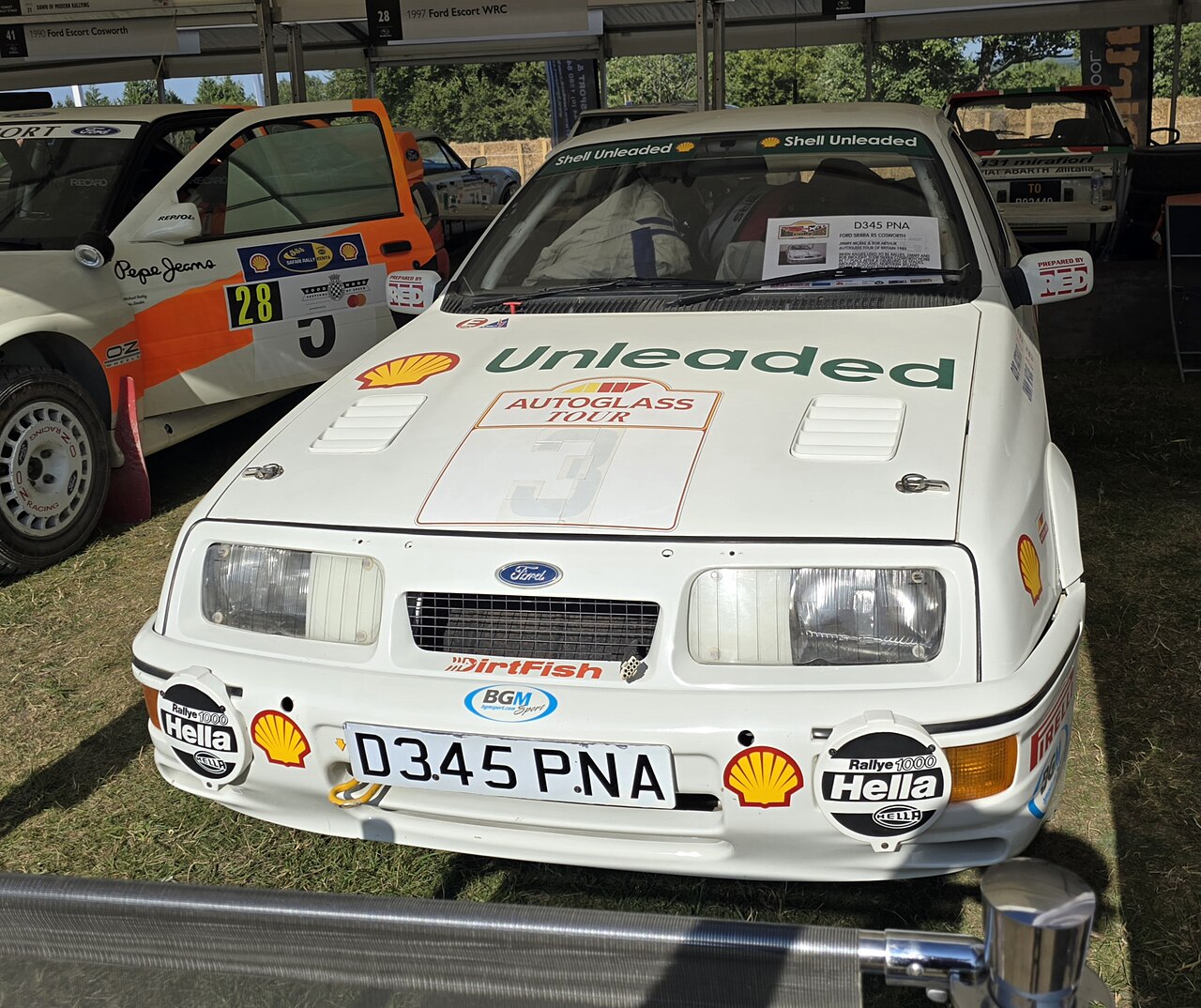
Stuart Turner arrived at the helm of Ford Motorsport in Europe in the spring of 1983 with an uncomfortable truth: the brand had lost its competitive edge on the continent. Determined to reverse that slide, he set his sights on Group A touring car racing and began assembling the political capital needed to make it happen. His key ally was Walter Hayes, then vice-president of public relations, a man whose earlier career had been inseparable from Ford's greatest motorsport triumphs—the GT40's 1966 Le Mans victory and the Cosworth DFV engine's 154 Formula One wins and 12 world titles across the 1960s and 1970s. Hayes found the Sierra project deeply appealing and pledged his full backing. Together, Turner and Hayes transformed a modest performance car into a strategic weapon, ensuring that Ford's racing heritage would not fade into obscurity but instead be reasserted on European circuits with a purpose-built, outright contender.
Forging the Powertrain and Chassis
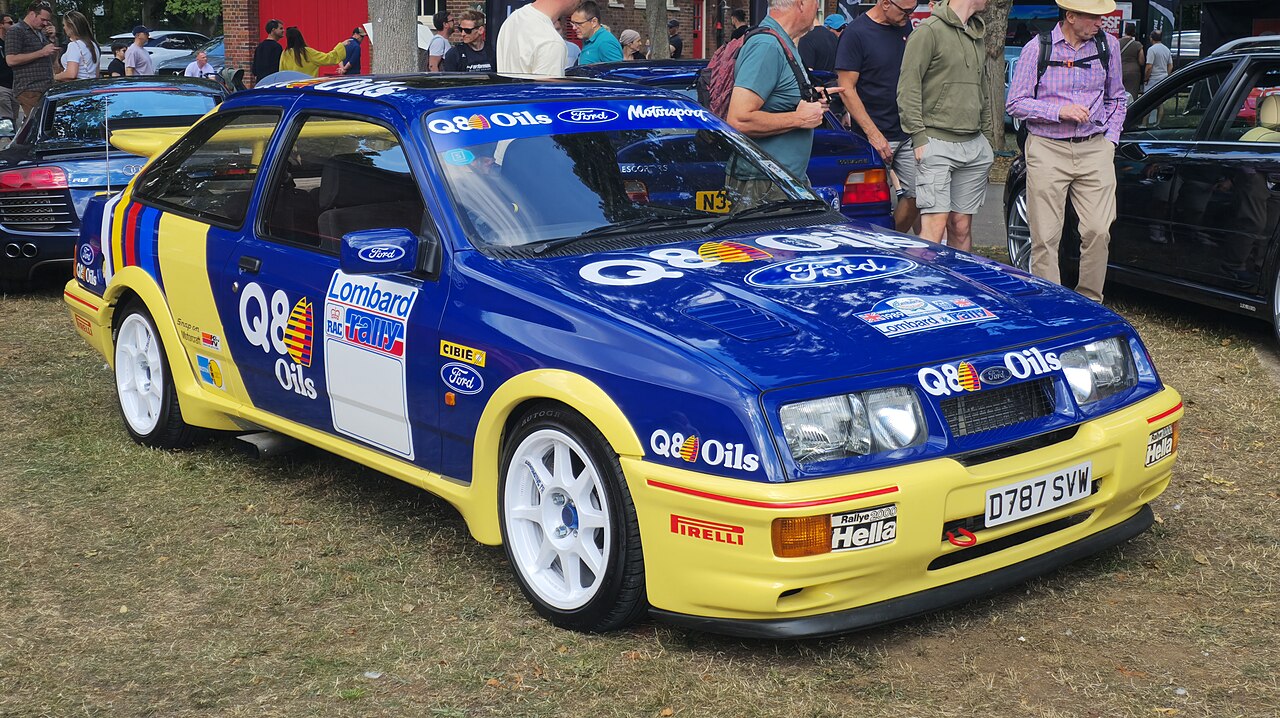
The heart of the Sierra RS Cosworth was the Cosworth YBB turbocharged engine, a 16-valve twin-cam unit built on the familiar T88 block that powered the Pinto. Turner's original request called for 180 HP in street trim and 300 HP in race specification, but Cosworth negotiated their own terms: a minimum of 204 HP for the road car and a commitment to 15,000 units, far exceeding the roughly 5,000 the project actually required. Ford accepted, a decision that later justified developing a four-door variant. The transmission presented its own headaches; the Borg-Warner T5 gearbox, shared with the Mustang, struggled with the Sierra's higher rev range until Borg-Warner dedicated an entire production line to Cosworth-specific units. Suspension tuning drew heavily on lessons from the turbocharged Merkur XR4Ti campaigned by Jack Roush in IMSA and Andy Rouse's 1985 British Saloon Car Championship, with components like the 909 chassis stiffening plates and a boost-gauge speedometer crossing directly from the American program into the European car.
Aerodynamics, Compromise, and the Road to Production
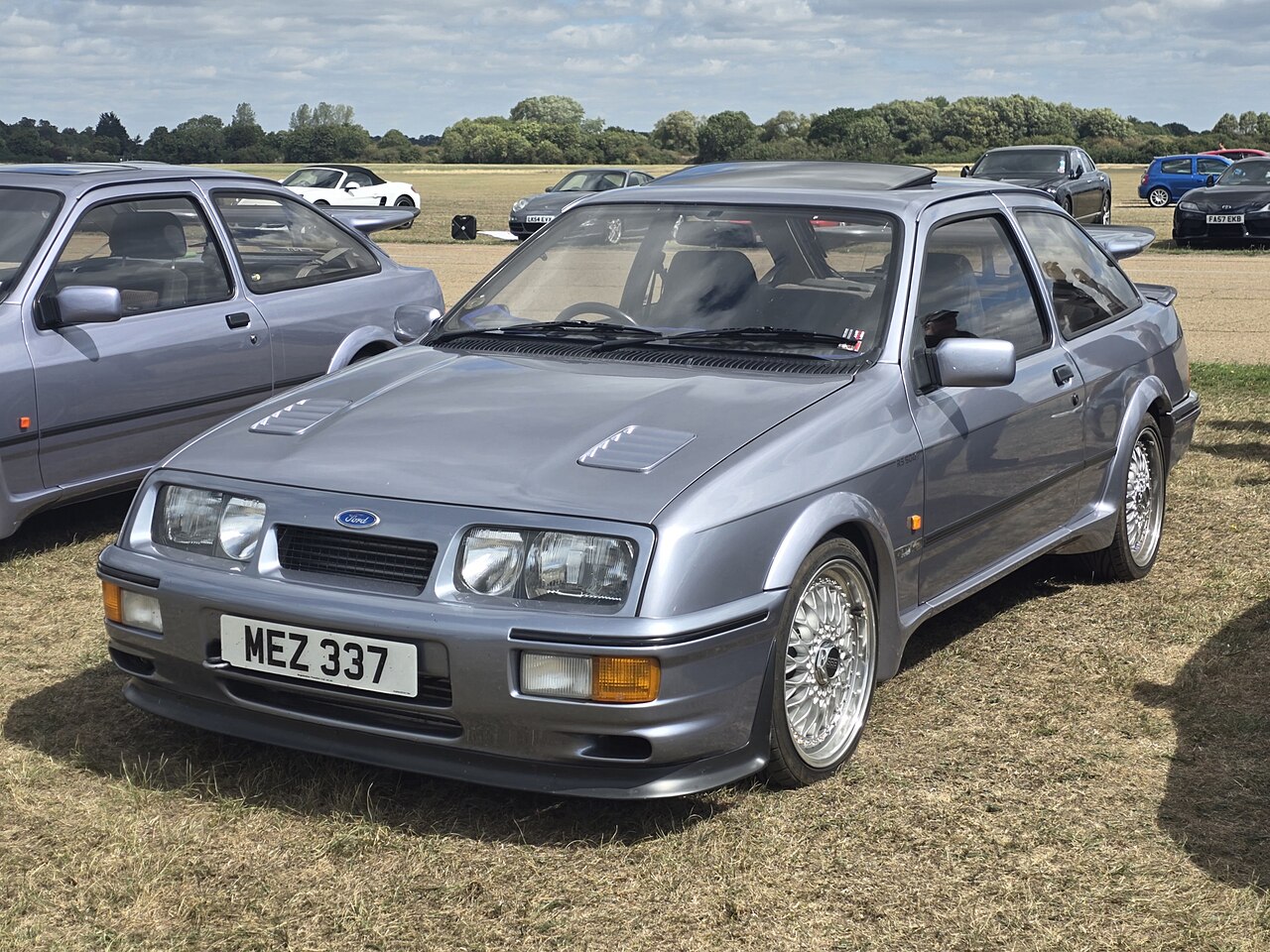
Lothar Pinske, tasked with the bodywork, demanded complete creative freedom to ensure the car remained stable at velocity. Wind tunnel sessions and test runs at Italy's Nardò circuit confirmed his concerns: the standard Sierra hatchback generated troubling aerodynamic lift even at moderate speeds. His solution—a large rear wing, an intercooler air intake carved between the headlights, and widened wheel arches to accommodate ten-inch racing wheels—initially met resistance from Ford's design team, who found the appearance uninspiring. Pinske held firm, arguing the modifications were non-negotiable for maintaining ground contact at 300 km/h. Eventually, designers agreed to translate the prototype into a production form. The car debuted at the Geneva Motor Show in March 1985, though actual sales did not begin until July 1986. To keep pricing competitive, Ford stripped the specification to three exterior colours, a single grey interior, and just two optional packages. All 5,545 units rolled off the line at Ford's Genk plant in Belgium between summer 1986 and December of that year, with 500 destined for Tickford's RS500 conversion.
Performance Credentials and a Rehabilitated Name
When the Sierra RS Cosworth finally reached customers, its published figures spoke to a genuine performance leap: a top speed of 149 mph, a 0-to-60 mph sprint completed in 6.5 seconds, and a drag coefficient of 0.345. The rear spoiler generated 20 kgf of downforce at 150 mph, and the front brakes featured 28.3-inch discs. These numbers were not merely marketing garnish; they were the direct result of the engineering compromises and racing-derived components described earlier. More broadly, the project served a reputational purpose. The Sierra name had suffered since its 1982 introduction, earning a somewhat undeserved poor public image. Turner's team had explicitly chosen the platform in part to use a competitive racing version as a vehicle for rehabilitation. The Cosworth badge, the turbocharged engine with its Formula One pedigree, and the car's outright Group A ambitions collectively repositioned the Sierra in the public mind from a mundane estate car to a serious performance machine, linking it to the same lineage of engineering excellence that had produced the GT40 and the DFV.
Gallery
More in Touring Cars 1-24
Spotted an error? Know more?
Reader corrections go straight into our review queue. Suggest an edit · How this site is sourced