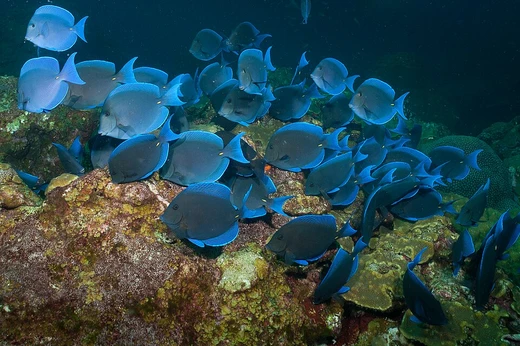
Whitemargin unicornfish
One of the largest surgeonfish, reaching 100 cm.

The whitemargin unicornfish, also called the ringtailed unicornfish or short-horned unicorn-fish, is a tropical species living across the Indo-Pacific. It grows up to 100 cm long, which makes it one of the biggest fish in the Acanthuridae family.
This fish was first scientifically described in 1825 by French naturalists Jean René Constant Quoy and Joseph Paul Gaimard, who named it *Priodon annulatus* based on a specimen from Timor Island. It belongs to the nominate subgenus of the genus *Naso*, which itself sits in the subfamily Nasinae within the family Acanthuridae.
The dorsal fin has 5 spines and 28 or 29 soft rays, while the anal fin has 2 spines and 27 or 28 soft rays. The body’s standard length is 2.2 to 3 times its depth, with adults being deepest. A long, horizontal, tapering bony bump sticks out in front of the eyes; this bump starts as a small protrusion in fish shorter than 20 cm. The angle between the snout and this protuberance is about 60°. On each side of the caudal peduncle are two bony plates, which in adults develop into blade-like keels. The tail fin is straight-edged in juveniles but becomes scalloped in adults, and males grow long filaments from the tips of the tail lobes. The body is bluish-grey or bluish-brown, lighter on the underside, with no dark markings. The lips are white. Juveniles and subadults have a clear white band on the caudal peduncle and a white edge on the tail fin. As they mature, a black submarginal band appears on the tail fin, while a thin white margin and tail filaments remain. Reaching a maximum total length of 100 cm, this is the largest species in the genus *Naso* and one of the largest among all acanthurids.
The whitemargin unicornfish ranges widely across the Indo-Pacific, from the Red Sea and eastern Africa to Cocos Island off Costa Rica. Juveniles live in shallow, clear water on lagoon reefs, as shallow as 1 meter, but adults are rarely seen above 25 meters deep, preferring the outer drop-offs of reefs.
These fish gather in small schools. Juveniles eat filamentous green algae, while adults longer than 20 cm switch to soft zooplankton like ctenophores and jellyfish. Males and females pair up to spawn.
People catch this fish for food, and it sometimes ends up in the aquarium trade.
Quick Facts
- Genus
- Naso
- Parent
- Naso (Naso)
- Species
- annulatus
Facts from the source article.
Lore & Background
The whitemargin unicornfish was first formally described in 1825 as Priodon annulatus by the French naturalists Jean René Constant Quoy and Joseph Paul Gaimard, with its type locality given as Timor Island. It is classified within the nominate subgenus of the genus Naso, which is placed in the subfamily Nasinae of the family Acanthuridae. The species has a long, horizontal, tapering bony protuberance in front of the eyes, which starts as a bump in individuals with a total length of less than 20 cm. The caudal peduncle has two bony plates on each side, and in adults these develop blade-like keels. The caudal fin is truncate in juveniles but becomes scalloped in adults, and males develop long filaments from the tips of the lobes. The background colour is bluish-grey or bluish-brown, paler on the lower body, with white lips. Juveniles and subadults have a clear white band on the caudal peduncle and a white edge to the caudal fin; adults develop a black submarginal band in the caudal fin while retaining a thin white margin and tail filaments.
Reader's Guide
The whitemargin unicornfish is notable as one of the largest species in the genus Naso and one of the largest of all Acanthurids, reaching a maximum total length of 100 cm. Its distribution spans the Indo-Pacific from the Red Sea and eastern coasts of Africa east to Cocos Island, part of Costa Rica. Juveniles inhabit shallow, clear water on reefs in lagoons as shallow as 1 m, while adults are infrequently encountered at depths of less than 25 m off outer reef drop-offs. The species forms small schools. Juveniles feed on filamentous green algae, but adults with total lengths greater than 20 cm change diet to feed on soft zooplankton such as ctenophores and jellyfish. Males and females form pairs to spawn. The whitemargin unicornfish is collected for food and is sometimes taken into the aquarium trade. Its distinctive bony protuberance, white lips, and the white band on the caudal peduncle in younger individuals are key identifying features.
Did You Know?
- Adults change diet from filamentous green algae to soft zooplankton like ctenophores and jellyfish.
- The bony protuberance in front of the eyes starts as a bump in fish under 20 cm total length.
More in Tangs and Surgeonfish 1-24
Spotted an error? Know more?
Reader corrections go straight into our review queue. Suggest an edit · How this site is sourced