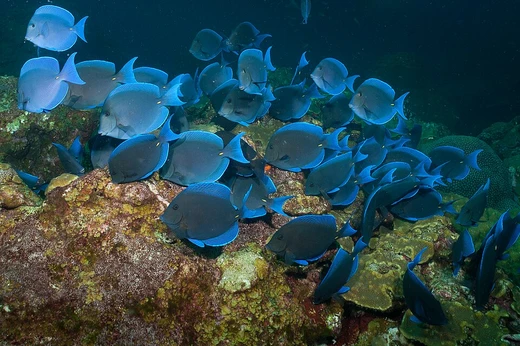
Naso annulatus
One of the largest surgeonfishes, reaching 100 cm total length.

The whitemargin unicornfish, also called the ringtailed or short-horned unicornfish, lives in tropical waters across the Indo-Pacific. It grows up to 100 centimeters long, placing it among the biggest fish in the Acanthuridae family.
French naturalists Jean René Constant Quoy and Joseph Paul Gaimard first described this species in 1825, naming it *Priodon annulatus* based on a specimen from Timor Island. It belongs to the nominate subgenus of the genus *Naso*, within the subfamily Nasinae of the family Acanthuridae.
The dorsal fin has 5 spines and 28 or 29 soft rays, while the anal fin has 2 spines and 27 or 28 soft rays. The body’s standard length is 2.2 to 3 times its depth, with adults being deepest. A long, tapering, horizontal bony bump sits in front of the eyes; in fish under 20 centimeters long, this starts as a small lump. The angle between the snout and this protuberance is about 60 degrees. The caudal peduncle has two bony plates on each side, which in adults develop into blade-like keels. The tail fin is straight across in juveniles but becomes scalloped in adults, and males grow long filaments from the tips of the tail lobes. Body color is bluish-gray or bluish-brown, lighter on the underside, with no dark markings. The lips are white. Juveniles and subadults have a clear white band on the caudal peduncle and a white edge on the tail fin. As adults grow, a black band appears near the tail fin’s edge, while a thin white margin and tail filaments remain. At a maximum total length of 100 centimeters, it is the largest species in the genus *Naso* and one of the largest acanthurids.
This fish has a wide Indo-Pacific range, from the Red Sea and eastern African coast east to Cocos Island off Costa Rica. Juveniles live in shallow, clear water on lagoon reefs, as shallow as 1 meter, but adults are rarely seen above 25 meters, staying near outer reef drop-offs.
The whitemargin unicornfish forms small schools. Juveniles eat filamentous green algae, while adults over 20 centimeters switch to soft zooplankton like ctenophores and jellyfish. Males and females pair up to spawn.
People catch this fish for food and sometimes keep it in aquariums.
Quick Facts
- Genus
- Naso
- Parent
- Naso (Naso)
- Species
- annulatus
Facts from the source article.
Lore & Background
The whitemargin unicornfish was first formally described in 1825 as Priodon annulatus by the French naturalists Jean René Constant Quoy and Joseph Paul Gaimard, with its type locality given as Timor Island. It is classified within the nominate subgenus of the genus Naso, which is placed in the subfamily Nasinae of the family Acanthuridae. The species has a long, horizontal, tapering bony protuberance in front of the eyes, which starts as a bump in individuals with a total length of less than 20 cm. The caudal peduncle bears two bony plates on each side; in adults these develop blade-like keels. The caudal fin is truncate in juveniles but becomes scalloped in adults, and males develop long filaments from the tips of the lobes. The background colour is bluish-grey or bluish-brown, paler on the lower body, with white lips. Juveniles and subadults have a clear white band on the caudal peduncle and a white edge to the caudal fin; adults develop a black submarginal band in the caudal fin while retaining a thin white margin and tail filaments.
Reader's Guide
The whitemargin unicornfish is notable as one of the largest species in the genus Naso and one of the largest of all Acanthuridae, reaching a maximum total length of 100 cm. It has a wide distribution across the Indo-Pacific, from the Red Sea and eastern coasts of Africa east to Cocos Island, part of Costa Rica. Juveniles inhabit shallow, clear water on reefs in lagoons as shallow as 1 m, while adults are infrequently encountered at depths of less than 25 m off the outer drop-offs of reefs. The species forms small schools. Juveniles feed on filamentous green algae, but adults with total lengths greater than 20 cm change diet to feed on soft zooplankton such as ctenophores and jellyfish. Males and females form pairs to spawn. The whitemargin unicornfish is collected for food and is sometimes taken into the aquarium trade.
Did You Know?
- The whitemargin unicornfish was first described in 1825 as Priodon annulatus by Quoy and Gaimard.
- It can reach a total length of 100 cm, making it one of the largest members of the family Acanthuridae.
- Adults change diet from filamentous green algae to soft zooplankton such as ctenophores and jellyfish.
Taxonomic Placement & Nomenclature
The whitemargin unicornfish belongs to the family Acanthuridae, a group of ray-finned marine fishes that encompasses surgeonfishes, tangs, and unicornfishes. The family name itself is a direct nod to the fish's most iconic feature, derived from two Ancient Greek words: ákantha, meaning "spine," and ourá, meaning "tail." This etymology points to the scalpel-like bony plates found on the caudal peduncle of the type species. In the early twentieth century, this family went by a different name, Hepatidae, before the current classification took hold. Within Acanthuridae, Naso annulatus sits in the subfamily Nasinae, described by Fowler and Bean in 1929, under the genus Naso first named by Lacépède in 1801. The broader family contains roughly 86 extant species distributed across tropical seas, typically associated with coral reef environments. The family is further divided into the subfamily Acanthurinae, which houses several tribes including Acanthurini, Prionurini, and Zebrasomini, each with their own distinct genera.
Physical Form & Growth
Naso annulatus stands out as the largest member of the entire Acanthuridae family, capable of reaching a length of up to one meter. Most other surgeonfishes, tangs, and unicornfishes top out between fifteen and forty centimeters, making the whitemargin unicornfish a remarkable outlier in size. Like all members of its family, it bears one or more scalpel-like modified scales on either side of the tail peduncle—structures that are dangerously sharp and can inflict serious injury on anyone who handles the fish carelessly. The dorsal, anal, and caudal fins are large and span most of the body's length, while the mouth is small with a single row of teeth adapted specifically for grazing on algae. A particularly striking aspect of its life cycle is the larval stage, called an acronurus, which appears almost unrecognizable compared to the juvenile and adult. The acronurus is largely transparent and lives a pelagic existence in open water for an extended period before settling near the shore to develop into its familiar adult form. In captivity, these fishes can grow rapidly, so prospective aquarists are advised to research average adult size and tank suitability before committing to keeping one.
Feeding Ecology & Symbiosis
In the wild, Naso annulatus and its relatives are primarily algae grazers, using their small mouths and single row of specialized teeth to scrape algal growth from coral reef substrates. While some individuals feed as solitary foragers, the family frequently travels and feeds in schools. This group-feeding strategy is thought to serve a specific ecological purpose: by presenting a large mass of grazers simultaneously, the fish can overwhelm the aggressive territorial defense of small damselfishes, which vigorously guard tiny patches of algae on the reef. Beyond simple grazing, acanthurids harbor a unique biological partnership. They are the only known hosts of bacteria belonging to the genus Epulopiscium, which colonize their digestive system and play a critical role in breaking down the algae that form the bulk of their diet. This symbiotic relationship underscores how the surgeonfish's digestive biology is not purely a product of its own anatomy but is co-dependent on microbial partners. In tropical seas, where the family's roughly 86 extant species thrive around coral reefs, this combination of grazing behavior, schooling strategy, and bacterial symbiosis creates a tightly integrated ecological niche.
Deep Fossil Heritage
The Acanthuridae family possesses one of the most extensive fossil records among marine fish families, with extinct genera stretching back to the Eocene epoch. The Monte Bolca Lagerstätte in Italy has yielded an exceptionally rich assemblage of fossil surgeonfishes, representing some of the earliest known representatives of the individual tribes within the family. From the Eocene alone, more than a dozen extinct genera have been described, including Acanthuroides, Eorandallius, Metacanthurus, Proacanthurus, and Protozebrasoma, among others. The Oligocene record adds further diversity with genera such as Arambourgthurus, Caprovesposus, and Glarithurus, while the Miocene contributes at least one known genus, Marosichthys. This deep temporal span—stretching from the Eocene through the Miocene—demonstrates that the basic body plan of surgeonfishes, tangs, and unicornfishes has remained remarkably stable over tens of millions of years. The fact that the whitemargin unicornfish today occupies the same general ecological role as its ancient Eocene ancestors highlights the evolutionary conservatism of this lineage, with the scalpel-like tail spines and algal-grazing dentition persisting as defining features across the entire fossil record.
Frequently Asked Questions
What is Naso annulatus?
Naso annulatus, commonly called the whitemargin unicornfish or ringtailed unicornfish, is a large surgeonfish native to tropical Indo-Pacific waters. It sits within the subfamily Nasinae of the family Acanthuridae.
How large does Naso annulatus grow?
This species can reach a total length of 100 centimeters, which places it among the biggest fish in the entire Acanthuridae family.
Where is Naso annulatus found?
It inhabits tropical waters across the broad Indo-Pacific region.
Who first described Naso annulatus and when?
French naturalists Jean René Constant Quoy and Joseph Paul Gaimard published the original description in 1825, naming it Priodon annulatus after examining a specimen from Timor Island.
What does Naso annulatus's fin structure look like?
The dorsal fin bears 5 spines and 28 or 29 soft rays, while the anal fin carries 2 spines paired with 27 or 28 soft rays.
More in Tangs and Surgeonfish 1-24
Spotted an error? Know more?
Reader corrections go straight into our review queue. Suggest an edit · How this site is sourced