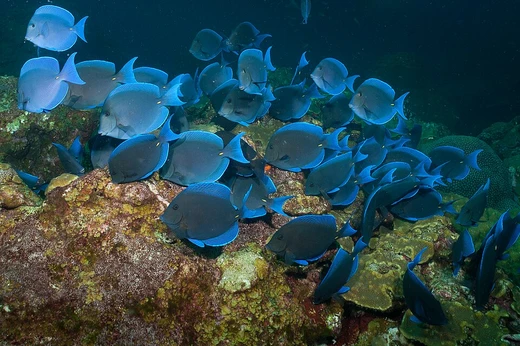
Naso brachycentron
A large unicornfish with a humped back and bony snout.

The humpback unicornfish, *Naso brachycentron*, is a marine ray-finned fish in the Acanthuridae family, which also includes surgeonfishes and tangs. It lives in the Indian and western Pacific Oceans. French zoologist Achille Valenciennes first described it as *Naseus brachycentron*, with the type location being Waigeo in Indonesia. It belongs to the nominate subgenus of the genus *Naso*, the only genus in the subfamily Nasinae. The species name combines *brachy* ("short") and *centron* ("thorn" or "spine"), referring to its shorter dorsal-fin spines compared to the type species *N. fronticornis*. Its dorsal fin has 4 or 5 spines and 28 to 30 soft rays, while the anal fin has 2 spines and 27 or 28 soft rays. Body depth is 2.2 to 2.7 times in standard length. In fish longer than about 20 cm, a hump develops on the back, making the dorsal profile concave between the area between the eyes and the soft-rayed part of the dorsal fin. The snout is steep, and adult males have a long, tapering bony projection in front of the eyes that can extend past the mouth; females have only a small bump. A pair of bony plates with blade-like keels sit on each side of the caudal peduncle. The upper body and head are grey, while the lower body is paler yellowish or whitish, with an irregular boundary between the colors. Blue spots often appear behind the eyes, and larger males may show dark bars on the lower flanks. This is a large species, reaching a maximum fork length of 90 cm. It has a wide distribution across the Indian and Pacific Oceans but is absent from the Red Sea, Gulf of Oman, and Persian Gulf. Its range extends from Kenya to Sodwana Bay in South Africa, through most Indian Ocean islands, east to French Polynesia and the Mariana Islands, north to the Ryukyu Islands, and south to the Great Barrier Reef. It is found alone or in small groups in shallow reef areas.
Quick Facts
- Taxon
- Naso brachycentron
- Parent
- Naso (Naso)
Facts from the source article.
Lore & Background
Naso brachycentron was first formally described as Naseus brachycentron by the French zoologist Achille Valenciennes, with its type locality given as Waigeo in Indonesia. It is classified within the nominate subgenus of the genus Naso, which is the only genus in the subfamily Nasinae within the family Acanthuridae. The specific name brachycentron combines brachy, meaning 'short', with centron, meaning 'thorn' or 'spine', alluding to the shorter spines in the dorsal fin compared to the type species of Naso, N. fronticornis.
In terms of physical characteristics, the dorsal fin is supported by 4 or 5 spines and between 28 and 30 soft rays, while the anal fin has 2 spines and 27 or 28 soft rays. The depth of the body fits into its standard length between 2.2 and 2.7 times. In fish with a standard length greater than about 20 cm (7.9 in), a hump begins to develop in the back, making the dorsal profile concave between the intraorbital area and the soft-rayed portion of the dorsal fin. The snout is steeply sloped, and adult males possess a long, tapering bony protuberance in front of the eyes that may extend past the mouth, whereas females have only a small bump. A pair of bony plates with a blade-like keel are present on each side of the caudal peduncle.
The overall colour is grey on the upper body and head, becoming paler yellowish or whitish on the lower body, with the coloured areas irregularly demarcated. Blue spots frequently appear behind the eyes, and larger males may have dark bars on the lower flanks. This is a relatively large species, reaching a maximum published fork length of 90 cm (35 in).
Reader's Guide
Naso brachycentron holds significance as a distinctive member of the surgeonfish family, recognized for its humped back and the prominent bony protuberance on the snout of adult males. Its description by Achille Valenciennes in the 19th century, with a type locality in Indonesia, places it within the well-studied genus Naso, the sole genus of the subfamily Nasinae. The species' etymology—'short spine'—highlights a morphological distinction from the type species of the genus, underscoring the taxonomic care taken in its classification.
Ecologically, the humpback unicornfish is a wide-ranging species found across the Indian and western Pacific Oceans, from the eastern coast of Africa to French Polynesia and the Mariana Islands, though it is absent from the Red Sea, the Gulf of Oman and the Persian Gulf. It inhabits shallow reef areas, typically as solitary individuals or in small aggregations. Its large size—up to 90 cm fork length—makes it one of the bigger unicornfishes, and the development of the hump and snout protuberance with age adds to its biological interest. The species' coloration, with grey upper parts, pale lower parts, and occasional blue spots and dark bars, provides a subtle but recognizable appearance among reef fishes. Its presence in diverse reef habitats from Kenya to the Great Barrier Reef underscores its adaptability within tropical marine ecosystems.
Did You Know?
- The specific name brachycentron means 'short spine', referring to the shorter dorsal-fin spines compared to the type species Naso fronticornis.
- A hump begins to develop on the back of individuals with a standard length greater than about 20 cm (7.9 in).
Frequently Asked Questions
What is Naso brachycentron?
Naso brachycentron is a large marine unicornfish commonly known as the humpback unicornfish. It sits within the Acanthuridae family, the same family that includes tangs and surgeonfishes.
Where does Naso brachycentron live in the wild?
This species ranges across the Indian Ocean and the western Pacific Ocean. Its original type locality is Waigeo, an island in Indonesia.
What does the name 'brachycentron' actually mean?
The epithet pairs the Greek brachy, meaning 'short,' with centron, meaning 'thorn' or 'spine.' It highlights that this fish has noticeably shorter dorsal-fin spines than the genus type species, N. fronticornis.
Who first described Naso brachycentron and under what original name?
French zoologist Achille Valenciennes originally named the species Naseus brachycentron. It has since been moved into the genus Naso, the only genus in the subfamily Nasinae.
What physical traits set Naso brachycentron apart from other unicornfish?
The humpback unicornfish is recognized by its pronounced humped back and a bony protrusion on the snout. It also belongs to the nominate subgenus Naso, a grouping shared with several other unicornfish species.
More in Tangs and Surgeonfish 1-24
Spotted an error? Know more?
Reader corrections go straight into our review queue. Suggest an edit · How this site is sourced