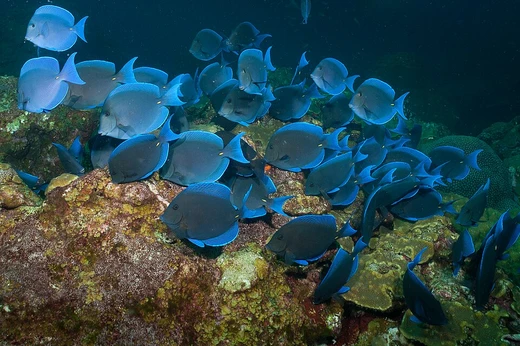
Prionurini
Tribe of surgeonfishes with immobile keeled plates on the tail.

Prionurini is a tribe of marine ray-finned fishes within the subfamily Acanthurinae of the family Acanthuridae, which includes surgeonfishes, unicornfishes and tangs. It is notable as the only tribe in the subfamily that contains the genus Prionurus, whose members are distinguished by immobile keeled bony plates on the caudal peduncle.
Quick Facts
- Taxon
- Prionurus
- Type Species
- Prionurus microlepidotus
- Type Species Authority
- Lacépède, 1804
Facts from the source article.
Lore & Background
The tribe Prionurini was established as the sole genus Prionurus was first proposed in 1804 by French naturalist Bernard Germain de Lacépède, who described the species Prionurus microlepidotus based on a specimen collected by François Péron off New South Wales. The genus name Prionurus means 'sawtail', referring to the 3 to 7 immobile keeled bony plates on each side of the caudal peduncle.
Prionurus species have oval, compressed bodies with a steep head angle above the snout, a small protrusible mouth positioned low on the head, and closely set, moderately large, flattened teeth with serrated edges. They possess 8 or 9 spines in the dorsal fin and 3 spines in the anal fin. The caudal peduncle bears between 3 and 7 bony plates with sharp keels on each side, which are immobile in this genus, unlike the mobile keels in other surgeonfishes.
Seven species are currently recognized in the genus, ranging in maximum published total lengths from 20 cm in P. biafraensis to 70 cm in P. microlepidotus. The tribe has a predominantly Pacific distribution, with six species found in the Pacific Ocean, including two endemic to the eastern Pacific (P. laticlavius and P. punctatus), and one species, P. biafraensis, endemic to the Eastern Atlantic.
Reader's Guide
The tribe Prionurini holds significance as the only tribe within the subfamily Acanthurinae that contains the genus Prionurus, whose members are commonly called sawtails or doctorfish. Its defining characteristic—the immobile keeled bony plates on the caudal peduncle—sets it apart from other surgeonfishes, which typically have mobile keels. This anatomical distinction underscores the tribe's unique evolutionary position within the family Acanthuridae.
The tribe's legacy is reflected in its taxonomic history, beginning with Lacépède's description in 1804, and in its geographic distribution: while most species inhabit the Pacific Ocean, the presence of P. biafraensis in the Atlantic Ocean highlights a notable biogeographic outlier. The species vary widely in size, from the relatively small P. biafraensis at 20 cm to the much larger P. microlepidotus at 70 cm, demonstrating ecological diversity within the tribe. The immobile plates, used defensively, contribute to the group's common name 'sawtail' and remain a key feature for identification.
Did You Know?
- Prionurini is the only tribe in the subfamily Acanthurinae that contains the genus Prionurus.
- One species, Prionurus biafraensis, is found in the Atlantic Ocean, while the other six are Pacific species.
- The largest species in the tribe, Prionurus microlepidotus, reaches a maximum total length of 70 cm.
Taxonomic Placement & Naming History
The tribe Prionurini was formally established by J. L. B. Smith in 1966, carving out a distinct lineage within the broader family Acanthuridae. This family, home to roughly eighty-six living species of marine fish, encompasses surgeonfishes, tangs, and unicornfishes found across tropical waters. The tribe's sole recognized genus, Prionurus, was originally described by Lacépède back in 1804, making it one of the earlier named groups within the family. Prionurini sits within the subfamily Acanthurinae, a grouping proposed by Bonaparte in 1835, which also houses the tribes Acanthurini and Zebrasomini. The family name itself is a nod to Ancient Greek: ákantha meaning "spine" and ourá meaning "tail," a direct reference to the distinctive scalpel-like bony plates found on the caudal peduncle of the type species. Interestingly, in the early twentieth century the entire family went by a different name altogether—Hepatidae—before the current nomenclature took hold.
Body Plan & Defining Features
Members of Prionurini share the hallmark anatomy that defines the entire Acanthuridae family. Most strikingly, they bear one or more scalpel-like modified scales on either side of the tail peduncle—sharp bony plates that can inflict serious injury on anyone who handles the fish carelessly. Their dorsal, anal, and caudal fins are notably large, stretching across most of the body's length and giving these fish a broad, laterally compressed silhouette. The mouth is small and equipped with a single row of teeth specifically adapted for scraping and grazing algae off coral reef surfaces. While the majority of surgeonfish species top out between fifteen and forty centimeters, certain Prionurus species are noted as exceptions that may grow beyond this typical range. In the wild, these fish are often vividly colored, a trait that has made them eye-catching residents of tropical coral reef ecosystems and a major draw for the ornamental fish trade.
Feeding Ecology & Symbiotic Partners
In their natural tropical coral reef habitats, Prionurini members are dedicated algae grazers. They may forage as solitary individuals, but more commonly they travel and feed in coordinated schools. This group-feeding strategy appears to serve a specific ecological purpose: by presenting a large, coordinated front, the school can overwhelm the aggressive territorial defense responses of small damselfishes that fiercely guard tiny patches of reef algae. Beyond their foraging behavior, these fish harbor a remarkable internal partnership. Acanthurids, including Prionurini, are the only known hosts of bacteria belonging to the genus Epulopiscium. These symbiotic microorganisms play a critical role in the fish's digestive process, enabling them to break down and extract nutrients from the algae that form the core of their diet. This unique bacterial relationship underscores how deeply the surgeonfish lineage is adapted to an herbivorous, reef-based lifestyle, with their small toothed mouths and specialized gut microbiota working in tandem to sustain them in their coral-rich environment.
From Larva to Aquarium Tank
The life cycle of Prionurini members begins with a dramatic transformation. The larval stage, known as an acronurus, is mostly transparent and bears little resemblance to the colorful adult that will eventually emerge. These larvae adopt a pelagic lifestyle, drifting in open water for an extended period before finally settling onto the ocean bottom near the shore. There, they gradually develop into recognizable juvenile forms and ultimately mature into the reef-dwelling adults familiar to divers and fishkeepers alike. In the aquarium trade, many Acanthuridae species—including members of Prionurus—are highly prized for their vivid coloration. However, enthusiasts must exercise caution: these fish can grow rapidly in captivity, and their adult size may far exceed expectations. Before adding any surgeonfish to a marine aquarium, it is essential to research the species' average growth size and long-term suitability to ensure the tank can accommodate the fish throughout its full life.
Frequently Asked Questions
What is Prionurini?
Prionurini is a small tribe of ocean-dwelling ray-finned fishes nested inside the Acanthurinae subfamily, which also holds surgeonfishes, unicornfishes, and tangs. It is the only tribe within that subfamily that contains members of the genus Prionurus.
What makes Prionurini stand out from other surgeonfish groups?
Every member of this tribe bears fixed, ridge-shaped bony plates along the base of the tail rather than the movable spines seen in many related surgeonfishes. Those keel-like structures cannot be raised or lowered, giving the group a distinctive silhouette.
How many species are in the Prionurini tribe and how big do they get?
Seven recognized species make up the tribe, and individuals range from roughly 20 cm to 70 cm in total length depending on the species.
Who first described Prionurini and when?
The French naturalist Bernard Germain de Lacépède established the group back in 1804. The type species, Prionurus microlepidotus, was collected off the coast of New South Wales, Australia.
Where can you find Prionurini in the wild?
These are fully marine fishes inhabiting ocean waters, with the original type locality recorded in New South Wales. As part of the broader Acanthuridae family, they are generally associated with tropical and subtropical reef and open-water environments.
More in Tangs and Surgeonfish 1-24
Spotted an error? Know more?
Reader corrections go straight into our review queue. Suggest an edit · How this site is sourced