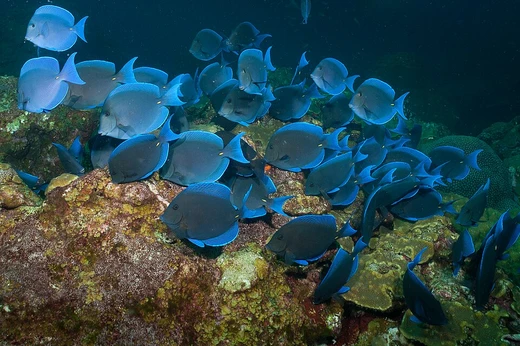
Bluespine unicornfish
A herbivorous surgeonfish that helps control invasive algae on reefs.

The bluespine unicornfish (Naso unicornis), also known as the short-nose unicornfish, is a species of marine ray-finned fish belonging to the family Acanthuridae, which includes surgeonfishes, unicornfishes and tangs. It is found in the Indo-Pacific and occasionally in the aquarium trade. It grows to a size of 70 cm in length. It is notable for its role in coral reef ecosystems as one of a small number of species that consumes fleshy macroalgae, including invasive algae.
Quick Facts
- Parent
- Naso (Naso)
- Taxon
- Naso unicornis
Facts from the source article.
Lore & Background
The bluespine unicornfish was first formally described as Chaetodon unicornis by Peter Forsskål, with its type locality given as Jeddah. In 1801 Bernard Germain de Lacépède described a new species Naso fronticornis as a replacement name, and in 1917 David Starr Jordan designated it as the type species of the genus Naso. Naso is the only genus in the monogeneric subfamily Nasinae, proposed by Henry Weed Fowler and Barton Appler Bean in 1929.
The fish has a blueish-gray body with two blue spines on each side at the base of the tail and a short bony horn on the forehead; small fish lack the horn. It is sexually dimorphic, with males having much larger tail spines, and on average slightly longer horns and tail streamers. The skin is leather-like instead of scales. It is called kala in Hawaii, dawa in New Caledonia, and ta or tā in Fiji; the name kala refers to all three species of horned unicornfish found around Hawaii.
Bluespine unicornfish are near-shore fish, with juveniles staying close to shore and adults living from shallow to the beginnings of deep water within the upper 40 feet. They enjoy spots with waves or strong surges and live often solitary on coral reefs or in small schools of unicornfish, or as part of larger schools with many other fish species.
Reader's Guide
The bluespine unicornfish is of great importance to coral reef ecosystems because it is one of a small number of species that consumes fleshy macroalgae (seaweed). It feeds on brown and red algae such as Sargassum. Notably, it has been recorded eating invasive algae species like Gracilaria salicornia, which forms dense mats on corals and prevents nutrient acquisition. While feeding on G. salicornia helps reduce the size of the alga on reefs, fragments found in the fish's feces are viable and can contribute to its spread.
In human use, bluespine unicornfish are eaten in abundance due to their commonness, caught using nets, hook and line, and nighttime spearfishing. Their meat is white with a slight pink-red taint and firm or moist texture, and they are usually eaten raw, boiled, grilled, baked, or sauteed. In pre-colonial Hawaii, kala was an important food source; its tough skin was stretched over a half coconut shell to make a small knee drum, and it was used in ceremonies between members of a tribe or between tribes. Today kala remains a common food source in Hawaii and other Pacific Islands. A commercial kala fishing permit is required by the Hawaiian Department of Land and Natural Resources, with a daily take limit of four fish per person and an annual commercial catch limit of 15,000 pounds. The fish is frequently found on postage stamps, as company logos, school mascots, and as a motif in indigenous artwork.
Did You Know?
- The largest bluespine unicornfish caught weighed 5.8 kg (13 lb).
- It feeds on invasive algae Gracilaria salicornia, but fragments in its feces can spread the alga.
The Scalpel and the Spine – Anatomy of a Defense
The most immediately striking feature of any acanthurid is the pair of razor-sharp, scalpel-like bony plates embedded in the fleshy region just before the tail. These modified scales, one on each side of the caudal peduncle, are dangerously sharp and can inflict serious wounds on anyone who handles the fish carelessly. Beyond this signature weapon, the body plan is built for sustained cruising: the dorsal, anal, and caudal fins are all large and sweep along most of the body's length, giving the fish powerful, continuous propulsion. At the front, a small mouth houses a single row of teeth specifically adapted for scraping algae off surfaces. Most species stay modest in size, topping out between fifteen and forty centimeters, though certain members of Acanthurus, Prionurus, and especially Naso push well beyond that range. The whitemargin unicornfish, Naso annulatus, is the family champion, reaching a full meter in length. Their rapid growth in captivity means aquarists must carefully check adult size and suitability before adding one to a marine tank.
A Deep Time Story – Fossils and Evolution
The fossil record of the Acanthuridae stretches back to the Eocene and continues through the Oligocene and Miocene, offering a remarkably detailed window into the family's ancient past. The Monte Bolca Lagerstätte in Italy has yielded an especially rich assemblage of fossil surgeonfish, representing some of the earliest known members of the individual tribes that make up the family today. Researchers have described over a dozen distinct Eocene genera from that single site, including Acanthuroides, Eorandallius, Frigosorbinia, Gazolaichthys, Lehmanichthys, Metacanthurus, Metaspisurus, Padovathurus, Pesciarichthys, Proacanthurus, Protozebrasoma, Sorbinithurus, Tauichthys, and Tylerichthys. The Oligocene adds Arambourgthurus, Caprovesposus, Glarithurus, and the uncertain Eonaso, while the Miocene contributes Marosichthys. Together, these extinct lineages paint a picture of a family diversifying and spreading across tropical seas tens of millions of years before modern reefs took their current shape.
A Partnership in the Gut – Symbiosis and Feeding
What makes acanthurids truly unique in the animal kingdom is their exclusive relationship with a genus of bacteria called Epulopiscium. These surgeonfish are the only known hosts for these microorganisms, which colonize the digestive tract and play a critical role in breaking down the algae that form the bulk of the fish's diet. Without this bacterial partnership, the tough algal material would be far harder to process. In the reef environment, feeding strategy matters as much as gut chemistry. While some individuals graze alone, many acanthurids travel and feed in schools. This group behavior appears to be a tactical response to the fiercely territorial damselfishes that guard small patches of algae on coral reefs; by arriving in numbers, the surgeonfish can overwhelm the aggressive defense displays of these smaller guardians. The life cycle adds another layer of complexity: the larval stage, called an acronurus, is mostly transparent and lives a pelagic existence in open water for an extended period before settling near the shore to develop into the recognizable juvenile and adult forms.
Names, Tribes, and a Family Tree
The very name Acanthuridae is a direct nod to the family's most famous anatomical feature. It derives from two Ancient Greek words: ákantha, meaning "spine," and ourá, meaning "tail," together referencing the scalpel-like bony plates on the caudal peduncle of the type species. In the early twentieth century, before the current nomenclature was settled, the family went by the name Hepatidae. Today, roughly eighty-six extant species are recognized, all marine and all inhabiting tropical seas, typically in association with coral reefs. Their vivid coloration has made many of them favorites in the aquarium trade. Taxonomically, the family splits into two subfamilies. Nasinae, described by Fowler and Bean in 1929, contains the single genus Naso. The larger Acanthurinae, named by Bonaparte in 1835, is divided into three tribes: Acanthurini (with Acanthurus and Ctenochaetus), Prionurini (with Prionurus), and Zebrasomini (with Paracanthurus and Zebrasoma). Each genus carries the name of the naturalist who first described it, spanning from Forsskål in 1775 to Winterbottom in 1993.
Frequently Asked Questions
What is the Bluespine unicornfish?
The Bluespine unicornfish (Naso unicornis), also called the short-nose unicornfish, is a marine ray-finned fish in the Acanthuridae family that groups tangs, surgeonfishes, and unicornfishes together. It is a herbivorous species native to Indo-Pacific waters.
How big does a Bluespine unicornfish grow?
Adults can reach up to 70 cm in length and weigh as much as 5.8 kg. That size makes it one of the larger members of the surgeonfish family.
Where do Bluespine unicornfish live?
They inhabit coral reef environments in the upper 40 feet of water across the Indo-Pacific region. They prefer warm conditions, typically between 25 and 29 °C.
What role does the Bluespine unicornfish play in reef ecosystems?
As a herbivore, it feeds on fleshy macroalgae, including invasive algae species that can smother coral. This makes it one of the few fish that actively helps keep reefs free of overgrown algae.
What are the fishing regulations for Bluespine unicornfish in Hawaii?
Recreational anglers in Hawaii may take up to 4 fish per person per day. The commercial sector is capped at an annual catch of 15,000 pounds.
More in Tangs and Surgeonfish 1-24
Spotted an error? Know more?
Reader corrections go straight into our review queue. Suggest an edit · How this site is sourced