Acanthuridae
Marine fishes with scalpel-like spines on the tail peduncle.

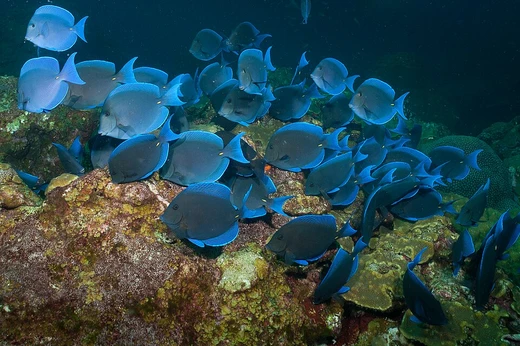
The Acanthuridae family consists of ray-finned marine fish, commonly called surgeonfishes, tangs, and unicornfishes. Around 86 living species inhabit tropical seas, typically near coral reefs. Their bright colors make them a common choice for home aquariums.
The family name derives from the Ancient Greek words for "spine" and "tail," referencing the sharp, scalpel-like bony plates on the tail stalk of the type species. In the early 1900s, this group was known as Hepatidae.
Living members are divided into two subfamilies: Nasinae (genus *Naso*) and Acanthurinae. The latter contains three tribes: Acanthurini (genera *Acanthurus* and *Ctenochaetus*), Prionurini (genus *Prionurus*), and Zebrasomini (genera *Paracanthurus* and *Zebrasoma*).
Fossil evidence shows several extinct genera from the Eocene to Miocene epochs. A rich collection of Eocene surgeonfish fossils comes from the Monte Bolca site in Italy, representing early members of the family’s tribes. Eocene genera include *Acanthuroides*, *Eorandallius*, *Frigosorbinia*, *Gazolaichthys*, *Lehmanichthys*, *Metacanthurus*, *Metaspisurus*, *Padovathurus*, *Pesciarichthys*, *Proacanthurus*, *Protozebrasoma*, *Sorbinithurus*, *Tauichthys*, and *Tylerichthys*. Oligocene genera are *Arambourgthurus*, *Caprovesposus*, *Glarithurus*, and possibly *Eonaso*. The Miocene genus is *Marosichthys*.
The family’s key feature is one or more sharp, scalpel-like scales on each side of the tail stalk. These spines are dangerous and can seriously injure anyone handling the fish carelessly. Their dorsal, anal, and tail fins are large, running most of the body length. Small mouths hold a single row of teeth for grazing algae. Surgeonfish sometimes feed alone, but often travel in schools—a strategy that may overwhelm the aggressive defenses of territorial damselfish guarding algae patches.
Most species are small, reaching 15–40 cm (6–15.5 inches) maximum length. However, some *Acanthurus* and *Prionurus* species, and most *Naso* species, grow larger. The whitemargin unicornfish (*Naso annulatus*) is the largest, up to 1 meter (3 feet 3 inches). These fish can grow quickly in aquariums, so their average adult size should be checked before adding them to a marine tank.
The larval stage, called an acronurus, looks very different from the juvenile and adult.
Quick Facts
- Taxon
- Acanthuridae
- Type Species
- Acanthurus triostegus
- Type Species Authority
- (Linnaeus, 1758)
Facts from the source article.
Lore & Background
The family name Acanthuridae derives from Ancient Greek terms ἄκανθα (ákantha), meaning 'spine', and οὐρά (ourá), meaning 'tail', referencing the scalpel-like bony plates on the type species's caudal peduncle. In the early 1900s, the family was called Hepatidae. The family contains two extant subfamilies: Nasinae and Acanthurinae, with several tribes and genera including Acanthurus, Ctenochaetus, Prionurus, Paracanthurus, Zebrasoma, and Naso.
The distinctive characteristic of the family is the presence of one or more scalpel-like modified scales on either side of the caudal peduncle. These spines are dangerously sharp and may seriously injure anyone who carelessly handles such a fish. The dorsal, anal, and caudal fins are large, extending for most of the length of the body. Their mouths are small with a single row of teeth adapted to grazing on algae. Surgeonfishes sometimes feed as solitary individuals, but often travel and feed in schools, which may be a mechanism for overwhelming the aggressive defense responses of small, territorial damselfishes that guard algae patches.
A larval acanthurid, known as an acronurus, looks strikingly different from the juvenile and adult forms. It is mostly transparent and tends to have a pelagic lifestyle, living in open water for an extended time before settling on the ocean bottom near the shore, where it develops into the juvenile and ultimately the adult form. Acanthurids are the only known hosts of the bacteria of the genus Epulopiscium, which affect digestion by enabling them to digest the algae in their diet.
Reader's Guide
The Acanthuridae family is notable for its distinctive scalpel-like spines on the caudal peduncle, a feature that gives the group its common names—surgeonfishes, tangs, and unicornfishes. The family includes about 86 extant species found in tropical seas, usually around coral reefs, and many are brightly colored and popular in aquaria. The family's evolutionary history is documented by several extinct genera known from fossils dating from the Eocene to Miocene, with a particularly large diversity of fossil surgeonfish known from the Monte Bolca Lagerstätte of Italy, representing some of the earliest representatives of individual tribes within the family.
Most species are fairly small, with a maximum length of 15–40 cm, but some in the genera Acanthurus, Prionurus, and most species in Naso may grow larger; the whitemargin unicornfish (Naso annulatus) is the largest species, reaching up to 1 m. These fishes may grow quickly in aquaria, so average growth size and suitability should be checked before adding them to any marine aquarium. The family's unique symbiotic relationship with Epulopiscium bacteria, which aid in digesting algae, further underscores their ecological specialization. The larval acronurus stage, which is transparent and pelagic, represents a distinct phase in their life cycle before settling near shore.
Did You Know?
- The family name comes from Ancient Greek words meaning 'spine' and 'tail', referring to the scalpel-like bony plates on the caudal peduncle.
- A larval acanthurid, known as an acronurus, is mostly transparent and has a pelagic lifestyle.
- Acanthurids are the only known hosts of the bacteria genus Epulopiscium, which help them digest algae.
Taxonomy, Naming, and Family Structure
The family name Acanthuridae draws from two Ancient Greek words: ákantha (spine) and ourá (tail), pointing to the distinctive scalpel-like bony plates found on the caudal peduncle of the type species. In the early 1900s, taxonomists referred to this group under the name Hepatidae before the current designation took hold. The family encompasses roughly 86 living species of marine, ray-finned fishes found in tropical waters, typically associated with coral reefs. Taxonomically, the family splits into two subfamilies: Nasinae (containing the genus Naso) and Acanthurinae, which further divides into three tribes. Acanthurini includes the genera Acanthurus and Ctenochaetus; Prionurini contains Prionurus; and Zebrasomini houses Paracanthurus and Zebrasoma. The common names—surgeonfishes, tangs, and unicornfishes—reflect the family's visual diversity, with many species displaying vivid coloration that makes them favorites in marine aquaria.
Morphology, Feeding, and Life Cycle
The defining morphological trait of Acanthuridae is the presence of one or more scalpel-like modified scales on either side of the tail peduncle—spines so dangerously sharp that careless handling can cause serious injury. Beyond this signature feature, these fishes possess large dorsal, anal, and caudal fins that span most of their body length, while their small mouths bear a single row of teeth specialized for grazing on algae. Most species are modest in size, ranging from 15 to 40 centimeters, though select members of Acanthurus, Prionurus, and especially Naso grow considerably larger; the whitemargin unicornfish (Naso annulatus) tops out near one meter. Feeding behavior is notable: while some individuals graze alone, many travel in schools, a strategy that appears to overwhelm the aggressive territorial defenses of damselfishes that guard small algal patches on reefs. The larval stage, called an acronurus, is strikingly different from later life forms—mostly transparent and pelagic, drifting in open water for an extended period before settling near shore to develop into juvenile and adult forms.
Fossil Record and Evolutionary History
The evolutionary history of Acanthuridae stretches back to the Eocene, with several extinct genera preserved in the fossil record through the Miocene. The Monte Bolca Lagerstätte in Italy is particularly significant, yielding an exceptionally rich assemblage of fossil surgeonfishes that represent some of the earliest known representatives of the individual tribes within the family. Eocene fossils include at least thirteen distinct genera—ranging from Acanthuroides and Eorandallius to Tylerichthys and Sorbinithurus—many described by Blot and Tyler in the 1990s. The Oligocene record adds genera such as Arambourgthurus, Caprovesposus, and Glarithurus, while the Miocene is represented by Marosichthys. This deep fossil record, spanning from the Eocene through the Miocene, underscores that the major tribal divisions seen in modern Acanthuridae were already established tens of millions of years ago, making the Monte Bolca deposits a cornerstone for understanding the family's long-term diversification in tropical marine environments.
Symbiotic Bacteria and Digestive Biology
One of the most remarkable biological relationships in the marine realm belongs to Acanthuridae: they are the only known hosts of bacteria in the genus Epulopiscium. This exclusive symbiosis is not incidental—it plays a direct role in the digestive physiology of surgeonfishes, enabling them to break down and extract nutrients from the algae that form the basis of their diet. Given that their small mouths and single row of grazing teeth are adapted for scraping algal surfaces rather than processing complex plant matter, the presence of Epulopiscium becomes a critical component of their nutritional strategy. This bacterial partnership effectively extends the functional capacity of the surgeonfish gut, turning a diet that would otherwise be difficult to fully utilize into a viable energy source. The fact that no other fish family is known to harbor Epulopiscium highlights the specificity of this relationship and suggests a long co-evolutionary history between the bacteria and their acanthurid hosts, potentially stretching back through the Eocene and Oligocene lineages documented in the fossil record.
Frequently Asked Questions
What is Acanthuridae?
Acanthuridae is a family of ray-finned marine fish that groups together surgeonfishes, tangs, and unicornfishes. Roughly 86 living species belong to it, and their vivid coloration makes them a staple pick for home reef aquariums.
Where do Acanthuridae live?
Members of this family are strictly marine and are found in tropical seas around the globe. They most often hang around coral reef structures, which provide both shelter and a constant supply of algae to graze on.
What does the name Acanthuridae actually mean?
The family name is built from two Ancient Greek words: ákantha, meaning 'spine,' and ourá, meaning 'tail.' It points to the sharp, scalpel-like bony plates on the tail stalk of the type species, which gave the group its common 'surgeonfish' nickname.
How big can Acanthuridae get?
Most species top out somewhere between 15 and 40 cm (about 6 to 15.5 inches) in total length. The exception is the whitemargin unicornfish (Naso annulatus), which can reach roughly 1 meter (3 ft 3 in), making it the largest member of the family.
How is Acanthuridae divided into subfamilies?
Living members fall into two subfamilies: Nasinae, home to the single genus Naso, and Acanthurinae, which contains the remaining genera organized into three tribes. The whole group went by the older name Hepatidae back in the early 1900s before the current classification stuck.
More in Tangs and Surgeonfish 1-24
Spotted an error? Know more?
Reader corrections go straight into our review queue. Suggest an edit · How this site is sourced