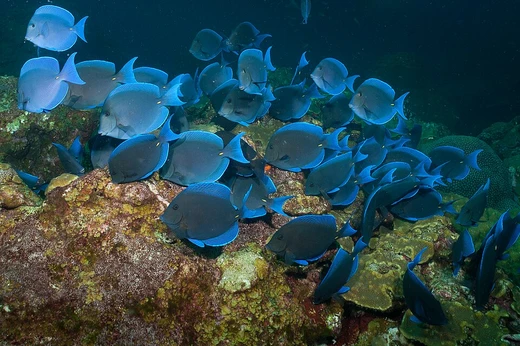
Naso brevirostris
A unicornfish with a short snout and long bony protuberance.

Naso brevirostris goes by many common names—short-nosed unicornfish, spotted unicornfish, brown unicornfish, lined unicornfish, longnose surgeonfish, palefin unicornfish, paletail unicornfish, shorthorned unicornfish, or shortsnouted unicornfish. It is a marine ray-finned fish in the family Acanthuridae, the group that includes surgeonfishes, unicornfishes, and tangs. Its range covers the Indian Ocean and the western Pacific Ocean.
The species was first formally described in 1829 by French zoologist Georges Cuvier, who named it *Naseus brevirostris*. The type locality was not given but is assumed to be Indonesia. It belongs to the nominate subgenus of the genus *Naso*, which is the sole genus in the subfamily Nasinae within Acanthuridae. The specific name *brevirostris* means "short nose," referring to its shorter snout compared to the type species of *Naso*, *N. fronticornis*.
This fish is widespread across the Indian and Pacific Oceans. Its range extends from the Red Sea south along eastern Africa to Durban, South Africa, then east across the Indian Ocean into the western Pacific, reaching the Pitcairn Islands and Hawaii, north to southern Japan, and south to Australia. In Australia, it appears from Ningaloo Reef around the northern tropical coasts to the northern Great Barrier Reef and Coral Sea, south to Moreton Bay in Queensland, and around Lord Howe Island in the Tasman Sea. In the eastern Pacific, it is found near the Galápagos Islands. It inhabits lagoon and seaward reefs down to depths of about 46 meters (151 feet).
The dorsal fin has 6 spines and 27 to 29 soft rays, while the anal fin has 2 spines and 27 to 29 soft rays. Body depth is roughly 2 to 2.7 times in standard length. The snout is very short and steep, almost vertical. Subadults and adults develop a long, tapering bony protuberance in front of the eyes; this can extend past the mouth by as much as the length of the head and first appears as a bump in individuals around 10 cm (3.9 inches) total length. On each side of the caudal peduncle are a pair of bony plates with poorly developed keels. The caudal fin ranges from truncate to slightly rounded. Overall color is light bluish-grey to olive-brown, though some individuals show a pale front quarter with a clear demarcation from the rest of the body.
Quick Facts
- Taxon
- Naso brevirostris
- Parent
- Naso (Naso)
Facts from the source article.
Lore & Background
Naso brevirostris was first formally described as Naseus brevirostris in 1829 by the French zoologist Georges Cuvier, with its type locality not given but considered to be Indonesia. It is classified within the nominate subgenus of the genus Naso, the only genus in the subfamily Nasinae within the family Acanthuridae. The specific name brevirostris means 'short nose', an allusion to its shorter snout compared to the type species of Naso, N. fronticornis.
The species is widespread throughout the Indian and Pacific Oceans, from the Red Sea south along the eastern coast of Africa as far as Durban in South Africa, eastward across the Indian Ocean into the western Pacific, extending to the Pitcairn Islands and Hawaiian Islands, north to southern Japan and south to Australia. In Australia it ranges from Ningaloo Reef around the northern tropical coasts to the northern Great Barrier Reef and the Coral Sea as far south as Moreton Bay in Queensland, as well as near Lord Howe Island. In the eastern Pacific it is found around the Galápagos Islands. These fish inhabit lagoon and seaward reefs down to depths of 46 m.
Adults have a very short, steep snout and a long, tapering bony protuberance in front of the eyes that may extend past the mouth by as much as the length of the head, first appearing as a bump in individuals around 10 cm total length. The overall colour is light bluish-grey to olive-brown, with a colour phase where the front quarter of the body is pale with a clear demarcation. The flanks have thin vertical dark grey lines that break into small spots on the lower body, and the head is marked with small dark spots or a lattice of lines. The protuberance has diagonal black lines, the operculum membrane is white, the lips have pale blue edges, and the caudal fin is largely whitish.
Reader's Guide
Naso brevirostris is a species of marine ray-finned fish in the family Acanthuridae, known for its distinctive bony protuberance that develops in subadults and adults. It occurs in the Indian Ocean and western Pacific Ocean, with a wide distribution from the Red Sea and eastern Africa to the Hawaiian Islands, southern Japan, Australia, and the Galápagos Islands. The species was first described by Georges Cuvier in 1829 as Naseus brevirostris, with its type locality considered to be Indonesia. It is classified within the nominate subgenus of the genus Naso, the only genus in the subfamily Nasinae.
The fish reaches a maximum total length of 60 cm and lives in lagoon and seaward reefs down to 46 m depth. Adults feed mainly on gelatinous zooplankton, while juveniles feed on benthic algae; the switch from grazing to preying on gelatinous zooplankton coincides with the development of the bony protuberance. Naso brevirostris forms spawning aggregations, pairing to spawn, and males have larger keels on the caudal peduncle than females. Eggs hatch into pelagic larvae that may remain in the water column for up to 90 days, and adults attain sexual maturity at around 25 cm. The species is caught for food using fish traps and spears, though there have been cases of ciguatera poisoning after eating this fish. It rarely appears in the aquarium trade. Due to its wide range and stable populations, the IUCN classifies it as Least Concern.
Did You Know?
- Juveniles feed mainly on benthic algae, while adults feed mainly on gelatinous zooplankton.
- The species has been associated with ciguatera poisoning when eaten.
Taxonomy & A Proliferation of Common Names
The short-nosed unicornfish was first given a formal scientific identity in 1829, when the French zoologist Georges Cuvier described it under the name Naseus brevirostris. Although Cuvier did not specify a type locality, researchers generally accept Indonesia as the origin point for the description. The species sits within the nominate subgenus of Naso, which stands as the sole genus in the subfamily Nasinae, itself nested inside the broader family Acanthuridae that encompasses surgeonfishes, unicornfishes, and tangs. The specific epithet 'brevirostris' translates simply to 'short nose,' a direct nod to the comparatively brief snout when measured against the genus's type species, N. fronticornis. Perhaps as telling as the taxonomy is the sheer number of common names this fish has accumulated across different regions and languages. It goes by at least nine informal titles, including spotted unicornfish, brown unicornfish, lined unicornfish, longnose surgeonfish, palefin unicornfish, paletail unicornfish, shorthorned unicornfish, and shortsnouted unicornfish. This proliferation of names reflects both the fish's wide geographic reach and the visual variety that different populations present to local observers.
A Vast Indo-Pacific Range
Few reef-dwelling fish command a geographic footprint quite as expansive as the short-nosed unicornfish. Its range stretches from the Red Sea southward along Africa's eastern seaboard all the way to Durban in South Africa, then sweeps east across the Indian Ocean into the Western Pacific. From there it pushes as far east as the Pitcairn and Hawaiian Islands, reaches north into southern Japan, and extends south to Australian waters. Within Australia itself, the species is recorded from Ningaloo Reef along the northern tropical coastline, through the northern Great Barrier Reef and Coral Sea, down to Moreton Bay in Queensland, and even appears near Lord Howe Island in the Tasman Sea. Remarkably, a population also turns up in the eastern Pacific around the Galápagos Islands. Despite this extraordinary spread, the fish remains tied to a relatively narrow habitat niche: lagoon and seaward reefs, where it can be found at depths reaching 46 metres. The combination of such a broad latitudinal and longitudinal range with a consistent preference for coral-reef environments makes this unicornfish one of the most geographically versatile members of the Acanthuridae family.
Anchored by the Bony Protuberance
The most immediately striking feature of a mature short-nosed unicornfish is the pair of long, tapering bony protuberances that project forward from in front of the eyes. These structures can extend beyond the mouth by a distance equal to the entire head length, giving the fish a distinctly horned profile. They are absent in young fish, first emerging as a small bump when the individual reaches roughly 10 centimetres in total length, and then elongating through subadult and adult stages. The protuberance itself is decorated with diagonal black lines. Beyond this signature trait, the body is a deep, compressed form whose depth fits into the standard length between about two and 2.7 times. The snout is notably short and steep, almost vertical. Colouration runs from light blueish-grey to olive-brown, with a distinct phase in which the front quarter of the body turns pale, sharply demarcated from the rest. Thin vertical dark-grey lines run down the mid-flanks, fragmenting into small spots toward the lower body. The head carries either small dark spots or a lattice of fine lines, the operculum membrane is white, the lips are edged in pale blue, and the caudal fin is predominantly whitish. The maximum published total length for the species is 60 centimetres.
Life Cycle, Diet Shift, and Human Encounters
Reproduction in the short-nosed unicornfish is a social affair: individuals gather into spawning aggregations and pair up to release eggs. Males can be distinguished from females by the larger keels on their caudal peduncle. Fertilized eggs develop into pelagic larvae that drift in the open water column for as long as 90 days before settling. Sexual maturity is reached at approximately 25 centimetres in length. A fascinating ecological transition occurs as the fish grows: juveniles graze primarily on benthic algae, while adults shift to feeding mainly on gelatinous zooplankton. This dietary switch lines up precisely with the development of the bony protuberance, suggesting a functional link between the structural change and the new feeding strategy. In terms of human interaction, the species is harvested for food using fish traps and spears, though it has been implicated in cases of ciguatera poisoning. It rarely enters the aquarium trade. Because of its broad distribution and apparently stable populations, the IUCN lists it as Least Concern.
Frequently Asked Questions
What is Naso brevirostris?
It is a marine ray-finned fish in the Acanthuridae family, best recognized by its short snout paired with a long bony protuberance on the head. You may also encounter it under common names such as short-nosed unicornfish, spotted unicornfish, or longnose surgeonfish.
Where can Naso brevirostris be found in the wild?
Its natural range spans the Indian Ocean and the western Pacific Ocean. Divers and researchers have recorded it at depths reaching as far down as 46 meters (about 151 feet).
Who first described Naso brevirostris and when?
French zoologist Georges Cuvier provided the species' formal scientific description in 1829, originally publishing it under the name Naseus brevirostris. The original account did not specify a type locality.
How big does Naso brevirostris get?
Adults can reach a maximum total length of roughly 60 centimeters (24 inches). Along its back it bears six dorsal-fin spines, a feature typical of the surgeonfish and unicornfish group.
Why does Naso brevirostris have so many common names?
Different regions and communities have highlighted different visual traits—snout shape, coloration, or the bony head crest—resulting in labels like palefin, paletail, shorthorned, and shortsnouted unicornfish. All of these names refer to the same short-snouted, long-horned member of the Acanthuridae family.
More in Tangs and Surgeonfish 1-24
Spotted an error? Know more?
Reader corrections go straight into our review queue. Suggest an edit · How this site is sourced