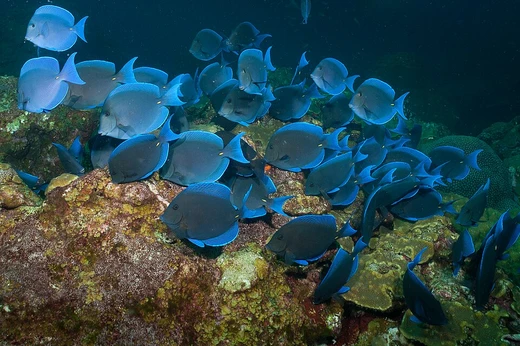
Naso tergus
A cryptic unicornfish described in 2011 from Taiwan.

Naso tergus is a marine ray-finned fish in the family Acanthuridae, which includes surgeonfishes, unicornfishes, and tangs. First formally described in 2011, it was identified from specimens collected off Taiwan’s coast.
In terms of classification, the species was described by Ho-Hsuan Ching, Shen Kang-Ning, and Chang Chi-Wei. Its type locality is off Nanfango in Ilan, northeastern Taiwan, at depths of 70 to 80 meters. It belongs to the nominate subgenus of the genus Naso, the sole genus in the subfamily Nasinae within Acanthuridae.
The specific name *tergus* comes from Latin, meaning “hide” as a noun (the skin of an animal), not the verb for concealment. This name was chosen because the fish was originally described as a cryptic species, blending in with closely related fish and resembling their subadults in appearance.
The body of Naso tergus is moderately elongated and compressed, with a slender build relative to other members of its genus. Its head is relatively large, with a smooth, sloping dorsal profile and a small mouth. The dorsal fin has 6 spines and 26 to 30 soft rays, while the anal fin has 2 spines and 26 to 28 soft rays. A pair of elliptical bony plates sits on each side of the caudal peduncle. The lower jaw contains 100 to 120 teeth, and the upper jaw has 90 to 110. Overall body color is brownish. This unicornfish is relatively small, with a standard length not exceeding 35 centimeters.
The species has been recorded in Taiwan, southern Japan, and the Philippines, at depths between 70 and 80 meters.
Quick Facts
- Parent
- Naso (Naso)
- Taxon
- Naso tergus
Facts from the source article.
Lore & Background
Naso tergus was first formally described in 2011 by Ho-Hsuan Ching, Shen Kang-Ning and Chang Chi-Wei, with its type locality given as off Nanfango in Ilan in northeastern Taiwan at a depth of 70 to 80 m. It is classified within the nominate subgenus of the genus Naso, the only genus in the subfamily Nasinae within the family Acanthuridae. The authors chose the Latin word tergus as its specific name, meaning 'hide' as a noun (the hide of an animal), because the species was originally described as a cryptic species that hid among closely related fishes and bore a morphological resemblance to the subadults of those species. Naso tergus has a moderately elongated and compressed body, described as having a slender body and head compared to its congeners, with a relatively large head and a smoothly sloping dorsal profile. It has a small mouth, and its dorsal fin is supported by 6 spines and between 26 and 30 soft rays, while the anal fin has 2 spines and 26 to 28 soft rays. There is a pair of elliptical bony plates on each side of the caudal peduncle, and it has between 100 and 120 teeth on the lower jaw and between 90 and 110 on the upper jaw. The overall color of the body is brownish, and it is a relatively small unicornfish with a standard length that may not exceed 35 cm.
Reader's Guide
Naso tergus is significant as a recently described species that highlights the hidden diversity within the genus Naso. Its description in 2011, based on specimens collected off Taiwan, underscores the importance of deep-reef surveys (at depths of 70 to 80 m) in discovering new taxa. The species' specific name, tergus, meaning 'hide' as a noun, directly references its cryptic nature—it was originally described as hiding among closely related fishes and resembling their subadults. This cryptic behavior may have contributed to its late recognition despite occurring in waters around Taiwan, southern Japan, and the Philippines. As a member of the family Acanthuridae, it belongs to the group of surgeonfishes, unicornfishes and tangs, and its placement in the nominate subgenus of Naso places it within the only genus of the subfamily Nasinae. The species' relatively small maximum size (35 cm standard length) and its brownish coloration, along with its distinctive dental counts (100–120 teeth on the lower jaw, 90–110 on the upper jaw) and paired bony plates on the caudal peduncle, provide key diagnostic features. Its legacy lies in demonstrating that even in well-studied regions like Taiwan, new species of conspicuous reef fishes can still be found, particularly those that evade detection through mimicry or deep-water habitats.
Discovery & Taxonomic Placement
Naso tergus entered the scientific record in 2011 when three researchers—Ho-Hsuan Ching, Shen Kang-Ning, and Chang Chi-Wei—formally described the species based on specimens gathered off the coast of northeastern Taiwan. The type locality they designated was the waters near Nanfango in the Ilan region, at a depth range of 70 to 80 meters. Taxonomically, this fish sits within the nominate subgenus of the genus Naso, which itself is the sole genus comprising the subfamily Nasinae. That subfamily, in turn, belongs to the broader family Acanthuridae, a group that encompasses surgeonfishes, unicornfishes, and tangs. The placement of Naso tergus within this lineage underscores its identity as a ray-finned marine fish with close evolutionary ties to other members of the Naso genus, while its formal recognition in 2011 marked the moment it was finally distinguished from the species it had previously been overlooked alongside in collections.
The "Hide" in Its Name: A Cryptic Species
The specific epithet "tergus" carries a deliberate and somewhat counterintuitive meaning. The authors selected the Latin word not for its verb sense of concealing or hiding, but for its noun meaning—the hide or skin of an animal. This etymological choice reflects the species' biological reality: Naso tergus was originally identified as a cryptic species, one that had been living in plain sight among closely related fishes. Its morphological profile closely mimicked the subadult stages of those neighboring species, making it easy to overlook or misidentify in collections. The fact that it required a dedicated 2011 description, well after other Naso species had been catalogued, speaks to how effectively this fish blended into the visual landscape of its reef community. The name thus serves as both a linguistic nod to its camouflage and a reminder that marine biodiversity still holds surprises even in well-studied regions of the western Pacific.
Morphology: A Slender Unicornfish
Naso tergus presents a distinctly slender and moderately elongated body that is laterally compressed, setting it apart from its congeners in the genus Naso. The head is relatively large compared to the rest of the body, featuring a smoothly sloping dorsal profile and a comparatively small mouth. The dorsal fin is structured with six spines supporting between 26 and 30 soft rays, while the anal fin carries two spines and 26 to 28 soft rays. A notable anatomical feature is the pair of elliptical bony plates situated on each side of the caudal peduncle. Dentition is substantial, with the lower jaw bearing between 100 and 120 teeth and the upper jaw holding between 90 and 110. The overall coloration is a uniform brownish tone. In terms of size, Naso tergus remains a relatively small member of the unicornfish group, with a standard length that does not appear to exceed 35 centimeters, roughly 14 inches.
Range and Depth: A Narrow Window in the Western Pacific
The known distribution of Naso tergus spans a modest but geographically spread area in the western Pacific Ocean. Records place this species in the waters around Taiwan, the southern reaches of Japan, and the Philippines. Across all three regions, the depth range remains remarkably consistent: between 70 and 80 meters, or roughly 230 to 260 feet. This narrow depth window suggests a preference for a specific mid-slope habitat rather than the shallower reef environments where many other Acanthuridae are commonly encountered. The type locality, off Nanfango in Ilan, anchors the species' discovery within this depth band, and subsequent records from Japan and the Philippines confirm that the 70-to-80-meter zone is a defining parameter of its ecological niche. The limited number of localities where it has been documented also reflects the challenges of collecting specimens at such depths and the species' cryptic nature, which likely contributed to its late formal description in 2011.
Frequently Asked Questions
What is Naso tergus?
Naso tergus is a deep-water unicornfish in the surgeonfish family Acanthuridae, recognized as a distinct species in 2011. It is a modest-sized fish, topping out at roughly 35 centimeters (about 14 inches) in standard length.
Who described Naso tergus and when?
The species was formally named in 2011 by Ho-Hsuan Ching, Shen Kang-Ning, and Chang Chi-Wei based on specimens gathered off northeastern Taiwan.
Where was Naso tergus first collected?
The type locality is off Nanfango in Ilan, on Taiwan's northeastern coast, at a depth of 70 to 80 meters. That relatively deep, localized site is where the original specimens came from.
What does the name Naso tergus mean?
The specific epithet 'tergus' is Latin for 'hide,' a nod to the fish's skin or overall appearance. The genus name Naso places it among the unicornfishes, the only genus in the subfamily Nasinae.
How does Naso tergus fit into the tang and surgeonfish family tree?
It sits in the nominate subgenus of Naso, the sole genus within the subfamily Nasinae of Acanthuridae. That makes it a close relative of other surgeonfishes and tangs, though it is specifically classified as a unicornfish rather than a tang.
More in Tangs and Surgeonfish 1-24
Spotted an error? Know more?
Reader corrections go straight into our review queue. Suggest an edit · How this site is sourced