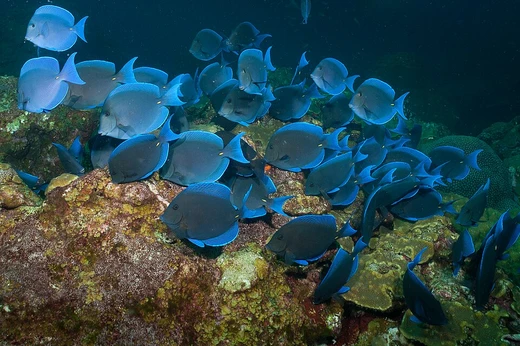
Prionurus
A genus of surgeonfishes with immobile keeled plates on the tail.

Prionurus is a genus of marine ray-finned fishes belonging to the family Acanthuridae, which includes surgeonfishes, unicornfishes and tangs. Some species in this genus are called sawtails or doctorfish. The genus is notable for having a predominantly Pacific distribution, with one species found in the Atlantic Ocean.
Quick Facts
- Taxon
- Prionurus
- Type Species
- Prionurus microlepidotus
- Type Species Authority
- Lacépède, 1804
Facts from the source article.
Lore & Background
The genus Prionurus was first proposed as a monospecific genus in 1804 by the French naturalist Bernard Germain de Lacépède, who described Prionurus microlepidotus. The type was collected by François Péron off New South Wales, though Lacépède did not give a type locality. Prionurus is the only genus in the tribe Prionurini, one of three tribes in the subfamily Acanthurinae, which is one of two subfamilies in the family Acanthuridae. The name Prionurus means 'sawtail', referring to the 3 to 7 immobile keeled bony plates on each side of the caudal peduncle.
Species in this genus have oval, compressed bodies with a steep angle on the head above the snout. Their small mouth is protrusible and positioned low on the head, with closely set, moderately large, flattened teeth that have serrated edges. They have 8 or 9 spines in the dorsal fin and 3 spines in the anal fin. The caudal peduncle bears between 3 and 7 bony plates with sharp keels on each side, and these keels are immobile in Prionurus, unlike the mobile ones in other surgeonfishes. Maximum published total lengths range from 20 cm in P. biafraensis to 70 cm in P. microlepidotus.
There are currently seven recognized species in the genus: Prionurus biafraensis (Biafra doctorfish), Prionurus chrysurus, Prionurus laticlavius (razor surgeonfish), Prionurus maculatus (yellowspotted sawtail), Prionurus microlepidotus (sixplate sawtail), Prionurus punctatus (yellowtail surgeonfish), and Prionurus scalprum (scalpel sawtail). The genus has a predominantly Pacific range, with six species found in the Pacific Ocean; two of these, P. laticlavus and P. punctatus, are endemic to the eastern Pacific, and one, P. biafraensis, is endemic to the Eastern Atlantic.
Reader's Guide
Prionurus holds significance as a distinct genus within the surgeonfish family, defined by its immobile keeled bony plates on the caudal peduncle, a feature that sets it apart from other surgeonfishes. The genus was established in 1804 by Bernard Germain de Lacépède, making it one of the earlier described groups in the family. Its placement as the sole genus in the tribe Prionurini underscores its taxonomic distinctiveness. The seven recognized species display a range of sizes, from the relatively small P. biafraensis at 20 cm to the larger P. microlepidotus at 70 cm. The genus is predominantly Pacific in distribution, with six species occurring there, including two endemics to the eastern Pacific. The single Atlantic species, P. biafraensis, is endemic to the Eastern Atlantic. The common names of some species—such as sawtail, doctorfish, and razor surgeonfish—reflect the characteristic keeled plates and the group's association with the surgeonfish family. The etymology of the genus name, meaning 'sawtail', directly references this key anatomical trait. The species are found in marine environments, and their compressed bodies and protrusible mouths are typical adaptations for feeding.
Did You Know?
- The type species, Prionurus microlepidotus, was described in 1804 by Bernard Germain de Lacépède from a specimen collected by François Péron off New South Wales.
- One species, Prionurus biafraensis, is endemic to the Eastern Atlantic, while the other six are found in the Pacific Ocean.
Taxonomic Identity & Classification
Prionurus occupies a specific niche within the Acanthuridae family, which encompasses surgeonfishes, tangs, and unicornfishes. The genus was established by Lacépède in 1804 and later placed within its own tribe, Prionurini, described by J. L. B. Smith in 1966. This tribe sits under the subfamily Acanthurinae, named by Bonaparte in 1835. The broader family name itself is a nod to Ancient Greek: ákantha (spine) and ourá (tail), referencing the distinctive scalpel-like bony plates found on the caudal peduncle of the type species. Interestingly, in the early 1900s the entire family went by a different name—Hepatidae—before the current nomenclature took hold. With roughly 86 extant species spread across tropical seas, Prionurus represents just one thread in a richly diverse tapestry of reef-dwelling ray-finned fishes.
Morphology & Physical Design
Members of the Acanthuridae family, including Prionurus, are defined by a striking anatomical feature: one or more scalpel-like modified scales positioned on either side of the tail peduncle. These spines are dangerously sharp and can seriously injure anyone who handles the fish carelessly. Beyond this signature trait, the family displays large dorsal, anal, and caudal fins that extend for most of the body's length. The mouth is small, equipped with a single row of teeth specifically adapted for grazing on algae. While most species in the family remain fairly small, typically reaching 15 to 40 centimeters, certain members of Prionurus—along with some Acanthurus and most Naso species—can grow considerably larger. This size variability means that aquarists should carefully research average growth rates before adding any of these brightly colored fishes to a marine tank, as they may outgrow their intended space quickly.
Ecology & Feeding Behavior
Prionurus and its Acanthuridae relatives inhabit tropical seas, typically around coral reefs, where their brightly colored bodies make them popular choices for marine aquaria. Their feeding strategy is particularly fascinating: while some individuals graze on algae as solitary foragers, they frequently travel and feed in schools. This group behavior appears to serve a specific ecological purpose—overwhelming the aggressive territorial defenses of small damselfishes that vigorously guard patches of algae on the reef. Perhaps even more remarkable is a hidden partnership within the gut: Acanthurids are the only known hosts of bacteria belonging to the genus Epulopiscium. These symbiotic microorganisms play a crucial role in digestion, enabling the fish to break down and extract nutrients from the algae that form the core of their diet. Without this bacterial assistance, the algae-grazing lifestyle that defines the family would be far less efficient.
Life Cycle & the Acronurus Stage
One of the most dramatic aspects of a Prionurus's life is the transformation it undergoes from larva to adult. The larval stage, known as an acronurus, looks strikingly different from both the juvenile and adult forms of the same individual. In this early phase the fish is mostly transparent and adopts a pelagic lifestyle, drifting in open water for an extended period. This free-floating existence is a stark contrast to the reef-bound life that follows. Eventually the acronurus settles on the ocean bottom near the shore, where it begins its development into the juvenile form and ultimately the recognizable adult. The fossil record, stretching from the Eocene through the Miocene, suggests this family has been navigating tropical seas for tens of millions of years, with the Monte Bolca Lagerstätte in Italy preserving some of the earliest known representatives of individual tribes within Acanthuridae.
Frequently Asked Questions
What is the Prionurus genus?
Prionurus is a group of marine ray-finned fishes within the Acanthuridae family, best known by the common names sawtail and doctorfish. It contains seven recognized species, all of which reach a maximum total length between 20 and 70 cm.
What makes Prionurus different from other surgeonfish?
The genus is set apart by its immobile keeled plates on the caudal fin, a structural feature that distinguishes it from other members of the Acanthuridae family.
Where can you find Prionurus species in the wild?
Most of the seven species are distributed across the Pacific Ocean, though one species extends its range into the Atlantic.
Who originally described Prionurus and when?
The genus was first formally described by French naturalist Bernard Germain de Lacépède in 1804, with the type species Prionurus microlepidotus sourced from New South Wales.
How big do Prionurus fish get?
Depending on the species, adults range from roughly 20 cm up to 70 cm in total length, making them a fairly compact group within the broader surgeonfish and tang family.
More in Tangs and Surgeonfish 1-24
Spotted an error? Know more?
Reader corrections go straight into our review queue. Suggest an edit · How this site is sourced