Bluetail unicornfish
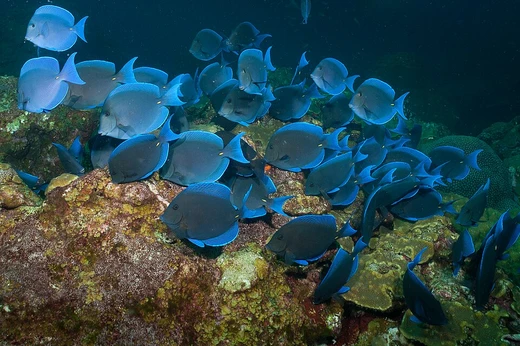
A blue-tailed surgeonfish from the western central Pacific.

The bluetail unicornfish (Naso caeruleacauda), sometimes called the blue unicornfish, is a marine ray-finned fish in the Acanthuridae family, which includes surgeonfishes, unicornfishes, and tangs. It lives in the western central Pacific Ocean.
American ichthyologist John Ernest Randall first described this species in 1994, using a specimen from Dumaguete on Negros in the Philippines. It belongs to the subgenus Axinurus within the genus Naso, the only genus in the subfamily Nasinae of the Acanthuridae family. Its scientific name, caeruleacauda, means "blue tail," referring to the fish's most striking feature: its blue caudal fin.
The dorsal fin has four or five spines and 28 to 30 soft rays, while the anal fin has two spines and 29 soft rays. The body's standard length is about 2.75 to 2.8 times its depth. The head's upper profile, from the upper lip to between the eyes, is straight, with a bulge between the eyes and nostrils. In life, the fish is bluish grey or brownish grey, paler (sometimes yellowish) on the lower body, with a yellow patch under the pectoral fins. It can reach a total length of 40 cm (16 in) and a maximum weight of 1.1 kg (2.4 lb).
This species is found in Indonesia, the Philippines, and the Great Barrier Reef of Australia, with one record off northeastern Madagascar. It forms schools on steep seaward slopes, typically at depths greater than 15 m (49 ft).
Quick Facts
- Parent
- Axinurus
- Taxon
- Naso caeruleacauda
Facts from the source article.
Lore & Background
The bluetail unicornfish was first formally described in 1994 by the American ichthyologist John Ernest Randall, with its type locality given as Dumaguete on Negros in the Philippines. It is classified in the subgenus Axinurus within the genus Naso, which is the only genus in the subfamily Nasinae of the family Acanthuridae. The specific name caeruleacauda means 'blue tail', an allusion to its 'most striking color feature', the blue caudal fin.
The body has a standard length between 2.75 and 2.8 times its depth. The dorsal profile of the head between the upper lip and the intraorbital space is straight, with a bulge between the eyes and the nostrils. In life, the colour is bluish grey or brownish grey, paler (even yellowish) on the lower body, with a yellow patch beneath the pectoral fins. The caudal fin is blue. This species forms schools over steep seaward slopes, typically at depths in excess of 15 m (49 ft).
Reader's Guide
The bluetail unicornfish is notable as a relatively recently described species, first formally recognized in 1994 by John Ernest Randall. Its striking blue tail, reflected in its scientific name caeruleacauda, distinguishes it from other surgeonfishes. The species is found in the western central Pacific, including Indonesia, the Philippines, the Great Barrier Reef of Australia, and has also been recorded off northeastern Madagascar. It inhabits steep seaward slopes at depths exceeding 15 meters, often schooling. With a maximum total length of 40 cm and weight of 1.1 kg, it represents a moderate-sized member of the Acanthuridae family. Its classification within the subgenus Axinurus of the genus Naso places it among the unicornfishes, though it lacks the prominent horn-like projection seen in some relatives. The species' blue caudal fin and yellow patch beneath the pectoral fins are key identifying features. Its distribution across the western central Pacific and Madagascar indicates a potentially broader range than initially documented.
Did You Know?
- Its specific name caeruleacauda means 'blue tail', referring to its blue caudal fin.
- The maximum published total length is 40 cm (16 in) and maximum weight is 1.1 kg (2.4 lb).
- It has been recorded off northeastern Madagascar as well as in Indonesia, the Philippines, and the Great Barrier Reef.
Taxonomic Identity & Family Context
The Bluetail unicornfish occupies a well-defined position within the surgeonfish family, Acanthuridae, a lineage that encompasses a remarkable diversity of reef-dwelling species. In the Red Sea, this family includes at least seven surgeonfish species such as the Black surgeonfish, the Brown surgeonfish, the Sohal surgeonfish, and the Yellowfin surgeonfish, alongside the unicornfishes. Within Acanthuridae, the genus Naso sets itself apart as the unicornfish lineage, a group whose members share a distinctive body plan that separates them from their surgeonfish relatives. The Bluetail unicornfish is one member of this Naso assemblage, which in the Red Sea also includes the Whitemargin, Spotted, Elegant, Sleek, and Bluespine unicornfishes. Together, these five additional Naso species form a close taxonomic neighborhood, all sharing the same family-level classification while maintaining their own individual identities. The Acanthuridae family as a whole represents one of the most species-rich groups on Red Sea reefs, with eleven distinct species documented in this region, underscoring the evolutionary success of this lineage in tropical reef environments.
Reef Habitat & Geographic Range
According to Fishbase, the Bluetail unicornfish is classified as a reef-associated species, a designation that anchors its ecological identity to the structured, three-dimensional habitats of coral and rocky reefs. Its geographic range is the Red Sea, a narrow, warm-water body where reef communities achieve a density and diversity that make them among the most studied marine ecosystems on the planet. The reef-associated label implies that this unicornfish is not a pelagic wanderer but rather a resident of the benthic zone, moving through the complex architecture of reef structures rather than open water. In the Red Sea, this habitat context places the Bluetail unicornfish among a vast assemblage of reef-dwelling species spanning dozens of families, from the small, camouflaged frogfishes of the Antennariidae to the large, fast-moving trevallies of the Carangidae. The reef itself serves as both shelter and foraging ground, and the Bluetail unicornfish's association with this environment distinguishes it from more open-water species that also occur in Red Sea waters, such as the Pelagic thresher or the Roundjaw bonefish.
The Naso Community & Acanthuridae Richness
Within the Red Sea, the Bluetail unicornfish shares its genus with five other recognized unicornfish species, creating a compact but visually diverse community of Naso. The Whitemargin, Spotted, Elegant, Sleek, and Bluespine unicornfishes each carry names that hint at their distinctive markings, suggesting a range of color patterns and body shapes within a single genus. All six species belong to the Acanthuridae family, which in the Red Sea also includes seven surgeonfish species: the Black, Elongate, Brown, Sohal, Doubleband, and Yellowfin surgeonfishes, plus the Striated surgeonfish. This concentration of Acanthuridae on Red Sea reefs indicates that the surgeonfish and unicornfish lineage has found particularly favorable conditions in this region. The co-occurrence of multiple Naso species in the same geographic area raises questions about how they partition their niches, forage at different depths, or occupy different reef zones, though the Fishbase listing confirms only their shared reef association and family membership as the unifying thread.
The Broader Red Sea Reef Ecosystem
The Bluetail unicornfish exists as one thread in an extraordinarily rich tapestry of Red Sea reef life. The Fishbase listing for reef-associated species in this region spans an enormous number of families, painting a picture of a community where the unicornfish shares its habitat with species as varied as the Scarlet frogfish, the Sargassum fish, dozens of cardinalfish species in the Apogonidae, multiple triggerfishes in the Balistidae, a wide array of blennies, several flounder species, numerous fusilier species in the Caesionidae, and an impressive collection of trevallies and runners in the Carangidae. The presence of the Pelagic thresher, the Flashlight fish, and various needlefish species further illustrates the breadth of ecological roles represented. For the Bluetail unicornfish, this means navigating a reef environment where visual diversity is extreme and where dozens of species compete for space, food, and shelter. The reef-associated classification unites all these species under a single ecological umbrella, confirming that the Red Sea's structured habitats support one of the most species-dense marine communities known to science.
Frequently Asked Questions
What is the bluetail unicornfish?
The bluetail unicornfish (Naso caeruleacauda) is a marine ray-finned fish placed in the Acanthuridae family, the group that covers surgeonfishes, unicornfishes, and tangs. It sits within the subgenus Axinurus of the genus Naso, which is the sole genus of the subfamily Nasinae.
Where does the bluetail unicornfish live?
This species is found in the western central Pacific Ocean. The original specimen used to describe it was collected from Dumaguete on Negros Island in the Philippines.
How big can a bluetail unicornfish grow?
Adults top out at roughly 40 cm (about 16 inches) in total length and can weigh up to 1.1 kg (around 2.4 lb). They carry 4 or 5 dorsal fin spines alongside 28 to 30 soft dorsal rays.
Who first described the bluetail unicornfish?
American ichthyologist John Ernest Randall formally named the species in 1994, working from a specimen gathered at Dumaguete, Negros, in the Philippines.
What does the name 'caeruleacauda' actually mean?
The specific epithet translates to 'blue tail,' a nod to the fish's most striking coloration. That same trait is why anglers and hobbyists often just call it the blue unicornfish.
More in Tangs and Surgeonfish 1-24
Spotted an error? Know more?
Reader corrections go straight into our review queue. Suggest an edit · How this site is sourced