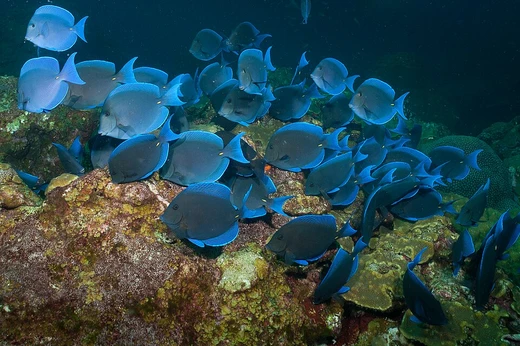
Naso (fish)
A genus of unicornfishes with a hornlike forehead protuberance.

The unicornfish genus *Naso* belongs to the family Acanthuridae, which also includes surgeonfishes and tangs. These marine ray-finned fish get their common name from the "rostral protuberance"—a horn-like bump on the forehead—that appears in some species. Found across the Indo-Pacific from the eastern coast of Africa to the Galápagos Islands, they live mainly around coral reefs and feed mostly on algae. Spearfishermen often target them, and they are commonly grilled whole. The genus was first proposed in 1801 by Bernard Germain de Lacépède, who described *Naso fronticornis* as a new species from Jeddah and Mauritius. Lacépède’s name replaced *Chaetodon unicornis*, which Peter Forsskål had described in 1775 from Jeddah. In 1917, David Starr Jordan designated *Naso fronticornis* as the type species. *Naso* is the sole genus in the monogeneric subfamily Nasinae, proposed by Henry Weed Fowler and Barton Appler Bean in 1929. The name *Naso* means "nose," referring to the fleshy forehead protuberance of *N. fronticornis* (=*unicornis*). The subgenus *Axinurus* comes from words meaning "axe-tail," possibly describing the single tail spine on each side, unlike the two spines in the subgenus *Naso*. These fish have a pointed snout and a rhomboidal or oval body. Some species sport a long forehead protuberance, usually in both sexes. The slender caudal peduncle bears one or two sharp, blade-shaped spines on each side, mounted on bony plates. The caudal fin ranges from slightly rounded to deeply forked, and in some species, long filaments extend from the fin tips—sometimes only in males. The dorsal fin has 4 to 7 spines and 24 to 31 soft rays; the anal fin has 2 spines and 23 to 30 soft rays. Pelvic fins have one spine and three soft rays, while pectoral fins have 16 to 19 soft rays. Size varies widely: the slender unicorn (*N. minor*) reaches a maximum standard length of 30 cm (12 in), while the whitemargin unicornfish (*N. annulatus*) can grow to 100 cm (39 in) total length. The two subgenera are distinguished by the number of keels on the caudal peduncle—*Naso* has a pair on each side, while *Axinurus* has a single keel per side. Unlike other acanthurids, *Naso* unicornfishes eat zooplankton rather than grazing on algae or detritus, and they tend to live at greater depths. The purpose of the forehead horn is uncertain.
Quick Facts
- Taxon
- Naso
- Type Species
- Acanthurus fronticornis
- Type Species Authority
- Lacepède, 1801
Facts from the source article.
Lore & Background
The genus Naso was first proposed in 1801 by Bernard Germain de Lacépède, who described Naso fronticornis as a new species from Jeddah and Mauritius. This name was an unnecessary replacement of Chaetodon unicornis, described by Peter Forsskål in 1775 from Jeddah. In 1917, David Starr Jordan designated Naso fronticornis as the type species. Naso is the only genus in the monogeneric subfamily Nasinae, proposed by Henry Weed Fowler and Barton Appler Bean in 1929 within the family Acanthuridae. The etymology of Naso means 'nose,' referring to the fleshy protuberance on the forehead of N. fronticornis. The subgenus Axinurus comes from words meaning 'axe-tail,' potentially referring to the presence of a single tail spine on each side, as opposed to two in the subgenus Naso. Naso unicornfishes have a pointed snout and a rhomboidal or oval body, with some species possessing a long protuberance on the forehead, typically present in both males and females. The caudal peduncle is slender, with 1 or 2 anteriorly directed sharp, blade-shaped spines mounted on bony plates on each side. The caudal fin varies from slightly rounded to highly emarginate, and in some species there are long filaments at the tips of the lobes, sometimes restricted to males. Dorsal fins are supported by 4 to 7 spines and 24 to 31 soft rays, while the anal fin contains 2 spines and 23 to 30 soft rays. The pelvic fins have a single spine and 3 soft rays, and the pectoral fins have 16 to 19 soft rays. The two subgenera are distinguished by the number of keels on the caudal peduncle: Naso has a pair on each side, while Axinurus has a single keel on each side. Naso unicornfishes differ from other acanthurids in that they eat zooplankton rather than grazing on algae or detritus, and they tend to live at greater ranges of depth. The function of the cephalic horn is uncertain. One explanation suggests it results from sexual selection, serving in competition and communication. Alternatively, it may perform a hydrodynamic function, assisting with precision movements, as fast-swimming 'scombriform' species and small species typically lack the horn, while large, relatively slow-swimming species display it. Molecular phylogenetics show that horns independently evolved multiple times within the genus, and only in benthic-feeding species. Pelagic feeding and the fast-swimming 'scombriform' body shape appear to be plesiomorphic traits, as the basalmost species in Naso are the pelagic-feeding 'scombriform' species in the subgenus Axinurus. In some species, both males and females display the horn; in the bluespine unicornfish, the horn is slightly sexually dimorphic, being larger in males. In the humpback unicornfish, the horn is almost completely absent in females.
Reader's Guide
Naso unicornfishes hold significance as a distinct group within the Acanthuridae, notable for the hornlike forehead protuberance that gives them their common name. The genus was first described in 1801 by Bernard Germain de Lacépède, and its type species was designated by David Starr Jordan in 1917. The genus is the sole member of the subfamily Nasinae, proposed in 1929. The etymology of Naso, meaning 'nose,' directly references this characteristic horn. The genus is divided into two subgenera based on the number of keels on the caudal peduncle, a key morphological distinction. The 20 species vary widely in size, from the slender unicorn at 30 cm to the whitemargin unicornfish at 100 cm. Their biology sets them apart from other acanthurids: they feed on zooplankton rather than algae and inhabit greater depth ranges. The function of the cephalic horn remains uncertain, with hypotheses ranging from sexual selection to hydrodynamic assistance. Molecular phylogenetics indicate that horns evolved multiple times independently within the genus, and only in benthic-feeding species, while pelagic feeding and the 'scombriform' body shape are ancestral traits. The horn shows sexual dimorphism in some species, such as the bluespine unicornfish, where it is slightly larger in males, and the humpback unicornfish, where it is nearly absent in females. These fishes are popular with spearfishermen and are often grilled whole, and they are distributed across the Indo-Pacific from Africa to the Galápagos Islands.
Did You Know?
- Naso unicornfishes differ from other acanthurids by eating zooplankton rather than grazing on algae or detritus.
- The function of the cephalic horn is uncertain; hypotheses include sexual selection and hydrodynamic assistance.
- The subgenus Axinurus has a single keel on each side of the caudal peduncle, while the subgenus Naso has a pair.
Naming and Taxonomic Lineage
The family name Acanthuridae draws from two Ancient Greek roots: ákantha, meaning spine, and ourá, meaning tail, a direct nod to the blade-like bony plates found on the caudal peduncle of the type species. Before settling on this name, the group was known as Hepatidae in the early twentieth century. The family is organized into two extant subfamilies: Nasinae, named by Fowler and Bean in 1929 and containing only the genus Naso (described by Lacépède in 1801), and Acanthurinae, established by Bonaparte in 1835. The latter subfamily is further divided into three tribes—Acanthurini, Prionurini, and Zebrasomini—encompassing the genera Acanthurus, Ctenochaetus, Prionurus, Paracanthurus, and Zebrasoma. Together, these lineages account for roughly 86 living species of marine ray-finned fishes, most of which inhabit tropical waters and are frequently encountered around coral reef structures, where their vivid coloration makes them popular subjects for the aquarium trade.
Body Plan, Feeding Ecology, and Growth
What sets every member of this family apart is a pair of scalpel-like modified scales positioned on either side of the tail peduncle. These spines are genuinely dangerous and can inflict serious wounds on anyone who handles the fish carelessly. The dorsal, anal, and caudal fins are notably large, stretching across most of the body length, while the mouth remains small with a single row of teeth specialized for grazing algae. Feeding behavior is flexible: individuals may forage alone or move in schools, the latter strategy likely serving to overwhelm the fierce territorial defenses of small damselfishes that guard algae patches on reefs. Most species top out between 15 and 40 centimeters, though select members of Acanthurus, Prionurus, and especially Naso grow considerably larger. The whitemargin unicornfish, Naso annulatus, is the family's champion, reaching up to a meter in length. In captivity these fish can grow rapidly, so prospective aquarists must verify adult size and tank suitability before introduction.
A Deep Fossil Record
The evolutionary history of surgeonfishes stretches back to the Eocene, with several extinct genera documented from fossils spanning the Eocene through the Miocene. The Monte Bolca Lagerstätte in Italy is particularly rich, yielding an unusually diverse assemblage of fossil surgeonfishes that represent some of the earliest known representatives of the individual tribes within the family. Eocene fossils include at least a dozen genera, many described by Blot and Tyler in the 1990s, such as Acanthuroides, Eorandallius, Metacanthurus, Proacanthurus, and Tylerichthys, alongside others like Frigosorbinia, Gazolaichthys, and Lehmanichthys. The Oligocene record adds Arambourgthurus, Caprovesposus, and Glarithurus, while the Miocene is represented by Marosichthys. This long fossil sequence provides a rare window into how the family's tribal structure and morphological diversity were established over tens of millions of years.
The Acronurus Larva and Bacterial Symbiosis
Two biological features distinguish acanthurids from other reef fishes. First, the larval stage—called an acronurus—bears almost no resemblance to the juvenile or adult that follows. It is largely transparent and adopts a pelagic lifestyle, drifting in open water for a prolonged period before eventually settling near the shore on the ocean floor, where it metamorphoses into the recognizable juvenile form and, ultimately, the adult. Second, surgeonfishes are the sole known hosts of bacteria belonging to the genus Epulopiscium. This symbiotic relationship is critical to the fish's digestive physiology, as the bacteria enable the breakdown and digestion of the algae that form the bulk of the diet. Without this microbial partnership, the small, single-row-toothed mouth and grazing feeding strategy would be far less effective. The combination of a radically different pelagic larval phase and an obligate bacterial symbiosis makes the family's life cycle and internal ecology uniquely complex among marine ray-finned fishes.
Frequently Asked Questions
What is Naso (fish)?
Naso is a genus of marine unicornfishes within the family Acanthuridae, best recognized by a horn-like bump on the forehead seen in several of its members. It comprises roughly 20 species split across two subgenera, Naso and Axinurus.
What sets Naso apart from other tangs and surgeonfish?
The key distinguishing feature is the rostral protuberance, a horn-shaped projection on the snout that earns the group its common name 'unicornfish.' Most other Acanthuridae species simply lack that forehead bump.
How big do Naso species get?
Sizes vary considerably across the genus, from about 30 cm (12 in) standard length in the slender unicorn (N. minor) up to roughly 100 cm (39 in) total length in the whitemargin unicornfish (N. annulatus).
Where can you find Naso in the wild?
These algae-grazing reef fish are distributed throughout the Indo-Pacific, ranging from the eastern coast of Africa eastward all the way to the Galápagos Islands.
Who originally described the genus Naso?
French naturalist Bernard Germain de Lacépède first proposed the genus in 1801 around the species Naso fronticornis, which David Starr Jordan later formally designated as the type species in 1917.
More in Tangs and Surgeonfish 1-24
Spotted an error? Know more?
Reader corrections go straight into our review queue. Suggest an edit · How this site is sourced