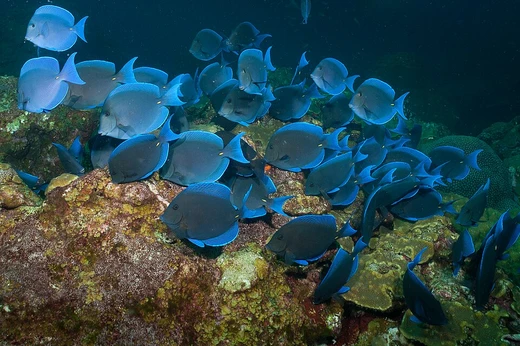
Acanthurinae
A subfamily of surgeonfishes and tangs from the Indo-Pacific and tropical Atlantic.

Acanthurinae is a subfamily of marine ray-finned fishes belonging to the family Acanthuridae, commonly known as surgeonfishes or tangs. They are found in the Indo-Pacific and the tropical Atlantic. The subfamily is notable for being the nominate subfamily of Acanthuridae, proposed by French zoologist Charles Lucien Bonaparte in 1835.
Quick Facts
- Taxon
- Acanthurinae
- Type Species
- Acanthurus triostegus
- Type Species Authority
- (Linnaeus, 1758)
Facts from the source article.
Lore & Background
The subfamily Acanthuriinae was proposed as the nominate subfamily of Acanthuridae by French zoologist Charles Lucien Bonaparte in 1835. The 5th edition of Fishes of the World recognizes three tribes within the subfamily: Acanthurini, Prionurini, and Zebrasomoni. The other subfamily in Acanthuridae is the monogeneric Nasinae.
Acanthurini surgeonfishes are characterized by having three spines in the anal fin and one or more mobile and flexible spines on the caudal peduncle, which may be extended as a defensive weapon. In the tribe Acanthurini, this spine is held in a deep slit. They have five branchiostegals and spatulate teeth in the jaws. The smallest species is the bluebarred surgeonfish (Acanthurus polyzona) with a maximum published total length of 11 cm, while the largest species, Fowler's surgeonfish (A. folweri) and the powderblue surgeonfish (A. leucosternon), both reach 54 cm.
Acanthurinae are mainly found in the Indo-Pacific region, but five species in the genus Acanthurus extend into the tropical and subtropical Atlantic Ocean. They are absent from the Mediterranean.
Reader's Guide
Acanthurinae holds significance as the nominate subfamily of Acanthuridae, proposed by Charles Lucien Bonaparte in 1835. The subfamily includes three tribes—Acanthurini, Prionurini, and Zebrasomoni—as recognized by the 5th edition of Fishes of the World. With 57 species listed by FishBase, the genus Acanthurus is the most speciose, containing 40 species. The subfamily's defining characteristics include three anal fin spines and a mobile, flexible spine on the caudal peduncle used for defense, except in Prionurus where the spine is not mobile. The smallest species, the bluebarred surgeonfish, reaches only 11 cm, while the largest, Fowler's surgeonfish and the powderblue surgeonfish, reach 54 cm. Their distribution is primarily Indo-Pacific, with five Acanthurus species extending into the tropical and subtropical Atlantic, but they are absent from the Mediterranean. These fishes are commonly called surgeonfishes or tangs.
Did You Know?
- Acanthurinae was proposed as a subfamily by French zoologist Charles Lucien Bonaparte in 1835.
- The subfamily contains 57 species, with Acanthurus being the most speciose genus at 40 species.
- The smallest species is the bluebarred surgeonfish (Acanthurus polyzona) at 11 cm, and the largest are Fowler's surgeonfish and the powderblue surgeonfish at 54 cm.
- Five species of Acanthurus extend into the tropical and subtropical Atlantic, but none are found in the Mediterranean.
Taxonomic Architecture and Nomenclature
The subfamily Acanthurinae, formally established by Bonaparte in 1835, occupies a central position within the broader Acanthuridae family of ray-finned marine fishes. Its taxonomic architecture is organized into three distinct tribes: Acanthurini, described by Bonaparte in 1839; Prionurini, named by J. L. B. Smith in 1966; and Zebrasomini, introduced by Winterbottom in 1993. Together, these tribes encompass five extant genera — Acanthurus (Forsskål, 1775), Ctenochaetus (Gill, 1884), Prionurus (Lacépède, 1804), Paracanthurus (Bleeker, 1863), and Zebrasoma (Swainson, 1839). The family name itself draws from two Ancient Greek words: ákantha, meaning "spine," and ourá, meaning "tail," a direct nod to the scalpel-like bony plates found on the caudal peduncle of the type species. Notably, in the early twentieth century the entire family carried the alternative designation Hepatidae before the current nomenclature took hold. The subfamily's members inhabit tropical seas worldwide, typically associated with coral reef environments, and the family as a whole comprises roughly 86 living species.
Morphology and Grazing Ecology
Members of Acanthurinae are immediately recognizable by a suite of morphological traits that set them apart from other reef fishes. The most striking feature is the presence of one or more scalpel-like modified scales on either side of the tail peduncle — dangerously sharp structures capable of inflicting serious injury on anyone who handles the fish carelessly. Their dorsal, anal, and caudal fins are proportionally large, stretching along most of the body's length, while their mouths remain small and bear a single row of teeth specifically adapted for grazing on algae. In terms of size, most species in the subfamily reach only 15 to 40 centimeters, though certain members of Acanthurus and Prionurus can grow considerably larger. Their feeding ecology is equally distinctive: while a surgeonfish may graze as a solitary individual, it frequently travels and feeds in coordinated schools. This group behavior appears to serve a strategic purpose, overwhelming the aggressive territorial defenses of small damselfishes that vigorously guard patches of algae on coral reefs. The result is a foraging strategy that balances individual efficiency with collective force.
Deep-Time Fossil Record
The evolutionary story of Acanthurinae stretches back millions of years, with fossil evidence spanning the Eocene, Oligocene, and Miocene epochs. The Monte Bolca Lagerstätte in Italy stands out as an exceptionally rich source of Eocene surgeonfish fossils, yielding a particularly large diversity of extinct genera. These specimens represent some of the earliest known representatives of the individual tribes that make up the Acanthuridae today. Among the Eocene genera documented from this site are Acanthuroides, Eorandallius, Frigosorbinia, Gazolaichthys, Lehmanichthys, Metacanthurus, Metaspisurus, Padovathurus, Pesciarichthys, Proacanthurus, Protozebrasoma, Sorbinithurus, Tauichthys, and Tylerichthys — a remarkable array that underscores the ancient origins of the group's tribal structure. The Oligocene record adds Arambourgthurus, Caprovesposus, Glarithurus, and possibly Eonaso, while the Miocene contributes Marosichthys. Together, these fossils paint a picture of a lineage that has maintained its fundamental body plan across tens of millions of years of marine environmental change.
Larval Metamorphosis, Symbiosis, and Aquarium Life
The life history of Acanthurinae members is marked by a dramatic transformation between life stages. The larval form, known as an acronurus, appears almost unrecognizable compared to the juvenile and adult fish: it is largely transparent and adopts a pelagic lifestyle, drifting in open water for an extended period before eventually settling near the shore on the ocean floor. There it undergoes development into the juvenile and ultimately the adult form we associate with coral reefs. Beyond this striking metamorphosis, surgeonfishes harbor a unique biological partnership: they are the only known hosts of bacteria belonging to the genus Epulopiscium. These symbiotic microorganisms play a critical role in the fish's digestive system, enabling them to break down and extract nutrients from the algae that form the basis of their diet. In the human world, Acanthurinae species are widely kept in marine aquaria, prized for their bright coloration. However, their rapid growth in captivity means that prospective aquarists must carefully research average adult size and tank suitability before introducing them into a marine setup.
Frequently Asked Questions
Who is Acanthurinae?
Acanthurinae is a subfamily of marine ray-finned fishes within the family Acanthuridae, the group most people recognize as surgeonfishes or tangs. It was formally proposed in 1835 by French zoologist Charles Lucien Bonaparte.
What are Acanthurinae's powers and role?
As the nominate subfamily of Acanthuridae, it serves as the default taxonomic bucket for the group, housing 57 species spread across three recognized tribes. Its most species-rich genus, Acanthurus, anchors much of the subfamily's overall diversity.
Why is Acanthurinae important?
It is the type subfamily of the entire Acanthuridae family, meaning the family's very name is etymologically anchored to it. Its members also play a significant ecological role across Indo-Pacific and tropical Atlantic reef systems.
Who are Acanthurinae's closest allies?
The subfamily is divided into three tribes: Acanthurini, Prionurini, and Zebrasomoni, each representing a distinct lineage within the group. Together they account for all 57 recognized species in Acanthurinae.
More in Tangs and Surgeonfish 1-24
Spotted an error? Know more?
Reader corrections go straight into our review queue. Suggest an edit · How this site is sourced