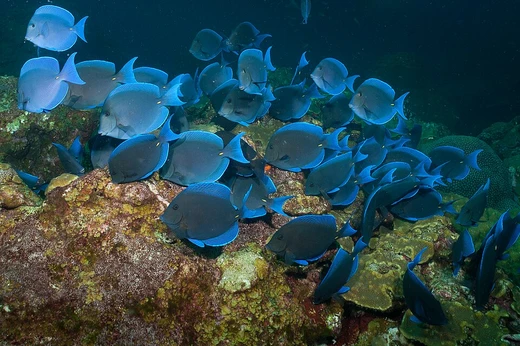
Squarenose unicornfish
A surgeonfish with a square forehead protuberance, found in the Indo-Pacific.

The squarenose unicornfish (Naso mcdadei) is a marine ray-finned fish in the surgeonfish family Acanthuridae. It lives in the Indo-Pacific region.
Australian ichthyologist Jeffrey W. Johnson of the Queensland Museum first described the species in 2002, based on a specimen from Flat Rock off Stradbroke Island, Queensland. It belongs to the nominate subgenus of the genus Naso, the sole genus in the subfamily Nasinae.
Its specific name honors Michael McDade, a spearfisher and records officer for the Australian Underwater Federation, who collected and donated many rare fish specimens—including the type—to the Queensland Museum.
The dorsal fin has 5 spines and 28–31 soft rays; the anal fin has 2 spines and 26–29 soft rays. Each jaw holds 50–70 serrated teeth, with tooth count increasing with age. Body standard length is about 2.4 to 3 times its depth, with a rounded dorsal profile. Adults have a square forehead protuberance. The caudal peduncle bears two bony plates per side, each with a forward-pointing spine. The caudal fin is truncate in mature fish and emarginate in juveniles. Overall color is bluish-grey to olive-grey, lighter below. The dorsal and caudal fins have thin pale margins, and the caudal fin also has a black subterminal band. Maximum total length is 75 cm (30 in).
The species occurs from the east African coast (Mozambique to KwaZulu-Natal) around Madagascar, Mauritius, the Chagos Archipelago, the Maldives, east through Indonesia to the western Pacific north to Taiwan and south to Australia. Australian records include the Dampier Archipelago (Western Australia), Ashmore Reef (Timor Sea), and from Cape Grenville to Stradbroke Island (Queensland). It inhabits steep coral reef drop-offs, rock outcrops, and areas away from reefs.
Quick Facts
- Taxon
- Naso mcdadei
Facts from the source article.
Lore & Background
The squarenose unicornfish was first formally described in 2002 by Australian ichthyologist Jeffrey W. Johnson of the Queensland Museum, with its type locality given as Flat Rock off Stradbroke Island in Queensland. It is classified within the nominate subgenus of the genus Naso, which is the only genus in the subfamily Nasinae within the family Acanthuridae. Its specific name honours Michael McDade, a spearfisher and records officer for the Australian Underwater Federation, who collected and donated many rare fish specimens to the Queensland Museum, including the type of this species.
In terms of description, the squarenose unicornfish has a dorsal fin supported by 5 spines and between 28 and 31 soft rays, while the anal fin has 2 spines and 26 to 29 soft rays. There are between 50 and 70 teeth in each jaw, with serrated edges, and the number of teeth increases with age. Its body has a standard length about 2.4 to 3 times its depth, with a rounded dorsal profile. Adults have a square protuberance on the forehead. The caudal peduncle bears a pair of bony plates on each side, each with a forward-pointing spine. The caudal fin is truncate in mature fish but emarginate in juveniles. The overall colour is bluish-grey to olive-grey, lighter on the lower body, with a thin pale margin on the dorsal and caudal fins, and a black subterminal band on the caudal fin.
The species is found in the Indo-Pacific region, from the east African coast (Mozambique to KwaZulu Natal), around Madagascar, Mauritius, the Chagos Archipelago, the Maldives, east through Indonesia into the Western Pacific north to Taiwan and south to Australia. In Australia, it has been recorded from the Dampier Archipelago in Western Australia, Ashmore Reef in the Timor Sea, and from Cape Grenville to Stradbroke Island in Queensland. It inhabits steep drop-offs of coral reefs or around rock outcrops, and is typical of habitats away from reef areas.
Reader's Guide
The squarenose unicornfish is significant as a species within the family Acanthuridae, representing the genus Naso and the subfamily Nasinae. Its description in 2002 by Jeffrey W. Johnson added to the known diversity of surgeonfishes in the Indo-Pacific. The species is notable for its square forehead protuberance in adults, which distinguishes it from other unicornfishes. Its specific name honors Michael McDade, a spearfisher and records officer for the Australian Underwater Federation, highlighting the role of citizen scientists in contributing to ichthyology through specimen collection. The species' distribution across a wide Indo-Pacific range, from East Africa to the Western Pacific, including Australian waters, underscores its adaptability to various coral reef and rocky habitats away from reef areas. Its maximum total length of 75 cm makes it a relatively large surgeonfish. The detailed description of its fin rays, teeth, and colouration provides a basis for identification and further study. The species' presence in locations such as the Dampier Archipelago and Ashmore Reef indicates its occurrence in both tropical and subtropical waters. Overall, the squarenose unicornfish contributes to the ecological diversity of reef-associated fish communities and represents a relatively recent addition to the known fauna of the region.
Did You Know?
- Adults have a square protuberance on the forehead, giving the species its common name.
- This species can reach a maximum total length of 75 cm (30 in).
More in Tangs and Surgeonfish 1-24
Spotted an error? Know more?
Reader corrections go straight into our review queue. Suggest an edit · How this site is sourced