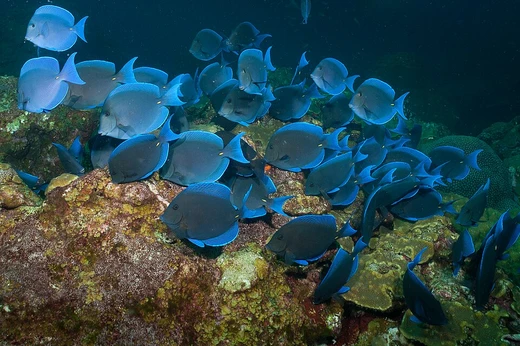
Sleek unicornfish
A widespread Indo-Pacific surgeonfish with no forehead protuberance.

The sleek unicornfish (Naso hexacanthus) is a marine ray-finned fish from the surgeonfish family Acanthuridae. It goes by several common names, including blue-tail unicorn, Thorpe's unicornfish, blacktongue unicornfish, and ʻopelu kala. This species lives in coral reefs across the Pacific and Indian Oceans, and it is caught for commercial fisheries, sport fishing, and kept in aquariums.
The fish was first scientifically described by Dutch ichthyologist Pieter Bleeker, who named it *Priodon hexacanthus* based on a specimen from Ambon Island in Indonesia. It belongs to the genus *Naso*, which is the sole genus in the subfamily Nasinae within the Acanthuridae family. The species name *hexacanthus* means "six spines," referring to the six spines on its dorsal fin.
The sleek unicornfish has a wide Indo-Pacific range, from Hawaii to Africa and India. It inhabits lagoons and seaward reef slopes. Because of this broad distribution, the IUCN lists its conservation status as Least Concern.
Unlike some other unicornfishes, this species lacks a horn-like protrusion on its forehead. Its body color ranges from dark brown to yellow, and it can sometimes shift to blue or silver. Adults reach up to 75 centimeters in length. Its teeth are angled backward, and its tongue is black.
The sleek unicornfish feeds on plankton, small crustaceans, and filamentous algae. It is moderately targeted by fisheries.
Quick Facts
- Parent
- Naso (Naso)
- Taxon
- Naso hexacanthus
Facts from the source article.
Lore & Background
The sleek unicornfish was first formally described as Priodon hexacanthus by the Dutch physician, herpetologist and ichthyologist Pieter Bleeker, with its type locality given as Ambon Island in the Moluccas, Indonesia. It is classified within the nominate subgenus of the genus Naso, the only genus in the subfamily Nasinae within the family Acanthuridae. Its specific name, hexacanthis, means 'six spines' and refers to the six dorsal fin spines.
This species does not have a protuberance extending from its forehead, unlike some of its congeners. Its colors range from dark brown to yellow, occasionally changing to blue or silver. Adults measure 75 centimeters in length. The teeth are angled backwards, and the tongue is black. The sleek unicornfish consumes plankton, small crustaceans, and filamentous algae. It is the subject of moderate fisheries.
Reader's Guide
The sleek unicornfish is notable for its wide Indo-Pacific distribution, from the Hawaiian islands to Africa and India, and its presence in lagoons and seaward reef slopes. Its conservation status has been assessed as Least Concern by the IUCN due to this broad range. The species holds value in commercial fisheries and as a game fish, and it is also seen in aquaria, indicating its appeal to both subsistence and recreational users. Its lack of a forehead protuberance distinguishes it from many other unicornfishes, and its variable coloration—from dark brown to yellow, and occasionally blue or silver—adds to its recognition. The black tongue and backward-angled teeth are specific anatomical features noted in the species. As a consumer of plankton, small crustaceans, and filamentous algae, it plays a role in the reef ecosystem. The species is subject to moderate fisheries, suggesting ongoing but not excessive exploitation. Its original description by Pieter Bleeker from Ambon Island in Indonesia anchors its taxonomic history within the broader context of Indo-Pacific ichthyology.
Did You Know?
- The species was first described as Priodon hexacanthus by Pieter Bleeker from Ambon Island in the Moluccas, Indonesia.
- Its tongue is black, and its teeth are angled backwards.
More in Tangs and Surgeonfish 1-24
Spotted an error? Know more?
Reader corrections go straight into our review queue. Suggest an edit · How this site is sourced