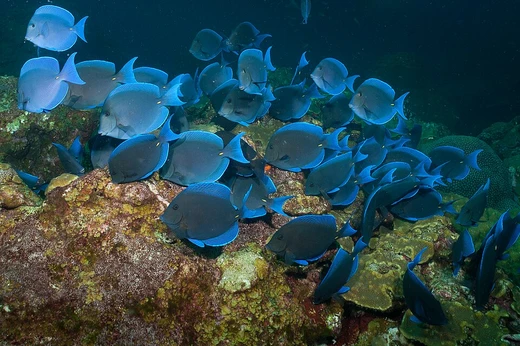
Reticulate unicornfish
A rare Indo-West Pacific coral reef fish with a net-like pattern.

The reticulate unicornfish (Naso reticulatus) is a marine ray-finned fish in the Acanthuridae family, which also includes surgeonfishes and tangs. This rare species inhabits coral reefs in the Indo-West Pacific.
American ichthyologist John Ernest Randall first formally described the fish in 2001, based on a specimen collected at a depth of 15 meters in Nanwan, Taiwan. It belongs to the nominate subgenus of the genus Naso, the only genus in the subfamily Nasinae.
Its species name, *reticulatus*, means "net-like," referring to the net-like pattern of lines on its body.
The fish lacks a forehead protuberance. Its head has a slightly convex profile with a small bump in front of the eyes. The body depth is less than one-third of its standard length. The dorsal fin has 5 spines and 29 soft rays; the anal fin has 2 spines and 27 soft rays. Two bony plates with small keels sit on each side of the caudal peduncle. The upper body is pale-brown to olive brown, the belly white. The upper 60% of the body is marked with small black spots and a network of dark lines. Maximum published standard length is 49 cm (19 in).
The species occurs in the Indian and Pacific Oceans, with records from India, Pakistan, China, Taiwan, Philippines, Indonesia, and the Dampier Archipelago off Western Australia. It is an uncommon coral reef fish, often found near drop-offs.
Quick Facts
- Parent
- Naso (Naso)
- Taxon
- Naso reticulatus
Facts from the source article.
Lore & Background
The reticulate unicornfish was first formally described in 2001 by American ichthyologist John Ernest Randall, with its type locality given as a bay off Taiwan at a depth of 15 meters. It is classified within the nominate subgenus of the genus Naso, which is the only genus in the subfamily Nasinae of the family Acanthuridae. The specific name reticulatus means 'net like', referring to the net-like pattern of lines on the body.
This species has no protuberance on the forehead, unlike some other unicornfishes. Its head has a slightly convex profile with a small bump in front of the eyes. The body depth fits into its standard length over three times. The caudal peduncle bears two bony plates on each side, each with small keels. The body is pale-brown to olive brown on the upper part and white on the belly, with the upper 60% marked by small black spots and a network of dark lines.
The reticulate unicornfish is found in the Indian and Pacific Oceans, with records off India, Pakistan, China, Taiwan, Philippines, Indonesia, and the Dampier Archipelago off Western Australia. It is an uncommon species of coral reefs, frequently found near drop offs.
Reader's Guide
The reticulate unicornfish is notable as a rare species within the family Acanthuridae, first described in 2001 by John Ernest Randall. Its description adds to the understanding of the genus Naso, the sole genus in the subfamily Nasinae. The species' net-like body pattern, referenced in its specific name reticulatus, distinguishes it from other unicornfishes. Its lack of a forehead protuberance and the presence of small keels on the caudal peduncle plates are key morphological features. The species' distribution across the Indo-West Pacific, from India to Western Australia, and its habitat on coral reefs near drop offs, highlight its ecological niche. As an uncommon fish, it contributes to the biodiversity of coral reef ecosystems, though the article does not discuss any conservation status or broader significance beyond its taxonomic and morphological description.
More in Tangs and Surgeonfish 1-24
Spotted an error? Know more?
Reader corrections go straight into our review queue. Suggest an edit · How this site is sourced