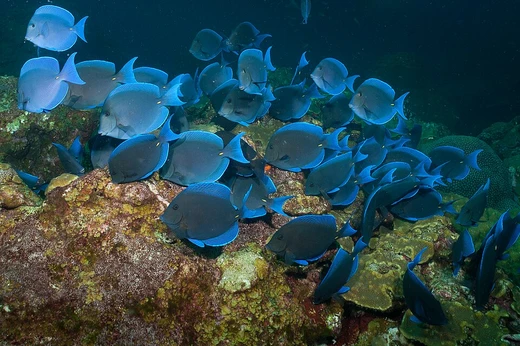
Naso elegans
A herbivorous surgeonfish found in the Indian and western Pacific Oceans.

Naso elegans, also called the elegant unicornfish, blonde naso tang, Indian orange-spine unicorn, lipstick surgeonfish, lipstick tang, orangespine unicornfish, or smoothheaded unicornfish, is a marine ray-finned fish in the family Acanthuridae—the group that includes surgeonfishes, unicornfishes, and tangs. It lives in the Indian Ocean and the western Pacific Ocean. For many years, scientists considered it just a color variant of the orangespine unicornfish (Naso lituratus) found in the Indian Ocean, until they discovered consistent differences in fin-ray and tooth counts.
The species was first formally described in 1829 by German zoologist and explorer Eduard Rüppell, who named it *Aspisurus elegans*. The type location is the northern Red Sea. It belongs to the nominate subgenus of the genus *Naso*, which is the only genus in the subfamily Nasinae within Acanthuridae. The specific name *elegans* is Latin for “choice,” “fine,” or “select,” referring to the fish’s attractive colors.
This fish occurs from the Red Sea south along East Africa to Durban, South Africa, then east across the Indian Ocean into the Pacific as far as Bali, Indonesia. It is absent from waters around mainland India. In Australia, it has been recorded only at Christmas Island and the Cocos (Keeling) Islands. In coastal and inshore reef flats, it swims in small schools; in more oceanic waters, it forms larger groups.
The dorsal fin has 6 spines and 26 to 30 soft rays (typically 28); the anal fin has 2 spines and 27 to 30 soft rays (typically 29). The pectoral fin usually has 17 rays (sometimes 16). Each jaw holds 30 to 35 teeth; in adults, these are incisor-like with rounded edges. Body depth is about a quarter of the standard length, and the body becomes more elongated as the fish grows. Males have larger keels on the caudal peduncle than females, and also longer filaments extending from the caudal fin. Overall color is grey, with a dark snout separated from the grey head by a yellow bar across the eyes. The dorsal fin is yellow with a thin blue edge and a black inner band. The anal and pelvic fins are dark brown. The plates on the caudal peduncle are bright orange, separated by a white patch. The caudal fin is yellowish with a black submarginal band and black upper and lower edges. Maximum total length is 45 cm (18 in), though 35 cm (14 in) is more common.
Quick Facts
- Parent
- Naso (Naso)
- Taxon
- Naso elegans
Facts from the source article.
Lore & Background
Naso elegans was first formally described as Aspisurus elegans in 1829 by the German zoologist and explorer Eduard Rüppell, with its type locality given as the northern Red Sea. It is classified within the nominate subgenus of the genus Naso, the only genus in the subfamily Nasinae within the family Acanthuridae. The specific epithet elegans is Latin for 'choice', 'fine', or 'select', a reference to the beautiful colours of this fish.
This species occurs in the Red Sea, south along the east African coast to Durban in South Africa, and eastward across the Indian Ocean into the Pacific as far east as Bali in Indonesia. It is absent from the waters off the mainland Indian subcontinent. In Australian waters it has been recorded from Christmas Island and the Cocos (Keeling) Islands. The elegant unicornfish inhabits reef flats in coastal and inshore waters in small schools, while in more oceanic waters it forms larger schools.
The body is grey, with a dark snout separated from the grey head by a yellow bar at the eyes. The dorsal fin is yellow with a thin blue edge and a black band inside that. The anal and pelvic fins are dark brown. The plates on the caudal peduncle are vivid orange separated by a patch of white. The caudal fin is yellowish with a black submarginal band and black lower and upper edges. Males have larger keels on the caudal peduncle and longer filaments growing from the caudal fin than females.
Reader's Guide
Naso elegans is notable for its long taxonomic history, having been first described in 1829 by Eduard Rüppell as Aspisurus elegans. For many years it was considered merely a colour morph of the related Naso lituratus, but consistent meristic differences—such as fin ray and tooth counts—eventually confirmed it as a distinct species. Its distribution spans the Indian Ocean and western Pacific, from the Red Sea and east African coast to Bali, though it is absent from mainland Indian waters. The species is herbivorous, feeding on benthic algae, particularly brown algae in the genera Sargassum and Dictyota. Its striking coloration—including a yellow bar across the eyes, vivid orange caudal peduncle plates, and a yellow dorsal fin with blue and black bands—makes it easily recognizable. The fish reaches a maximum total length of 45 cm, though 35 cm is more typical. Its presence in both coastal and oceanic reef habitats, and its schooling behavior that varies with water type, reflect its ecological adaptability. The species is part of the family Acanthuridae, which includes surgeonfishes, unicornfishes, and tangs.
Did You Know?
- Naso elegans was first described as Aspisurus elegans in 1829 by German zoologist Eduard Rüppell.
- For a long time it was regarded as an Indian Ocean colour morph of Naso lituratus until consistent meristic differences were shown.
Frequently Asked Questions
What is Naso elegans?
Naso elegans is a marine ray-finned fish in the surgeonfish family (Acanthuridae), known by common names such as elegant unicornfish, blonde naso tang, and lipstick surgeonfish. It is a reef-dwelling species native to the Indian Ocean and the western Pacific.
How is Naso elegans different from Naso lituratus?
For many years researchers treated Naso elegans as nothing more than a color variant of the orangespine unicornfish (Naso lituratus) in the Indian Ocean. It was later confirmed as a separate species once scientists documented consistent differences in the counts of fin rays and teeth between the two.
Where can you find Naso elegans in the wild?
This species ranges across the Indian Ocean and the western Pacific Ocean. It is typically encountered around coral reefs, where it spends much of its time grazing on algae.
How large does Naso elegans grow?
A typical adult measures around 35 cm (14 in) in total length, with a maximum recorded size of about 45 cm (18 in). Its fin formula includes six dorsal spines, 26–30 dorsal soft rays (usually 28), two anal spines, and 27–30 anal soft rays (usually 29).
What role does Naso elegans play in its ecosystem?
As a herbivorous member of the Acanthuridae, Naso elegans primarily feeds on algae, helping to keep algal growth in check on reef surfaces. This grazing activity contributes to the overall balance and health of the coral reef communities it inhabits.
More in Tangs and Surgeonfish 1-24
Spotted an error? Know more?
Reader corrections go straight into our review queue. Suggest an edit · How this site is sourced