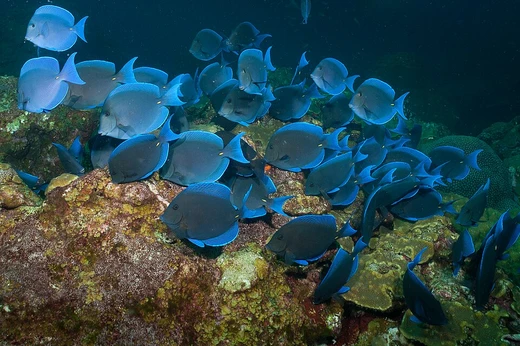
Naso vlamingii
A color-changing unicornfish of the Indo-Pacific.

Naso vlamingii, commonly known as the bignose unicornfish, scibbled unicornfish, Vlaming's unicornfish, or zebra unicornfish, is a species of marine ray-finned fish belonging to the family Acanthuridae, which includes surgeonfishes, unicornfishes, and tangs. It is notable for its bulbous head protuberance, ability to change color quickly, and its wide distribution across the Indo-Pacific.
Quick Facts
- Parent
- Naso (Naso)
- Taxon
- Naso vlamingii
Facts from the source article.
Lore & Background
Naso vlamingii was first formally described as Naseus vlamingii in 1835 by French zoologist Achille Valenciennes, with the type locality given as Molucca Island in Indonesia. The specific name honors Dutch explorer Admiral Cornelis de Vlamingh, who collected specimens and drew illustrations of fishes for the Muséum national d'Histoire naturelle; Valenciennes based his description on one of Vlamingh's illustrations. This species is classified within the nominate subgenus of the genus Naso, the only genus in the subfamily Nasinae within the family Acanthuridae.
The bignose unicornfish has a wide Indo-Pacific range from the eastern coast of Africa between Kenya and South Africa, through Indian Ocean islands (but absent from continental southern Asian waters), the Andaman Sea, Indonesia, and into the Pacific, where it extends north to southern Japan, east to the Galápagos Islands, and south to New Caledonia and Australia. In Australia, it is found at offshore islands and reefs, from the northern Great Barrier Reef south to waters off Sydney, and around Lord Howe Island. It inhabits deep lagoons and seaward reefs, frequently aggregating in schools that feed on zooplankton around higher areas of deep slopes and drop-offs.
Adults have a relatively deep body, a bulbous protuberance on the head above the snout, two bony plates with keels and anterior-pointing spines on each side of the caudal peduncle, and long filaments from the tips of the caudal fin lobes. Their overall color is greyish-brown or reddish brown, with small dark blue spots on the head and upper flanks that join to form stripes on the lower flanks, a wide blue band from the eye to the front of the protuberance, blue lips, and an irregular blue blotch behind the pectoral fin base. The caudal fin is blue at the base, grey in the middle, with an ill-defined yellow margin and blue outer edges extending onto the filaments. The intensity of blue markings can increase to brilliant blue during courtship or when communicating with cleaner fish at cleaning stations.
Reader's Guide
Naso vlamingii holds significance as a species that changes its feeding pattern throughout life: juveniles are herbivores feeding mainly on algae, semi-adults are omnivores, and adults are primarily carnivores hunting zooplankton. This ontogenetic shift in diet is a notable biological trait. The species can live up to 40 years in captivity, and its eggs are fertilized externally after being released in batches by the female, with spawning typically occurring in aggregations. Young individuals are often confused with Naso lopezi due to similar appearance. An unusual behavior observed is swimming at night among schools of predatory fish such as bigeye (Sphyraena forsteri), blackfin barracudas (Sphyraena queni), and bigeye trevally (Caranx sexfasciatus), feeding on the fecal matter of these fishes. The bignose unicornfish is targeted by subsistence fisheries in some areas and is occasionally captured for the aquarium trade. Its ability to rapidly change color, especially to a brilliant blue during social interactions, adds to its interest for aquarists and researchers alike.
More in Tangs and Surgeonfish 1-24
Spotted an error? Know more?
Reader corrections go straight into our review queue. Suggest an edit · How this site is sourced