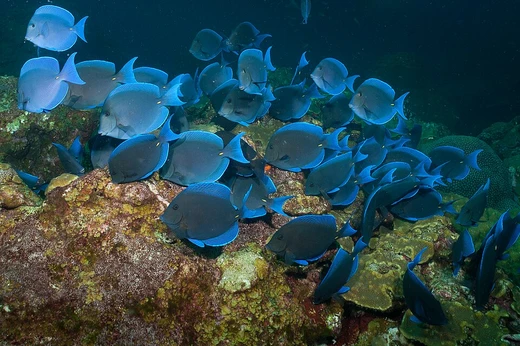
Naso tuberosus
A humpnose unicornfish found in the Indian Ocean.

Naso tuberosus, commonly known as the humpnose unicornfish, belongs to the family Acanthuridae—the group that includes surgeonfishes, unicornfishes, and tangs. This marine ray-finned fish is found in the Indian Ocean, although its range may extend further.
The species was first formally described in 1801 by French naturalist Bernard Germain de Lacépède, who designated Mauritius as the type locality. It is placed in the nominate subgenus of the genus Naso, which is the sole genus within the subfamily Nasinae of the family Acanthuridae.
Its specific name, *tuberosus*, means "lumpy," referring to the bulging protuberance on the front of its head.
The dorsal fin has 5 spines and 26 to 29 soft rays, while the anal fin has 2 spines and 26 to 28 soft rays. Each jaw contains 30 to 46 teeth, with serrated tips, and the tooth count increases as the fish grows. Body depth is about 2.3 to 2.7 times the standard length, with adults having shallower bodies than subadults. Adults develop a bulging protuberance on the front of the head that never extends past the mouth. The dorsal body profile is weakly convex beneath the spiny part of the dorsal fin. A pair of bony plates sit on each side of the caudal peduncle, each with a keel bearing a forward-projecting point. The caudal fin is very emarginate in juveniles and slightly emarginate in adults. Overall coloration is greyish, with small blackish spots on the upper body and a large black spot located below and forward of the pectoral fin base. The maximum published standard length is 60 cm (24 in).
This uncommon species inhabits the Indian Ocean, though some records from the western Pacific may actually refer to *Naso tonganus*. It has been documented along the eastern African coast from Somalia south to Sodwana Bay in South Africa, as well as the Comoro Islands, Madagascar, the Seychelles, the Mascarenes, and Yemen. It also occurs at Rottnest Island in Western Australia and the Cocos (Keeling) Islands. The humpnose unicornfish primarily lives on coral reefs, where it grazes on algae of the genus *Caulerpa*.
Quick Facts
- Parent
- Naso (Naso)
- Taxon
- Naso tuberosus
Facts from the source article.
Lore & Background
Naso tuberosus was first formally described in 1801 by the French naturalist Bernard Germain de Lacépède, with its type locality given as Mauritius. Its specific name tuberosus means 'lumpy', a reference to the bulging protuberance on the front of its head. This species is classified within the nominate subgenus of the genus Naso, the only genus in the subfamily Nasinae within the family Acanthuridae.
The humpnose unicornfish has a dorsal fin supported by 5 spines and between 26 and 29 soft rays, while the anal fin has 2 spines and 26 to 28 soft rays. It has between 30 and 46 teeth in each jaw, with serrated tips, and the number increases as the fish grows. Adults have a bulging protuberance on the front of the head that never extends beyond the mouth. The body depth fits into the standard length around 2.3 to 2.7 times, with adults having less deep bodies than subadults. The overall colour is greyish with small blackish spots on the upper part of the body, and a large black spot is located underneath and to the front of the base of the pectoral fins. The caudal fin is very emarginate in juveniles and slightly emarginate in adults.
Naso tuberosus is an uncommon species found in the Indian Ocean, recorded from the eastern coast of Africa from Somalia to Sodwana Bay in South Africa, the Comoro Islands, Madagascar, the Seychelles, the Mascarenes, Yemen, Rottnest Island in Western Australia, and the Cocos (Keeling) Islands. It may occur in the western Pacific Ocean, but many if not all records outside the Indian Ocean may refer to Naso tonganus. This species is found mainly on coral reefs where it grazes on algae of the genus Caulerpa.
Reader's Guide
Naso tuberosus is notable as a member of the Acanthuridae family, which includes surgeonfishes, unicornfishes and tangs. Its description by Bernard Germain de Lacépède in 1801 places it among early modern ichthyological records. The species' specific name tuberosus, meaning 'lumpy', highlights its distinctive bulging head protuberance, a key characteristic that distinguishes it from other unicornfishes. The article notes that while it occurs in the Indian Ocean, its presence in the western Pacific is uncertain, as many records there may actually refer to Naso tonganus. This uncertainty underscores the need for careful taxonomic verification. The humpnose unicornfish is uncommon and grazes on Caulerpa algae on coral reefs, indicating a specialized ecological role. Its maximum recorded standard length of 60 cm makes it a moderately large reef fish. The species' bony caudal peduncle plates with forward-projecting keels are typical of the genus Naso and serve as defensive structures. Overall, Naso tuberosus represents a distinct but poorly understood unicornfish species, with its distribution and taxonomy still subject to clarification.
More in Tangs and Surgeonfish 1-24
Spotted an error? Know more?
Reader corrections go straight into our review queue. Suggest an edit · How this site is sourced