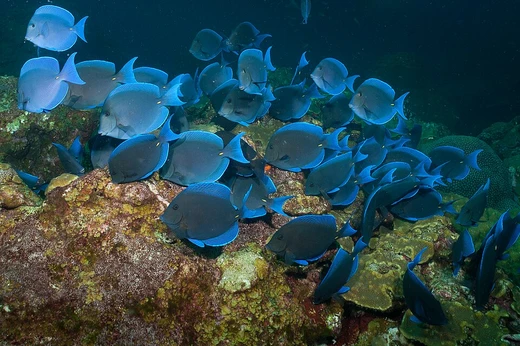
Naso tonganus
Indo-Pacific surgeonfish with a bulging forehead protuberance.

Naso tonganus, known as the bulbnose unicornfish, hump-nosed unicornfish, humphead unicornfish, or humpnose unicorn, is a species of marine ray-finned fish belonging to the family Acanthuridae, which includes surgeonfishes, unicornfishes, and tangs. This species is found in the Indo-Pacific and is of value in commercial fisheries.
Quick Facts
- Parent
- Naso (Naso)
- Taxon
- Naso tonganus
Facts from the source article.
Lore & Background
Naso tonganus was first formally described as Naseus tonganus in 1835 by the French zoologist Achille Valenciennes, with its type locality given as Tongatapu in Tonga. The specific name tonganus refers to this type locality. This species is classified within the nominate subgenus of the genus Naso, which is the only genus in the subfamily Nasinae within the family Acanthuridae.
Adults have a bulging protuberance on the front of the head; in larger males this may extend beyond the mouth. The overall colour is silvery to brownish-grey, shading to yellowish-grey on the ventral part of the body, with an irregular pattern of pale and black spots below the spiny part of the dorsal fin. Juveniles are covered in dense, dark spotting. The species is often solitary but may be found in small groups on coral reefs, where it feeds on zooplankton and algae.
Reader's Guide
Naso tonganus is notable as a commercially valuable species within the surgeonfish family, distributed widely across the Indo-Pacific from eastern Africa to the Samoan Islands, and from southern Japan to Australia. Its distinctive bulging forehead protuberance, especially pronounced in larger males, gives it the common name bulbnose unicornfish. The species exhibits ontogenetic changes in body depth, with adults having less deep bodies than subadults, and in dentition, with tooth count increasing from 22 to 46 as the fish grows. Its caudal fin changes from emarginate in juveniles to truncate in adults. The fish is typically solitary or found in small groups on coral reefs, feeding on zooplankton and algae. The article does not provide further details on its ecological role or conservation status, but its inclusion in commercial fisheries indicates human use.
Did You Know?
- The specific name tonganus refers to its type locality of Tongatapu in Tonga.
- Adults have a bulging protuberance on the front of the head that may extend beyond the mouth in larger males.
- The number of teeth in each jaw increases with growth, ranging from 22 to 46.
- This species is found from the eastern coast of Africa to the Samoan Islands and from southern Japan to Australia.
More in Tangs and Surgeonfish 1-24
Spotted an error? Know more?
Reader corrections go straight into our review queue. Suggest an edit · How this site is sourced