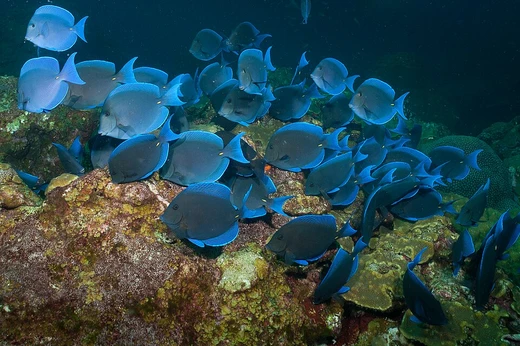
Naso thynnoides
A slender unicornfish with a tuna-like body and no head protuberance.

Naso thynnoides, commonly known as the oneknife unicornfish, oneknife unicorn, thunny unicornfish, singlespine unicornfish, one-spine unicorn, or barred unicornfish, is a species of marine ray-finned fish belonging to the family Acanthuridae, which includes surgeonfishes, unicornfishes, and tangs. This species is found in the Indo-Pacific and is notable for its slender, tuna-like body and the absence of a head protuberance.
Quick Facts
- Parent
- Axinurus
- Taxon
- Naso thynnoides
Facts from the source article.
Lore & Background
Naso thynnoides was first formally described in 1829 as Axinurus thynnoides by French zoologist Georges Cuvier, with its type locality given as Dorey Harbour in Papua New Guinea. It is classified in the subgenus Axinurus within the genus Naso, which is the only genus in the subfamily Nasinae of the family Acanthuridae. The specific name thynnoides means 'tuna-like,' explained by Achille Valenciennes in 1835 as an allusion to the species' more elongated and compressed body, resembling that of a tuna.
This fish has a dorsal fin supported by 5 or 6 spines and 28 to 30 soft rays, while the anal fin has 2 spines and 28 to 30 soft rays. Its standard length is about three times the body's depth, and the head is smoothly rounded with no protuberance. A short, diagonal groove lies in front of the eye and below the nostrils. A single bony plate on each side of the caudal peduncle bears a small, semicircular keel. The overall color is grey, fading on the underside, with around 30 bluish horizontal stripes along the back and flanks that break into irregular spots on the head, plus an indistinct yellowish horizontal stripe along the flanks. The bony plates and keels are dusky, and the caudal fin is bluish grey.
Naso thynnoides is found across the Indian Ocean and into the Pacific, from eastern Africa to the Ryukyu Islands, American Samoa, Johnston Atoll, Tuamoto islands, and south to the Great Barrier Reef. It inhabits steep outward reef and lagoon slopes at depths between 2 and 40 m. It feeds on zooplankton, typically forms small schools, is diurnal, and at night sleeps on the reef, changing color to adopt disruptive camouflage. It also visits the reef to be cleaned by cleaner wrasse of the genus Labroides.
Reader's Guide
Naso thynnoides holds significance as a distinct member of the unicornfish group, notable for its lack of a head protuberance—a feature that sets it apart from many other Naso species. Its slender, tuna-like body, reflected in its scientific name, underscores its unique morphology within the family Acanthuridae. The species was first described by the prominent French zoologist Georges Cuvier in 1829, adding to the historical foundation of ichthyology in the Indo-Pacific region. Its wide distribution across the Indian and Pacific Oceans, from the eastern coast of Africa to the Great Barrier Reef and Pacific islands, highlights its adaptability to diverse reef environments. Ecologically, it plays a role as a zooplankton feeder in small schools, and its diurnal behavior, nocturnal camouflage, and reliance on cleaner wrasse for parasite removal illustrate its integration into reef ecosystems. The species' maximum fork length of 40 cm and its presence on steep reef and lagoon slopes at depths up to 40 m provide practical information for marine biologists and aquarists. Its multiple common names—including oneknife unicornfish, barred unicornfish, and thunny unicornfish—reflect regional variations in recognition, though the article does not resolve any disputes among these names. Overall, Naso thynnoides contributes to the biodiversity of surgeonfishes and serves as an example of the morphological diversity within the genus Naso.
Did You Know?
- Naso thynnoides was first described in 1829 by French zoologist Georges Cuvier as Axinurus thynnoides.
- Its specific name thynnoides means 'tuna-like,' referring to its elongated and compressed body.
- This species has no head protuberance, unlike many other unicornfishes.
- At night, it sleeps on the reef and changes color to adopt disruptive camouflage.
More in Tangs and Surgeonfish 1-24
Spotted an error? Know more?
Reader corrections go straight into our review queue. Suggest an edit · How this site is sourced