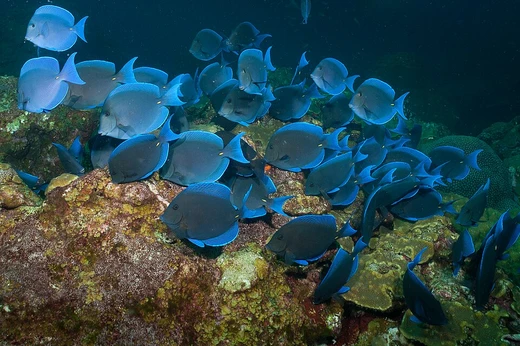
Naso minor
Smallest unicornfish, found in Indo-Pacific reefs.

Naso minor, known commonly as the blackspine unicornfish, slender unicornfish, lesser unicornfish, or pony unicornfish, is a species of marine ray-finned fish belonging to the family Acanthuridae, which includes surgeonfishes, unicornfishes, and tangs. It is notable for being the smallest species in the genus Naso, hence its specific name 'minor'.
Quick Facts
- Parent
- Axinurus
- Taxon
- Naso minor
Facts from the source article.
Lore & Background
Naso minor was first formally described in 1966 by South African ichthyologist James Leonard Brierley Smith, with its type locality given as Pinda Reef in Mozambique. It is classified in the subgenus Axinurus within the genus Naso, which is the only genus in the subfamily Nasinae of the family Acanthuridae. The specific name 'minor' reflects that it is the smallest species in the genus.
The species has a relatively slender body, with standard length about three times body depth, and a smoothly rounded head lacking any protuberance. It has a short diagonal groove in front of the eye and below the nostrils, and a single bony plate on each side of the caudal peduncle bearing a large keel and a forward-pointing spine. Its overall color is grey fading to white on the underside, with a purplish-grey head, and it may show five or six bluish-grey horizontal stripes along the flanks. The lips are blackish, there is a lighter area under the pectoral fins, the bony plates and caudal peduncle are black, and the caudal fin is yellow. During courtship, males display a black upper body with a white stripe along the flanks.
Naso minor feeds on zooplankton in the water column at depths between 8 and 40 m, close to reefs, and will move onto reefs to be cleaned by the bluestreak cleaner wrasse (Labroides dimidiatus). Males can rapidly change their color and pattern when courting females.
Reader's Guide
Naso minor holds significance as the smallest member of the genus Naso, a group known for the prominent horn-like protuberances in many species, though this species lacks such a feature. Its description in 1966 by James Leonard Brierley Smith added to the known diversity of Indo-Pacific surgeonfishes. The species is found in a wide but localized distribution across the Indian Ocean and western Pacific Ocean, recorded from Mozambique, Mauritius, and Réunion in the west, and from eastern Indonesia, the Philippines, Taiwan, Australia, and Guam in the Pacific. In Australia, it occurs from the northern Great Barrier Reef south to waters off Cairns. It inhabits coastal reefs to outer reef slopes, typically swimming in small groups around the upper edges of drop-offs. Its diet of zooplankton and its use of cleaner wrasse for parasite removal illustrate its ecological role in reef systems. The species' ability to rapidly change color during courtship highlights behavioral adaptations for reproduction. With a maximum standard length of 30 cm, it is a relatively small reef fish, and its distinctive black caudal peduncle plates and yellow tail make it identifiable among unicornfishes.
Did You Know?
- Naso minor is the smallest species in the genus Naso, which is why it is named 'minor'.
- Males can rapidly change their color and pattern when courting females, showing a black upper body and white stripe.
More in Tangs and Surgeonfish 1-24
Spotted an error? Know more?
Reader corrections go straight into our review queue. Suggest an edit · How this site is sourced