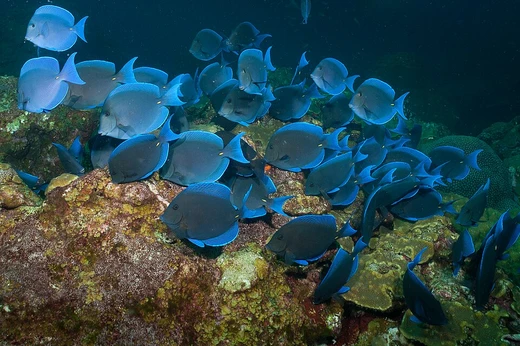
Naso maculatus
A deep-water unicornfish with dark spots and no forehead horn.

Naso maculatus, known as the scribbled unicornfish or spotted unicornfish, is a species of marine ray-finned fish belonging to the family Acanthuridae, which includes surgeonfishes, unicornfishes, and tangs. This fish is found in the western Pacific Ocean. It is notable for its slender body, lack of a forehead protuberance, and numerous dark spots covering the upper body.
Quick Facts
- Parent
- Naso (Naso)
- Taxon
- Naso maculatus
Facts from the source article.
Lore & Background
Naso maculatus was first formally described in 1981 by American ichthyologists John Ernest Randall and Paul J. Struhsaker, with its type locality given as the northern shore off Haliewa on Oahu in Hawaii. It is classified within the nominate subgenus of the genus Naso, which is the only genus in the subfamily Nasinae within the family Acanthuridae. The specific name maculatus means 'spotted,' referring to the many dark spots on both adults and juveniles.
This species has a slender body and lacks any protuberance growing from the head at any size. Its dorsal fin is supported by 6 or 7 spines and between 26 and 28 soft rays, while the anal fin has 2 spines and 26 to 28 soft rays. Two small bony plates on the caudal peduncle each bear a roughly semi-circular keel that projects outward. The caudal fin is emarginate with no filaments on the fin lobes. The overall color is bluish gray, paler on the lower body, with the upper three-quarters covered in numerous dark spots and lines; similar but less distinct markings appear on the head. The lateral line is marked by a dark line that breaks into spots toward the caudal peduncle.
Naso maculatus has an anti-tropical distribution in the western Pacific Ocean. It is found in the Wakayama Prefecture in Japan and the Hawaiian Islands in the north, and in the south it occurs in New Caledonia and islands off Australia, including the Capricorn Group off southern Queensland, Lord Howe Island, and Middleton Reef. This species inhabits deep water at depths between 20 and 220 m on the seaward slopes of reefs.
Reader's Guide
Naso maculatus is significant as a relatively recently described species (1981) within the well-known family Acanthuridae, adding to the diversity of unicornfishes. Its description by Randall and Struhsaker clarified its distinction from other spotted unicornfishes, such as Naso brevirostris, with which it can be confused. The species is notable for its anti-tropical distribution in the western Pacific, occurring in both northern (Japan and Hawaii) and southern (New Caledonia and eastern Australia) waters, but not in the tropics between. Its deep-water habitat on reef slopes (20–220 m) sets it apart from many shallow-water surgeonfishes. The lack of a forehead horn at any size is a key characteristic that distinguishes it from other unicornfishes. The specific name maculatus ('spotted') accurately describes its most prominent visual feature: numerous dark spots and lines covering the upper body and head. With a maximum length of 45 cm, it is a moderately sized surgeonfish. Its presence in Australian waters, including Lord Howe Island and Middleton Reef, contributes to the known biodiversity of those regions.
More in Tangs and Surgeonfish 1-24
Spotted an error? Know more?
Reader corrections go straight into our review queue. Suggest an edit · How this site is sourced