Naso lopezi
Elongated unicornfish found in western Pacific, lacks forehead horn.

Naso lopezi, commonly known as the elongated unicornfish, slender unicornfish, or Lopez' unicornfish, is a species of marine ray-finned fish belonging to the family Acanthuridae, which includes surgeonfishes, unicornfishes, and tangs. This species is found in the western Pacific Ocean and is notable for its elongate body and lack of a bony protuberance on the forehead, distinguishing it from many other members of the genus Naso.
Quick Facts
- Parent
- Naso (Naso)
- Taxon
- Naso lopezi
Facts from the source article.
Lore & Background
Naso lopezi was first formally described in 1923 by the Norwegian-born American ichthyologist Albert William Herre, with its type locality given as Ambil Island southwest of Manila Bay in the Philippines. This species is classified within the nominate subgenus of the genus Naso, which is the only genus in the subfamily Nasinae within the family Acanthuridae. The specific name honors G. A. Lopez, a specimen collector for the Philippine Bureau of Science, though it is not known whether he collected the type specimen; the type is thought to have been destroyed in the Second World War.
The species has an elongate body with a depth that fits into its standard length between 3.3 and 3.7 times. It is one of the species in the genus Naso that does not possess a bony protuberance, or horn, on the forehead. The dorsal fin is supported by 5 spines and between 27 and 30 soft rays, while the anal fin is supported by 2 spines and 26 to 30 soft rays. The overall color is greyish with dense black spotting on the upper body and caudal fin, and it reaches a maximum published total length of 60 cm.
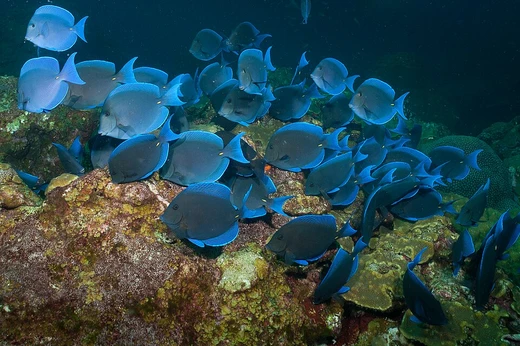
Naso lopezi is found in the western Pacific Ocean, ranging as far north as Honshu in Japan, south to the Great Barrier Reef, the Capricorn Group, and reefs in the Coral Sea, and east to New Caledonia, with reports also from the Similan Islands in Thailand and Tonga. It typically inhabits areas of outer reef slopes with strong currents, usually at depths greater than 6 m. The species feeds largely on ctenophores and crustaceans, also consuming algae, diatoms, dinoflagellates, and molluscs, and has been observed gathering in large schools to feed during daylight hours in the Philippines, feeding in the upper water column at midday and near the bottom in early morning and late afternoon.
Reader's Guide
Naso lopezi holds significance as a distinct member of the surgeonfish family, notable for its elongate body and the absence of the forehead horn typical of many unicornfishes. Its description in 1923 by Albert William Herre, with a type locality in the Philippines, places it within the broader taxonomic framework of the genus Naso, the sole genus in the subfamily Nasinae. The species' specific name honors G. A. Lopez, a collector for the Philippine Bureau of Science, though uncertainty remains about his role in collecting the type specimen, which was likely destroyed during the Second World War.
Ecologically, Naso lopezi occupies a specific niche on outer reef slopes with strong currents at depths greater than 6 m, ranging across the western Pacific from Japan to the Great Barrier Reef and New Caledonia. Its diet is varied, including ctenophores, crustaceans, algae, and other small organisms, and it exhibits distinct feeding behavior, schooling in large groups during daylight hours in the Philippines and shifting its feeding depth throughout the day. This species is also a target for fisheries in the Philippines, indicating its economic importance in that region.
The legacy of Naso lopezi lies in its contribution to the diversity of the Acanthuridae family and its role in reef ecosystems as a planktivorous and herbivorous fish. Its distribution across a wide geographic range and its behavioral adaptations to current-swept reef slopes highlight its ecological specialization. The species' taxonomic history, including the unresolved question of the type specimen's collector and its wartime destruction, adds a layer of historical context to its scientific record.
More in Tangs and Surgeonfish 1-24
Spotted an error? Know more?
Reader corrections go straight into our review queue. Suggest an edit · How this site is sourced